The best famous-painting jigsaw puzzles to give in 2026
Van Gogh, Klimt and Hokusai in 1,000 and 1,500 pieces from Ravensburger, Pomegranate and Eurographics, and how to choose a puzzle an art lover will want to finish.
Culturera may earn a commission if you buy through the links on this page. As an Amazon Associate I earn from qualifying purchases. The selection is ours alone.
At a glance
- Best overallRavensburger Van Gogh: Starry Night (1,500 pieces)Amazon
- Most challengingPomegranate Gustav Klimt: The Kiss (1,000 pieces)Amazon
- Best for beginnersEurographics Hokusai: The Great Wave (1,000 pieces)Amazon
A jigsaw puzzle of a great painting is a gift that lasts several evenings and teaches you the picture brushstroke by brushstroke. For most people, the one to give is Ravensburger's Van Gogh Starry Night: 1,500 precisely cut pieces of one of the most recognizable paintings in the world, for $33.99. For a bigger challenge, choose Pomegranate's Klimt; for a quicker, satisfying one, Eurographics' Hokusai wave. We have not assembled these puzzles; this guide compares what the makers publish.
Prices are the makers' list prices on November 22, 2026.
What makes a good art puzzle?
The brand and the cut. Better puzzles have thick board, a precise cut so pieces lock firmly, and a matte finish without glare. Ravensburger, Pomegranate and Eurographics are among the brands puzzlers trust most.
The painting. Paintings with strong contrasts and distinct areas, like the swirls of Starry Night or the Great Wave, are easier. Large areas of similar color, like Klimt's gold, make a puzzle much harder.
Size and table space. A 1,000-piece puzzle is usually about 50 × 70 cm finished; 1,500 pieces is about 60 × 80 cm. Check that the person has a table or a puzzle board where it can sit for a week.
Piece count. 500 pieces is a puzzle for one or two evenings. 1,000 pieces is the standard adult size and the one with the widest choice of paintings. 1,500 pieces or more is for someone who can leave a table occupied for a week or longer. If you do not know how much the person has puzzled before, 1,000 pieces is the safe choice.
The finish. A matte or linen finish matters more with paintings than with photographs, because dark areas, like a night sky, reflect lamp light. All three picks in this guide have a low-glare surface.
Which one is for you?
Best overall
1. Ravensburger Van Gogh: Starry Night (1,500 pieces)
Best for: Anyone who loves Van Gogh and wants a long project
One of the world's most famous paintings in 1,500 precisely cut pieces.
See it at AmazonCheck the current price at the store.
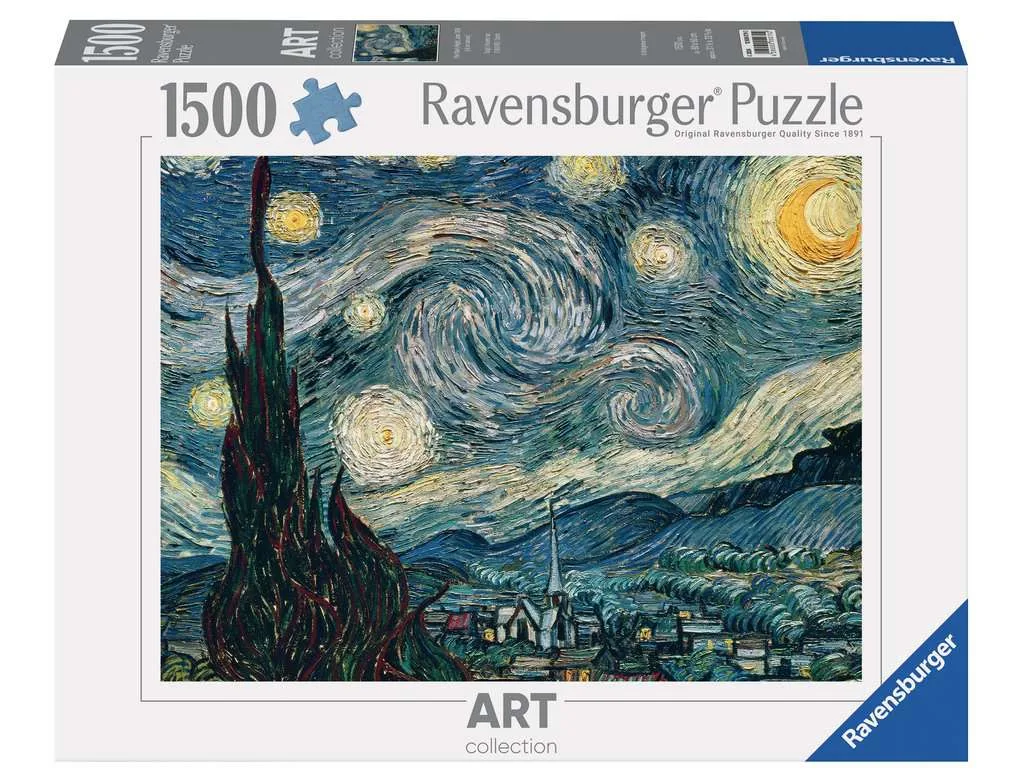
Ravensburger's Starry Night ($33.99 list) has 1,500 pieces and finishes at about 80 × 60 cm. The German company makes its own cutting tools in Ravensburg, and its pieces are known for a firm, clean fit. Van Gogh's swirling sky, the dark cypress and the bright stars give the puzzle distinct areas to work on, so it is long but not frustrating.
Van Gogh painted The Starry Night in June 1889 in Saint-Rémy, in the south of France, and it has been in the Museum of Modern Art in New York since 1941. The original measures 73.7 × 92.1 cm (29 × 36¼ inches), so the finished Ravensburger puzzle is only a little smaller than the painting itself. Ravensburger says its pieces are punched so precisely that you hear a soft click when one fits another, which it calls Softclick Technology; a clear fit helps in the sky, where many pieces look alike.
Who it's for: an experienced puzzler or a Van Gogh fan with a big table. Keep in mind: 1,500 pieces is a long project, often more than a week of evenings. On Amazon US it is sold by Amazon itself.
Most challenging
2. Pomegranate Gustav Klimt: The Kiss (1,000 pieces)
Best for: Experienced puzzlers who want a challenge
Klimt's golden masterpiece on matte art paper, with a ribbon cut, and a real test of patience.
See it at AmazonCheck the current price at the store.
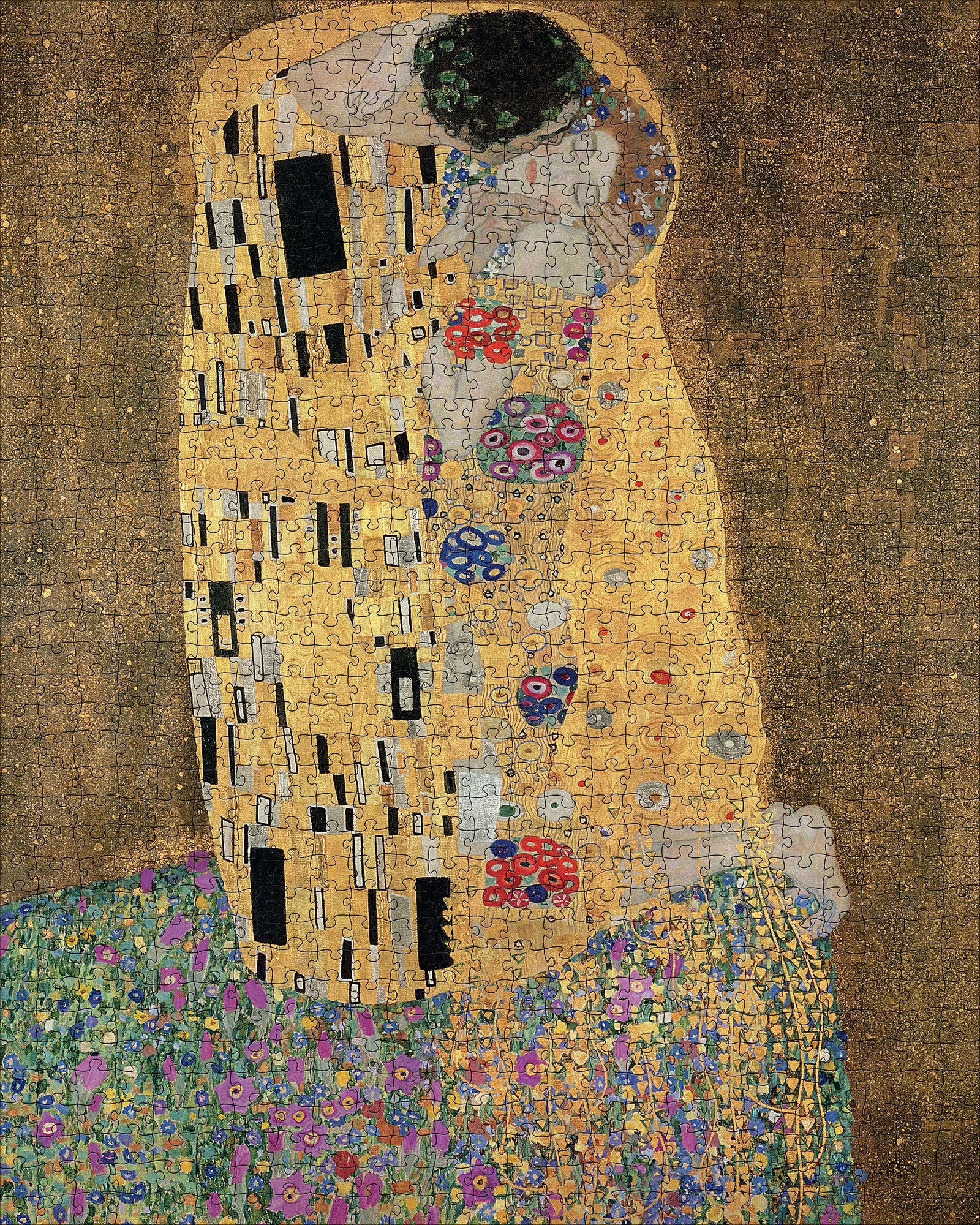
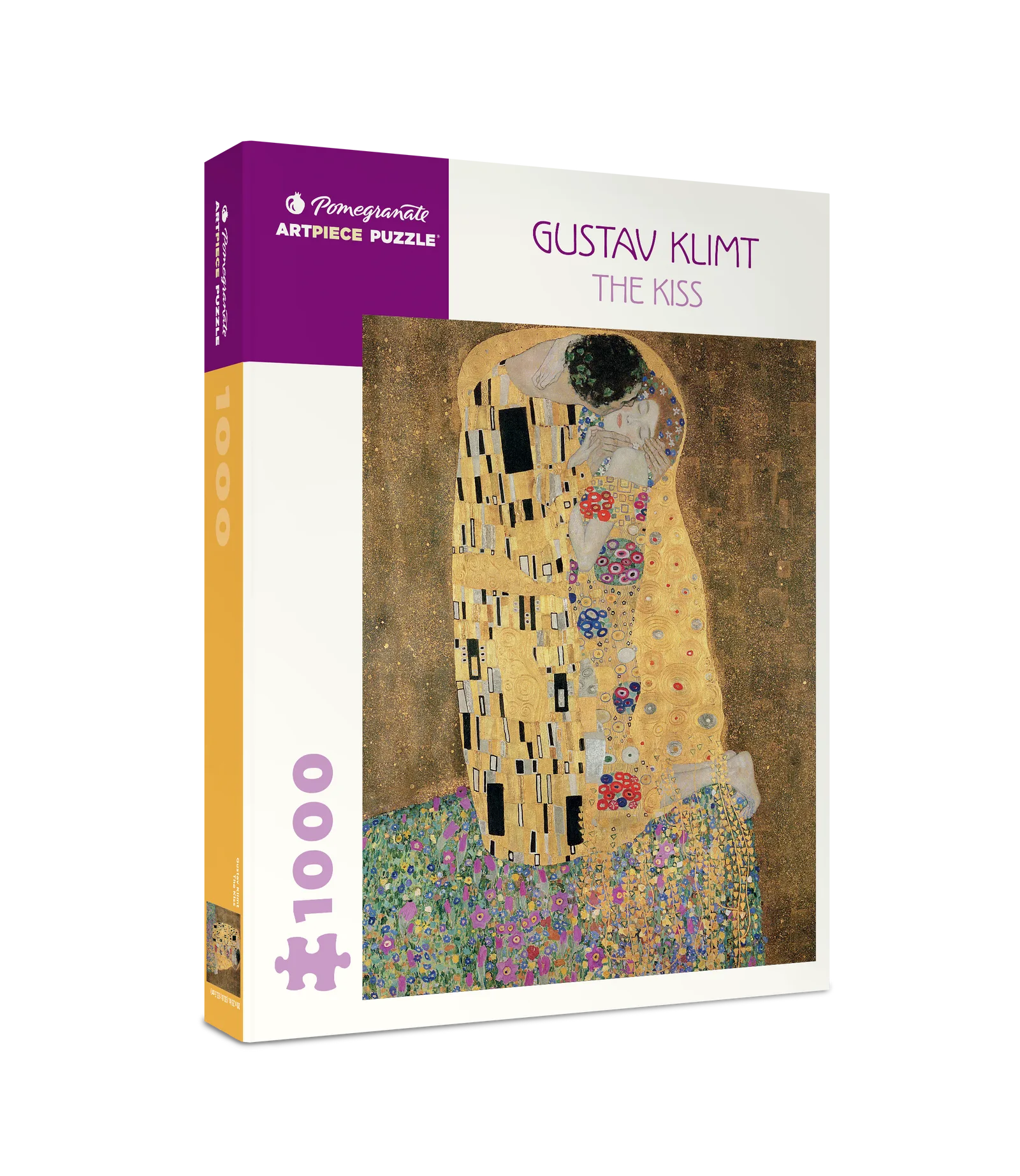
Pomegranate, a California art publisher, prints its puzzles on 250-gsm matte art paper over thick recycled board, with a ribbon cut that locks pieces firmly and leaves little dust. The Kiss ($24.95 list) finishes at 20 × 25 inches. The gold patterns that make the painting famous are also what makes it hard: large areas of similar color and texture.
Gustav Klimt painted The Kiss in Vienna around 1908, in oil and gold leaf on a square canvas 180 cm (about 6 feet) on each side. It hangs in the Belvedere museum in Vienna. In the puzzle, the two figures' robes help: the man's has black and white rectangles, the woman's has colored circles and flowers. Start with the faces, the hands and the flower meadow at the bottom, then the robes, and leave the gold background for last.
Who it's for: someone who has done many puzzles and wants a slow, absorbing one. Keep in mind: beginners may find it frustrating. On Amazon US the listing we found was from a third-party seller, so the link opens a search.
Best for beginners
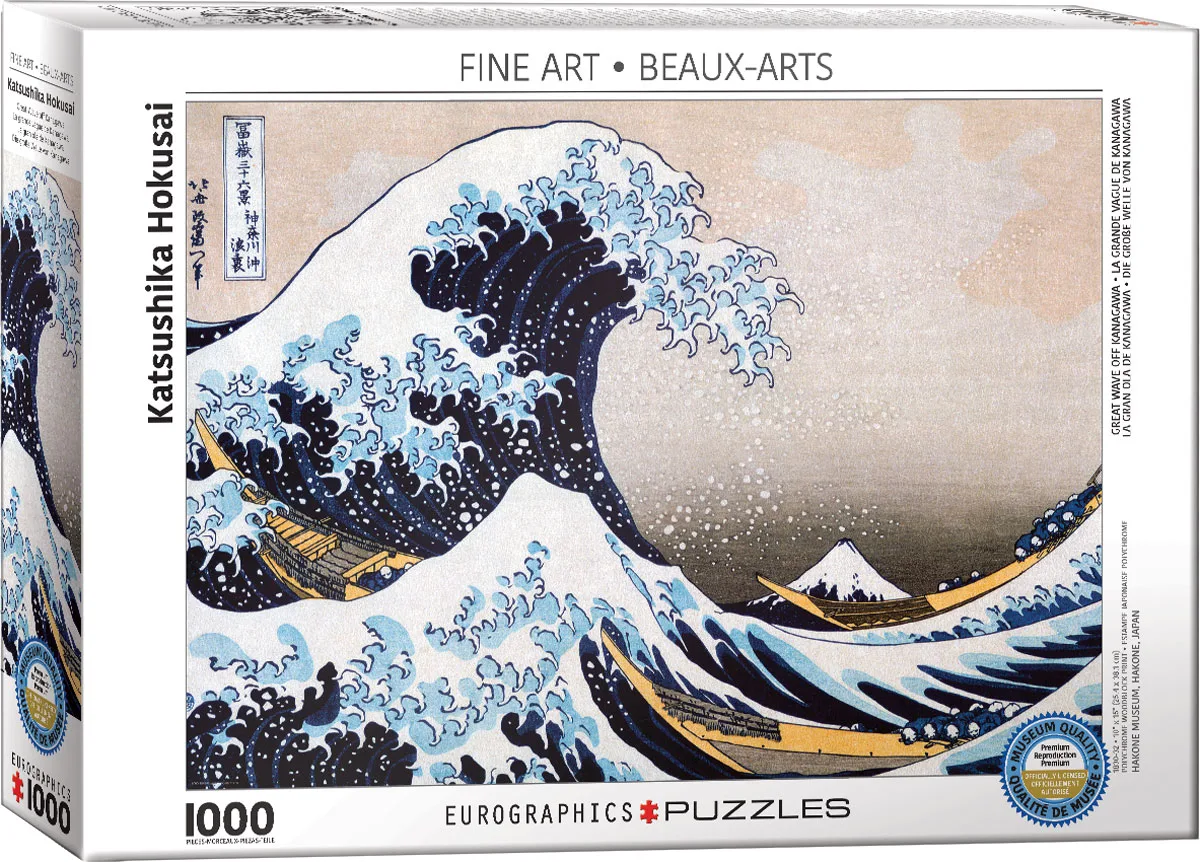
3. Eurographics Hokusai: The Great Wave (1,000 pieces)
Best for: A first art puzzle or a weekend project
Hokusai's wave in strong blues and whites, with clear areas that make it approachable.
See it at AmazonCheck the current price at the store.
Eurographics, a Canadian puzzle maker, publishes a large fine-art collection printed on recycled board. Its Great Wave off Kanagawa ($21.99 list) has 1,000 pieces and finishes at about 49 × 68 cm. The bold contrast between the dark blue wave, the white foam and the pale sky makes it easier than most art puzzles.
Katsushika Hokusai designed The Great Wave around 1830 to 1832 as a woodblock print, part of his series Thirty-six Views of Mount Fuji. The print in the Metropolitan Museum of Art in New York measures only 25.7 × 37.9 cm (about 10 × 15 inches), so the Eurographics puzzle is nearly twice as wide as the original. Mount Fuji is the small peak in the background. The image has only a few colors, mainly Prussian blue, white and cream, with sharp outlines, so pieces are easy to sort.
Who it's for: someone new to art puzzles, or a family project. Keep in mind: Eurographics also sells a panoramic version of the same image; check that you are buying the standard 1,000-piece puzzle (model 6000-1545). On Amazon US the listings we found were from third-party sellers, so the link opens a search.
Is there a cheaper option?
Clementoni's Museum Collection includes 1,000-piece puzzles of Vermeer's Girl with a Pearl Earring, Van Gogh's Sunflowers and dozens of other masterpieces at lower prices, and many come with a poster of the image to help.
How long does a 1,000-piece puzzle take?
Ravensburger estimates 10 to 15 hours for a 1,000-piece puzzle, which is several evenings for one person and less for two. A 1,500-piece puzzle takes longer, and the painting matters as much as the piece count: a 1,000-piece Klimt with a large gold background can take longer than a 1,500-piece picture with many distinct areas. For a gift, this means choosing by the person's patience, not only by their experience.
How do you start an art puzzle?
1. Turn every piece face up and pull out the edge pieces. 2. Build the frame first; it shows the size and fixes the corners. 3. Sort the rest into groups by color and by brushstroke: in The Starry Night, the yellow stars, the dark cypress, the village and the blue swirls. Box lids, trays or plates work as sorting trays.
4. Assemble the most distinct areas first and join them to the frame as they grow. 5. Leave the most uniform area for the end, and sort those pieces by shape (two knobs, three knobs, four knobs) instead of by color. Paintings help here: the direction of the brushstrokes shows which way up a piece goes. Use a lamp from the side, not from above, to cut glare.
What if a piece is missing?
Finish the puzzle first; a missing piece usually turns up under the table, in the box or in a sleeve. If it does not, makers cannot send a single piece, because each cutting run is different and a piece from another box does not fit. Eurographics' warranty replaces the puzzle with the same title, and Ravensburger's Care Commitment in the United States offers a replacement within 365 days; both set conditions, so keep the box and the proof of purchase.
Can you frame a finished puzzle?
Yes, and with a famous painting many people do. Slide wax paper or baking parchment under the finished puzzle, spread puzzle glue over the front with a plastic card so it runs into the seams, and let it dry completely before moving it. Gluing is permanent. Measure the finished puzzle before buying a frame, because sizes vary by maker: the three picks here measure about 80 × 60 cm, 51 × 64 cm and 49 × 68 cm.
To keep the puzzle reusable, Ravensburger's guide to framing notes that a puzzle can also be framed without glue, pressed between the backing board and the glass of a frame that fits it tightly.
Which one at each price?
Around $20 to $25: the Eurographics Great Wave, $21.99, for a first art puzzle; or the Pomegranate Klimt, $24.95, for an experienced puzzler.
Around $34: the Ravensburger Starry Night, $33.99, with 1,500 pieces, for the longest project of the three.
Before you order
Add a puzzle mat or a portable puzzle board if the person has no dedicated table; it lets them roll up or slide away an unfinished puzzle.
A set of stackable sorting trays and a bottle of puzzle glue are small extras that fit the gift: the trays for a 1,500-piece puzzle, the glue for someone who will want the painting on the wall.
Amazon US usually extends its return window for gifts bought during the holidays; check the exact dates on the listing before you buy.
How to get it right
Choose the painting first, then the difficulty. For a Van Gogh fan, the Ravensburger Starry Night; for a serious puzzler, Pomegranate's Klimt; for a first art puzzle, Eurographics' Great Wave.