A short history of the audiobook
Long before apps, there were talking books on records for blind readers and poets on vinyl. How listening to books went from a niche to a habit.
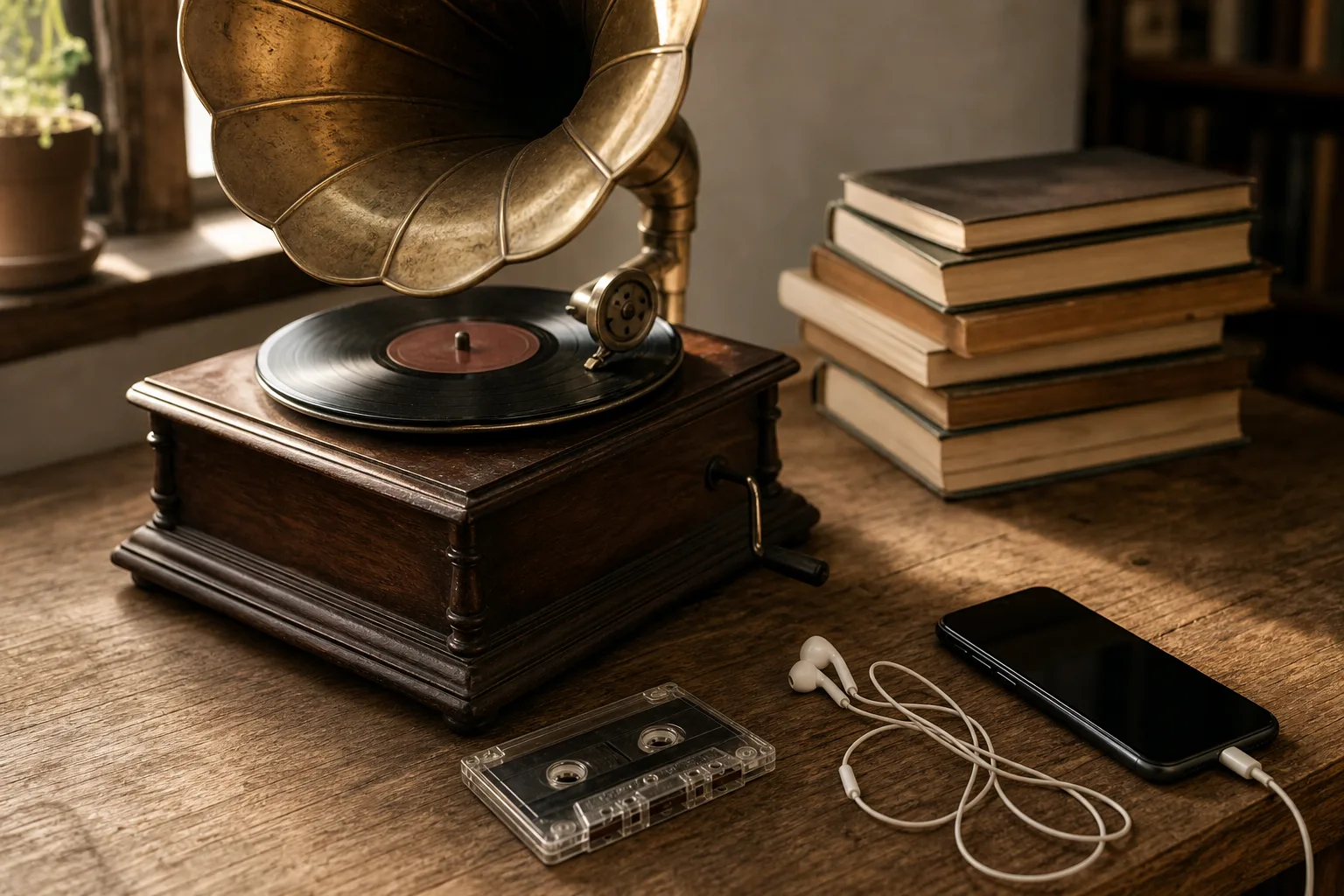
Audiobooks feel like a creation of the smartphone age, but the idea is almost as old as recorded sound. The story runs from wax cylinders and long-playing records made for blind readers, through poets on vinyl and boxes of cassettes in the car, to apps that hold thousands of titles in a pocket. Along the way, it changed who gets to read, and how.
This guide traces that history, explains how audiobooks are made today, and looks at the old question that still comes up at dinner tables: does listening to a book count as reading it?
The first recorded words
When Thomas Edison demonstrated his phonograph in 1877, one of the first things he recorded was a spoken nursery rhyme, "Mary Had a Little Lamb". The following year, in an article about the future of his invention, Edison listed possible uses, and among them were "phonographic books" that would speak to blind people without any effort on their part.
The technology was not ready. Early cylinders held only a few minutes of sound and wore out quickly, so a novel would have needed hundreds of them. For half a century, recorded speech was limited to short pieces: speeches, comic monologues, recitations of famous poems.
Talking books for blind readers
The real start came in the 1930s, and it came from the world of blindness and disability, not from entertainment. In the United States, a law passed in 1931 created a national library service for blind adults run by the Library of Congress. In 1934, together with the American Foundation for the Blind, it launched a Talking Books programme. To fit long texts on records, engineers used discs that turned slowly, at 33⅓ revolutions per minute, with fine grooves that held far more sound than ordinary records. This was more than a decade before the record industry adopted the long-playing record for music.
In Britain, the Royal National Institute for the Blind began a similar service in 1935. Among its first titles was Agatha Christie's The Murder of Roger Ackroyd. For the first time, readers who could not see print could borrow novels, history and the Bible, read aloud by professional narrators, and listen at home on special players. In the German-speaking world, libraries of recorded books for blind readers, the Blindenhörbüchereien, were founded from the 1950s onwards.
For decades, the audiobook was not a convenience. It was a right to read.
Poets on vinyl
In 1952, two young women in New York, Barbara Holdridge and Marianne Roney, recently graduated from university, founded a record label called Caedmon, named after the earliest known English poet. Their first release was the Welsh poet Dylan Thomas reading his own work, including A Child's Christmas in Wales. The record was a success, and Caedmon went on to record authors such as T. S. Eliot, William Faulkner and Sylvia Plath reading their writing, as well as actors performing plays and classic novels.
Spoken-word records became a genre of their own, and the idea of hearing a book in the author's own voice took hold. Today, Caedmon's first Dylan Thomas record is preserved in the American National Recording Registry as a recording of cultural importance.
Stories on the radio
At the same time, radio was training generations of listeners to follow long stories by ear. Radio drama, readings and serials were among the most popular programmes of the mid-20th century. In Latin America, radionovelas gripped whole countries; in Mexico, the adventures of the hero Kalimán were broadcast on radio for decades from 1963. In Spain, radio serials gathered families around the set in the 1950s and 1960s. In Germany, the Hörspiel, the radio play, developed into a respected art form, with writers composing works specifically for sound.
These traditions explain why audiobooks felt natural in many countries. Listening to a story was not new. What changed was the ability to choose the story and to listen whenever you wanted.
The cassette and the car
The compact cassette, which became common in the 1970s, made audiobooks portable. In 1975, a former Californian businessman named Duvall Hecht founded a company called Books on Tape, renting unabridged recordings to commuters who spent long hours driving on the freeways. Other companies followed, and libraries began lending audiobooks by the shelf.
Books were sold in large boxes of tapes. Because a long novel could need twenty or more cassettes, many publishers released abridged versions, cut down to fit a few tapes. Abridgement divided listeners: some appreciated a shorter version, others felt cheated of the real book. Over time, as storage became cheaper, unabridged recordings became the standard.
In Germany, cassettes also created a mass phenomenon among children. Audio drama series such as Die drei ???, which began on cassette in 1979, and Benjamin Blümchen sold millions of copies and remain popular with adults who grew up with them.
The digital turn
Compact discs replaced cassettes in the 1990s, but the real revolution was digital. Audible, founded in 1995, launched a portable digital player designed for spoken content in 1997, years before the iPod. The player was expensive and the downloads were slow, and few people bought one. But when Apple's iTunes store began selling Audible's catalogue in 2003, and Amazon bought the company in 2008, audiobooks reached a mass audience.
Smartphones did the rest. Downloading a book took seconds, and listening fit into any moment of the day: the commute, the gym, the kitchen, the walk with the dog. Today audiobooks are one of the fastest-growing parts of publishing in many countries, and many new titles are released in audio and print on the same day.
Subscription services have shaped different markets in different ways. Storytel, founded in Sweden in 2005, made audiobooks hugely popular in the Nordic countries and expanded into markets including Spain and Mexico. Music streaming services have also begun to include audiobooks, bringing them to people who had never thought of buying one.
Beyond the read-aloud book
As listening grew, so did the forms. Alongside straight readings of printed books, publishers and platforms began commissioning audio originals: stories, memoirs and essays created first for listening, sometimes never published in print at all. Some are performed by a single narrator; others are full-cast dramas with music and sound effects, much closer to the radio plays of the past.
Fiction podcasts blurred the line further. Welcome to Night Vale, a surreal fictional community radio show that began in 2012, built a huge following and later produced novels and live tours. Homecoming, a psychological thriller told in audio from 2016, was adapted into a television series starring Julia Roberts in 2018. Today, a story might begin as an audio drama and become a book, or begin as a book and become a podcast.
These hybrids raise new questions for the industry. Is a dramatised production with a dozen actors still an audiobook? Should a story written for the ear be judged by the standards of print? For listeners, the answer matters less than the result: there has never been so much spoken storytelling available, in so many styles.
Children remain one of the biggest audiences. Families use audiobooks on long car journeys and at bedtime, and screen-free audio players designed for young children, which start a story when a figure or card is placed on top, have become popular in many countries.
How an audiobook is made
A professionally produced audiobook usually involves a narrator, a director or producer, and an engineer.
1. **Preparation**: the narrator reads the whole book first, notes the characters, accents and moods, and researches the pronunciation of names and foreign words, sometimes checking directly with the author.
2. **Recording**: narrators work in a small, padded booth, reading for several hours a day. Mistakes are fixed on the spot or marked for later. One finished hour of audio, which covers roughly 9,000 words, often takes two hours or more to record.
3. **Editing and proofing**: an editor removes breaths, mouth noises and errors, and a proof listener follows the text to catch any missing or misread words, which the narrator then re-records as **pickups**.
4. **Mastering**: the files are polished to meet the technical requirements of the platforms that sell them.
A 400-page novel can become a recording of twelve to fifteen hours.
Narrators: the invisible performers
The narrator can make or break an audiobook. Some are actors trained for the stage or for dubbing; some are authors reading their own books, which is especially common for memoirs. Celebrities attract attention, but professional narrators, who may record dozens of books a year, are often the most admired by regular listeners.
Some productions go much further than a single voice. The audiobook of George Saunders's novel Lincoln in the Bardo, released in 2017, used 166 different narrators, from famous actors to the author's friends and family. In Germany, the actor Rufus Beck became famous for reading the Harry Potter books, creating distinct voices for dozens of characters. In Spain and Latin America, many audiobooks are narrated by experienced dubbing actors, whose voices listeners may already know from films and series.
The industry has its own awards. In the United States, the Audio Publishers Association has presented the Audie Awards since 1996.
The arrival of synthetic voices
The newest chapter is the most controversial. Several companies now offer audiobooks narrated by synthetic voices generated by artificial intelligence, which can produce a recording quickly and cheaply. Supporters argue that this allows many books that would never be recorded, such as academic works or older backlist titles, to become available in audio. Narrators and many listeners worry about the quality of the performances, about the future of a skilled profession and about whether voices are being used without consent. Platforms increasingly label synthetic narration so that listeners know what they are buying.
Is listening reading?
The debate comes up every few years. Researchers who study comprehension generally find that understanding a story by ear and by eye is similar for most adult readers. A 2016 study by the psychologist Beth Rogowsky and colleagues, for example, found no significant difference in comprehension between people who read a non-fiction text, listened to it, or did both at once.
There are differences, though. Print makes it easier to slow down, go back and study a difficult passage, which matters for complex arguments and for studying. Listening, on the other hand, carries tone, rhythm and emotion through the narrator's voice, which can make dialogue and humour come alive. For people with dyslexia, visual impairments or other print disabilities, audio is not an alternative to reading: it is reading.
Much also depends on how we listen. An audiobook is often played while doing something else, such as driving, cooking or exercising, and divided attention makes it easier to drift away for a few minutes and miss a plot point. Readers holding a book are usually doing nothing else. Researchers suggest that, for difficult material, listening while sitting still, or pausing to rewind, brings understanding much closer to that of reading on the page.
Accessibility still matters
The audiobook's roots in accessibility are still important. International agreements such as the Marrakesh Treaty, adopted in 2013, make it easier to share accessible books, including audio and braille versions, across borders for people who are blind, visually impaired or otherwise unable to read print. Specialised libraries continue to produce recordings for readers who need them, often in formats with detailed navigation so that a listener can jump between chapters and pages.
How to get started
5. **Try your library**: many public libraries lend audiobooks free through apps. In Germany, many libraries offer them through the Onleihe service.
6. **Listen to a sample**: the narrator matters as much as the book. Most shops let you hear a few minutes first.
7. **Adjust the speed**: many listeners prefer slightly faster or slower playback than the default.
8. **Mix formats**: some people alternate between the printed book at home and the audio version on the move.
9. **Revisit a favourite**: a good narrator can make a familiar novel new. Try a book you have already read: you may hear things you missed.
From Edison's cylinders to today's apps, the audiobook has always been about the same thing: letting a voice carry a story to someone who wants to hear it. That ancient pleasure, older than writing itself, has simply found new machines.