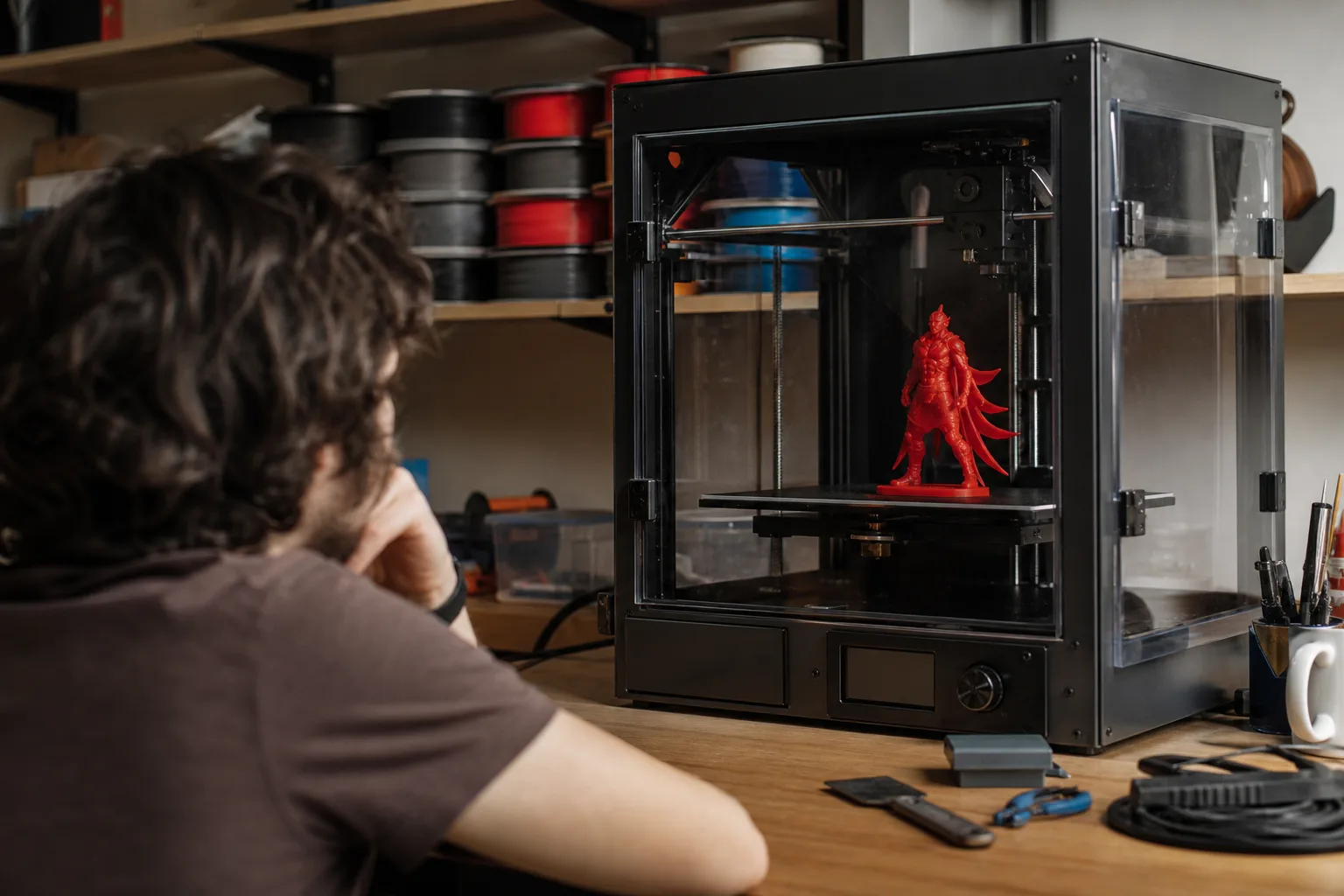
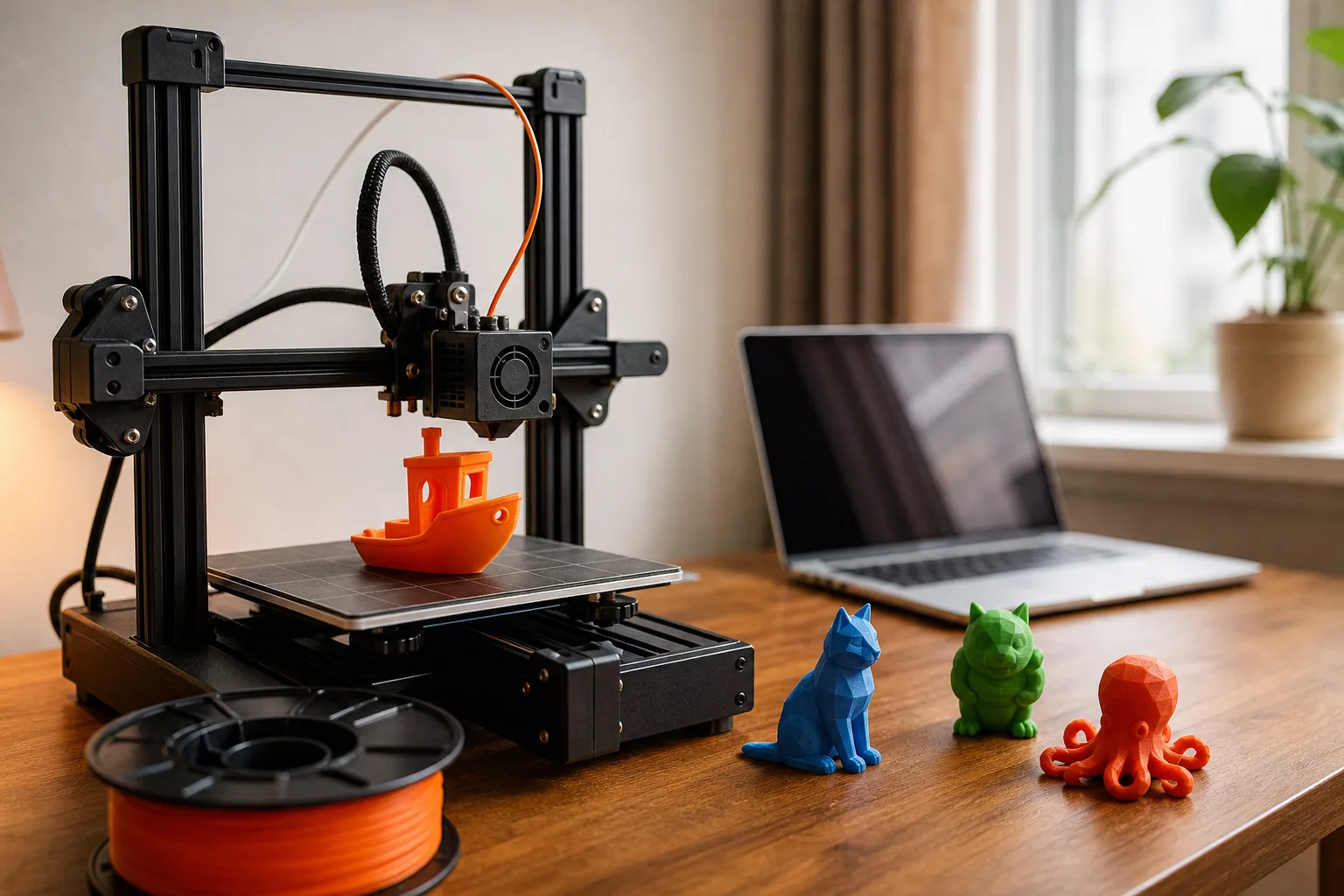
A first 3D printer: which one to buy for home
Bambu Lab A1 mini, A1 and P2S, Elegoo Centauri Carbon 2 and Creality SPARKX i7 compared: print size, open or enclosed, color, what filament costs and what to check before a first 3D printer comes home.
Culturera may earn a commission if you buy through the links on this page. As an Amazon Associate I earn from qualifying purchases. The selection is ours alone.
At a glance
- Best overallBambu Lab A1Amazon
- Best budgetBambu Lab A1 miniAmazon
- Best enclosedBambu Lab P2SAmazon
- Best value enclosedElegoo Centauri Carbon 2 ComboAmazon
The first 3D printer to buy for most homes is the Bambu Lab A1, $299 at list price: it arrives almost assembled, calibrates itself before each print and has room for objects up to 256 mm on each side. For a small desk, a teenager or a tight budget, the Bambu Lab A1 mini does the same on a smaller bed for $219. We have not tested these printers; we chose them from the makers' published specifications.
Prices are the makers' regular prices on November 25, 2026, taken from their own stores. Every brand here is running a Black Friday sale this week, with $20 to $100 off, so check the current price on Amazon and treat the list price as a ceiling. All five picks are filament printers, the kind that melts a plastic thread and draws the object layer by layer. Resin printers give finer detail for miniatures, but they need gloves, ventilation and chemical cleanup, and they are not a first printer for a family home.
For how home 3D printing works and what it costs to run, start with our guide a first 3D printer: what to know before you buy; this one picks the printers.
What should you check before buying a first 3D printer?
Print size. The build volume is the largest object the printer can make in one piece. A 180 mm cube covers figurines, phone stands, cable clips and most toys. A 256 mm cube fits helmets in sections, storage boxes and larger household parts. Bigger objects can be printed in pieces and glued.
Open or enclosed. An open-frame printer is cheaper and fine for PLA and PETG, the two plastics beginners use. An enclosed printer keeps heat in and fingers out, which matters for plastics such as ABS and ASA that warp in a draft, and it is quieter and tidier in a shared room.
Automatic calibration. Older printers made you level the bed with a sheet of paper. Every pick here levels and calibrates itself, which is the single biggest reason beginners now succeed on the first day.
One color or several. A multicolor unit feeds up to four spools and swaps between them. It adds about $100, prints more slowly and wastes some plastic at each color change. It is worth it for signs, toys and gifts, and unnecessary for functional parts.
Space and noise. Measure the desk, then add room for the spool and for the bed, which on open printers slides forward and back. A print takes hours, so think about where the hum will be least annoying.
Which one is for you?
Best overall
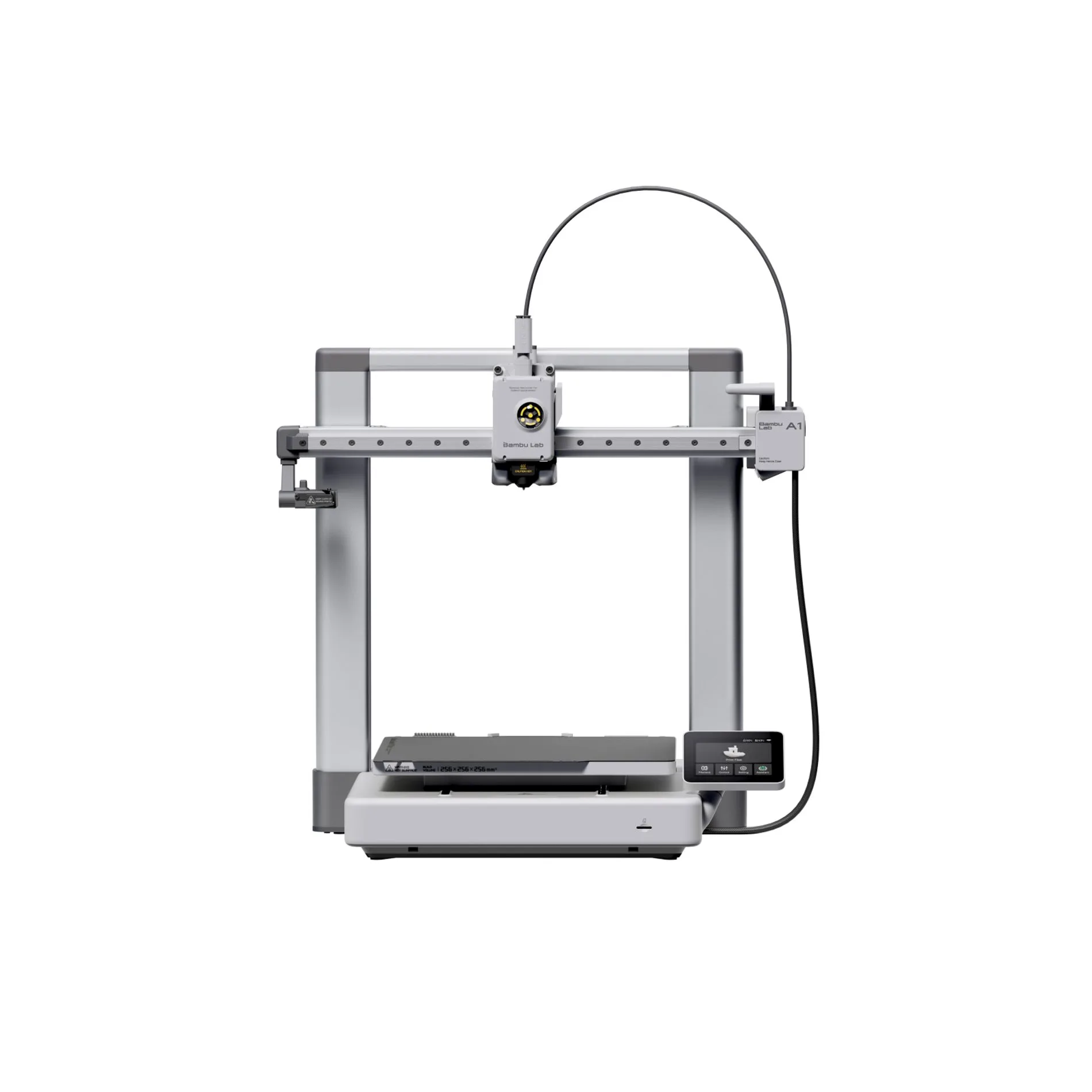
1. Bambu Lab A1
Best for: Most beginners and families
A full-size 256 mm bed, automatic calibration and optional four-color printing for $299.
See it at AmazonCheck the current price at the store.
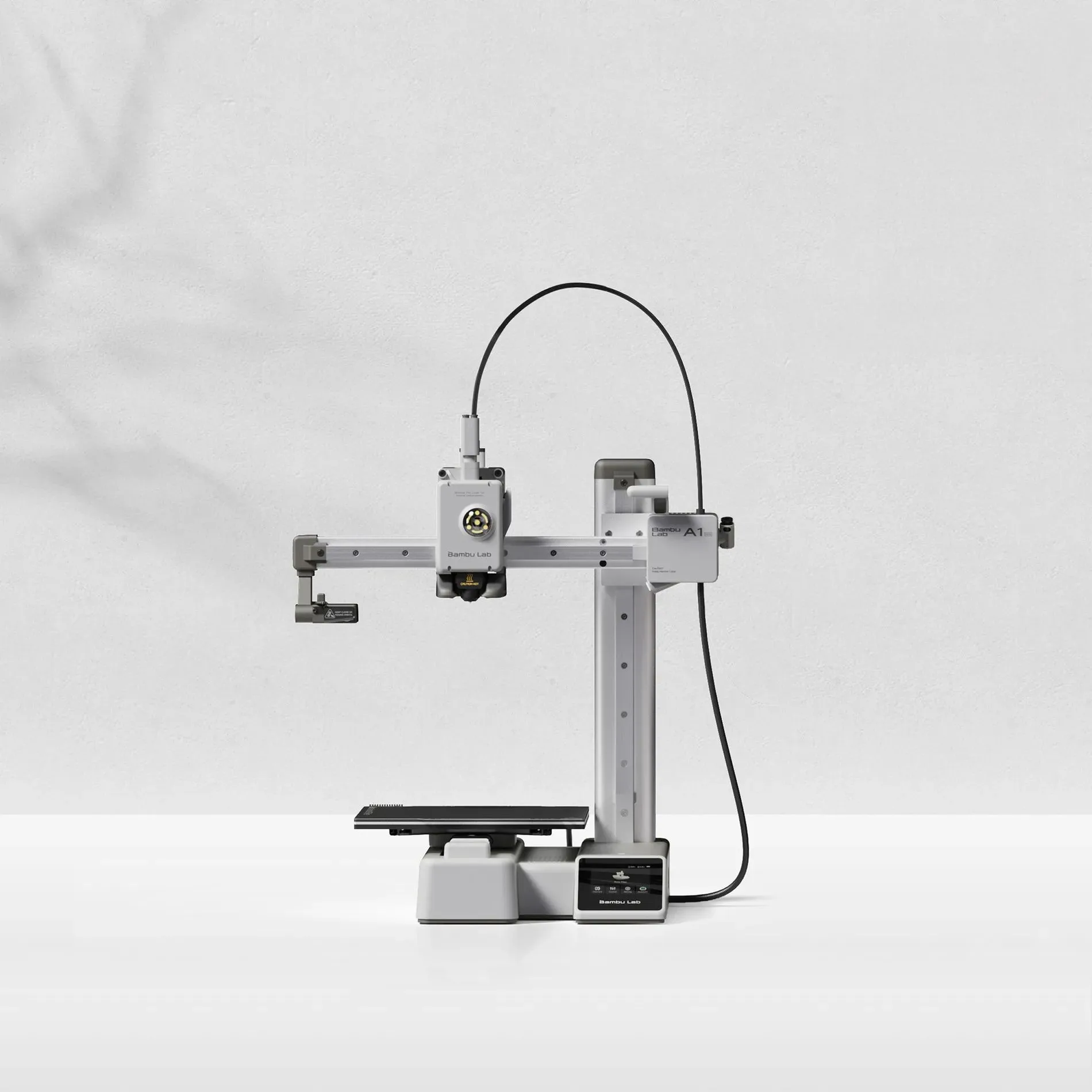
The Bambu Lab A1 ($299 regular price in Bambu's US store; $399 as the A1 Combo with the AMS lite four-color unit) is an open-frame printer with a 256 x 256 x 256 mm build volume. Bambu lists a nozzle that reaches 300 °C, a heated bed, a touchscreen, Wi-Fi and a camera for checking on prints from the phone app. It levels the bed and tunes the plastic flow by itself before printing. The Amazon listing we link is sold by the Bambu Lab Store and shipped by Amazon.
Who it's for: anyone who wants to print from the first evening and not outgrow the machine in a year. Keep in mind: the Bambu Lab A1 is open, so it is meant for PLA, PETG and flexible TPU, not ABS, and its bed moves back and forth, which needs clear space behind and in front. Bambu recalled early A1 units in 2024 over a heatbed cable; the company says printers sold since January 30, 2024 include the fix, which matters only if you buy second-hand.
Best budget
2. Bambu Lab A1 mini
Best for: Small desks, kids and teenagers
The same easy start as the A1 on a 180 mm bed, for $219.
See it at AmazonCheck the current price at the store.
The Bambu Lab A1 mini ($219 regular price; $329 as the A1 mini Combo with the AMS lite) has a 180 x 180 x 180 mm build volume and weighs 5.5 kg. Bambu says it arrives pre-assembled and takes about 20 minutes to set up, with the same automatic calibration, 300 °C nozzle and camera as the larger A1. The Amazon listing we link, sold by the Bambu Lab Store, bundles the printer with an LED lamp kit to print as a first project.
Who it's for: a first printer for a student's desk, a classroom or a family that wants to try the hobby without giving up a table. Keep in mind: the Bambu Lab A1 mini's 180 mm limit is the thing owners outgrow, and with the four-spool AMS lite beside it the footprint roughly doubles.
Best enclosed
3. Bambu Lab P2S
Best for: Shared rooms and tougher plastics
An enclosed 256 mm printer with a carbon filter and a camera that watches the print, for $549.
See it at AmazonCheck the current price at the store.
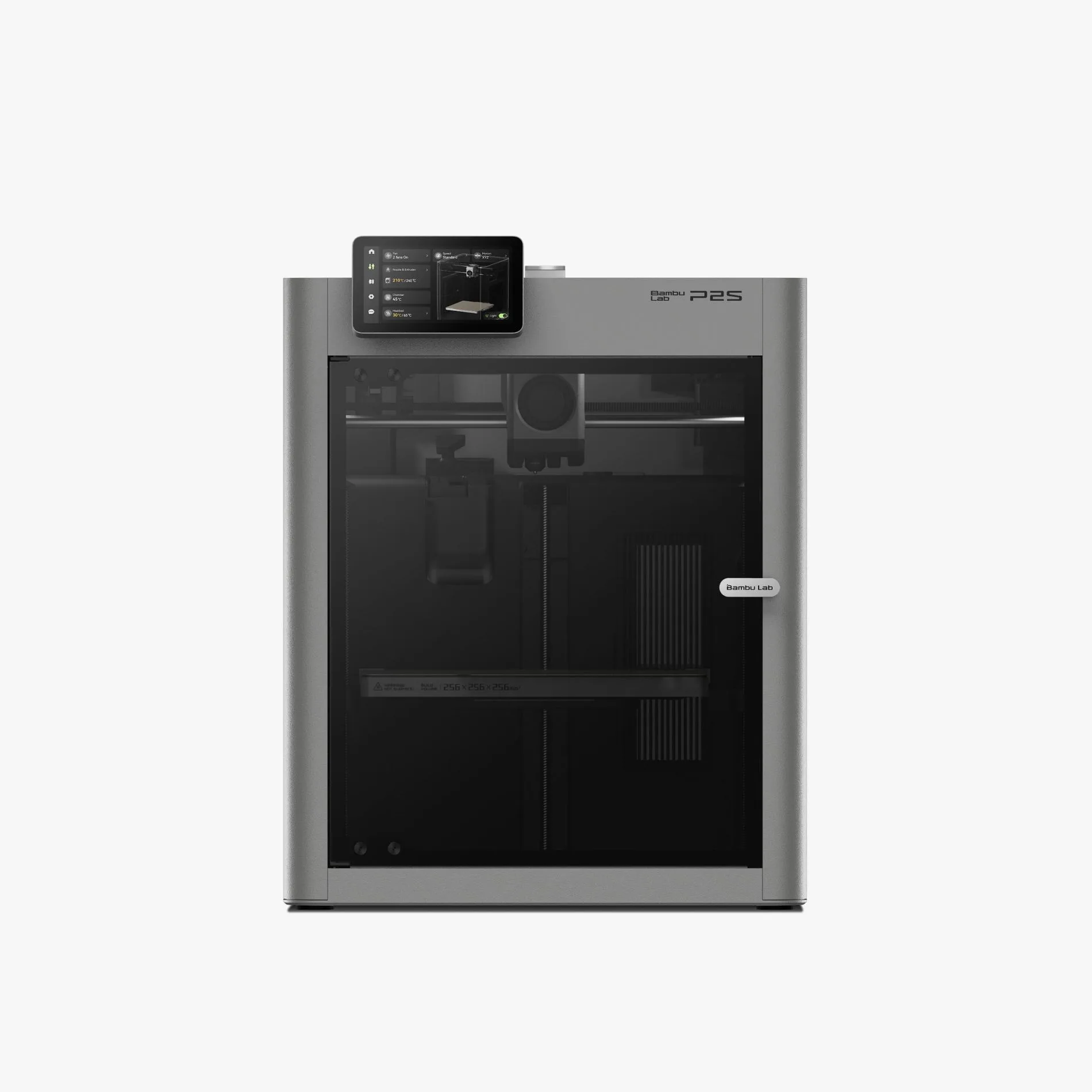
The Bambu Lab P2S ($549 regular price; $749 as the P2S Combo with the AMS 2 Pro) is the enclosed successor to the best-selling P1S. Bambu lists a 256 x 256 x 256 mm build volume, a closed chamber with an activated carbon filter, a touchscreen, dual-band Wi-Fi and a camera with computer vision that checks for failed prints. The enclosure lets it print ABS and ASA as well as PLA and PETG. On Amazon, choose the listing sold by the Bambu Lab Store.
Who it's for: people who already know they will print functional parts, and homes where a closed box is welcome because of children, pets or dust. Keep in mind: the Bambu Lab P2S costs almost twice as much as the A1 for the same print size, and a beginner who only prints PLA will not see the difference in the results.
Best value enclosed
4. Elegoo Centauri Carbon 2 Combo
Best for: An enclosed printer with color on a smaller budget
A closed CoreXY printer with a 350 °C nozzle and four-color printing for $399 on Elegoo's US store.
See it at AmazonCheck the current price at the store.
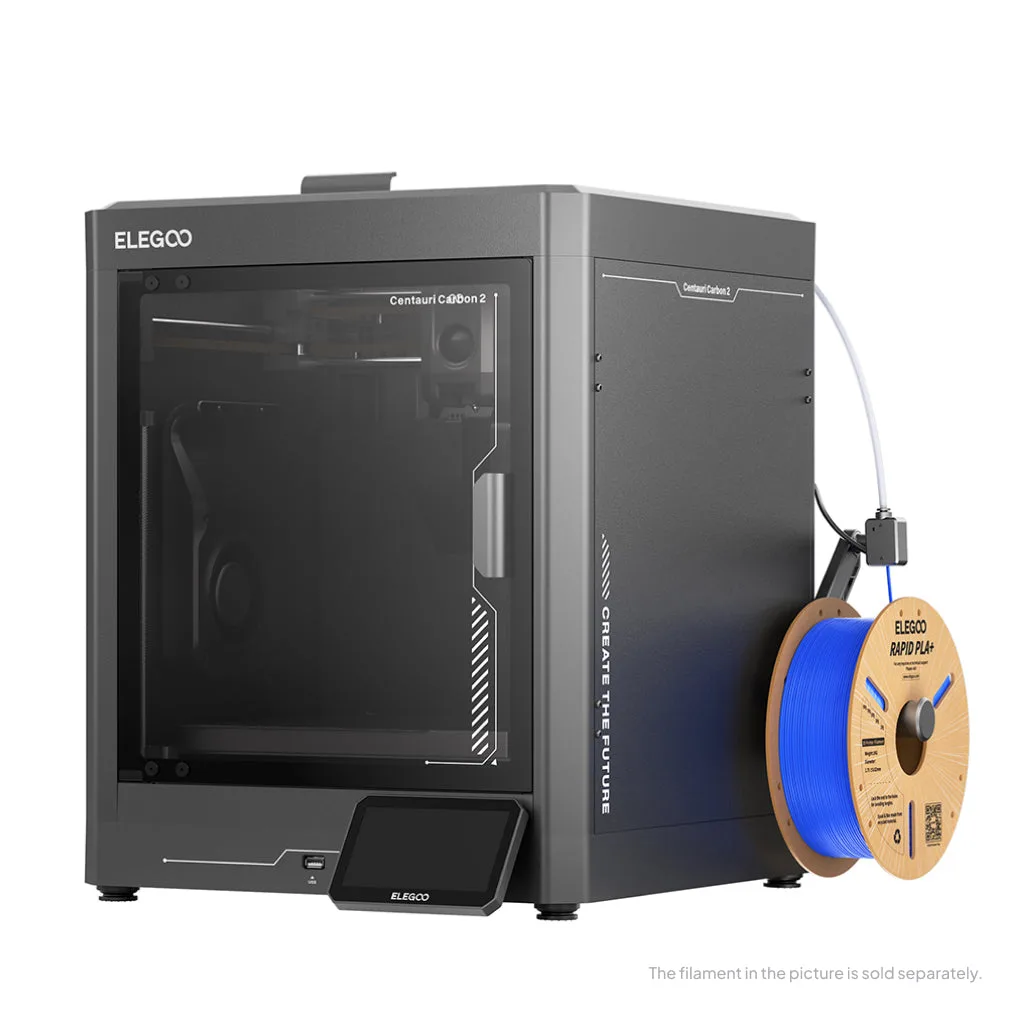
The Elegoo Centauri Carbon 2 ($349 in Elegoo's US store; $399 as the Combo with the CANVAS four-color unit, the version sold on Amazon) is an enclosed printer with a 256 x 256 x 256 mm build volume. Elegoo lists a 350 °C nozzle, speeds up to 500 mm/s, full automatic calibration and noise under 45 dB. The Amazon listing we link is sold by Elegoo's official US store and shipped by Amazon.
Who it's for: buyers who want an enclosure and multicolor printing for less than a Bambu Lab P2S alone. Keep in mind: Amazon sells the Elegoo Centauri Carbon 2 as the Combo, so you pay for the four-color unit even if you would rarely use it, and an enclosed 256 mm printer with spools beside it is bulky: measure the shelf first.
5. Creality SPARKX i7 Nano Combo
Best for: An open printer with a camera that spots failed prints
Creality's beginner printer: a 260 mm bed, automatic leveling and an AI camera for $279.
See it at AmazonCheck the current price at the store.
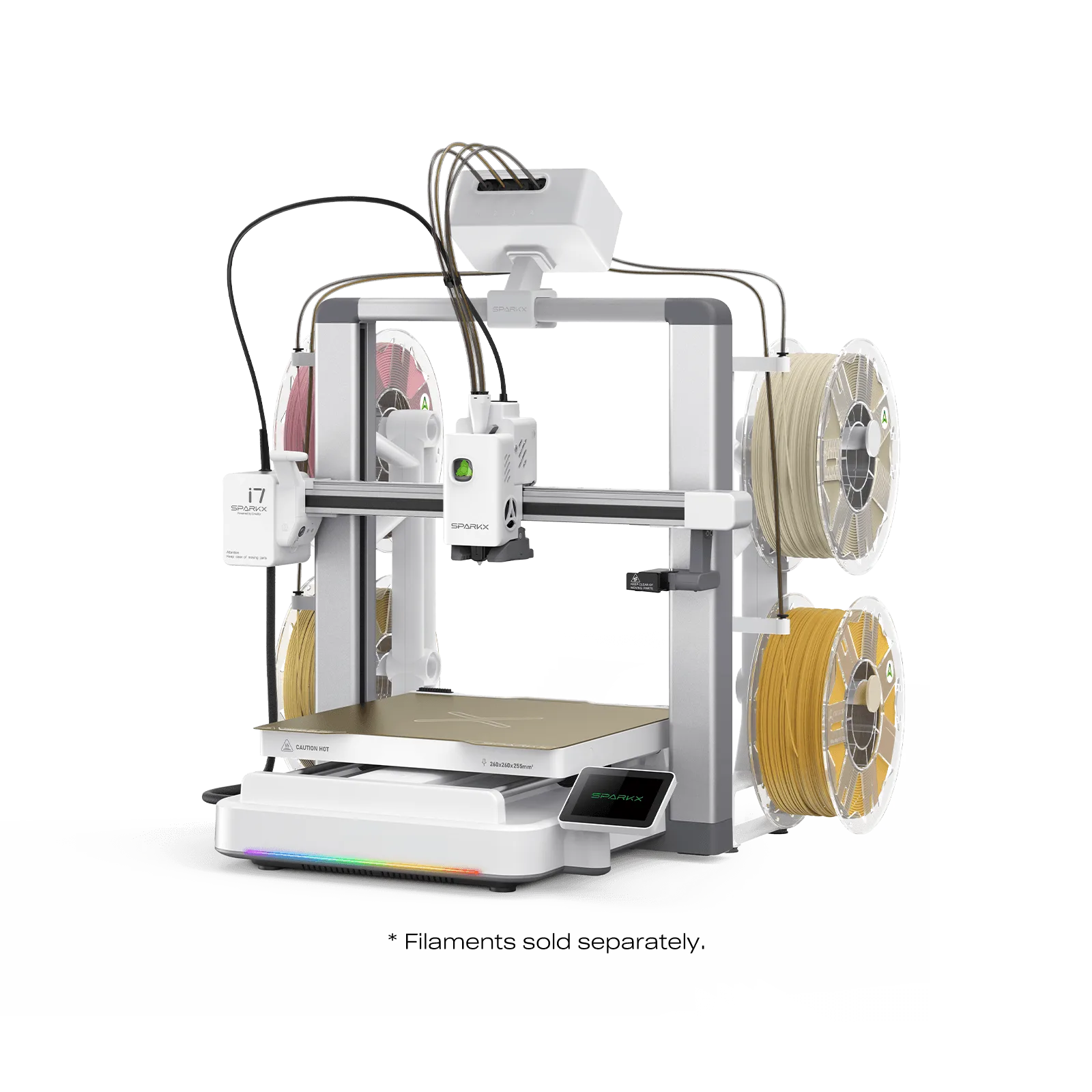
The Creality SPARKX i7 Nano Combo ($279 regular price in Creality's US store) is the plug-and-print answer from the brand that made its name with build-it-yourself kits. Creality lists a 260 x 260 x 255 mm build volume, speeds up to 500 mm/s, a 300 °C nozzle, full automatic leveling and a 720p camera that detects the tangle of loose plastic known as spaghetti. It prints PLA, PETG, TPU and carbon-fiber PLA.
Who it's for: someone comparing against the Bambu Lab A1 who wants a slightly larger bed and the failure-detecting camera at a lower price. Keep in mind: the Creality SPARKX i7 is sold in several bundles with similar names (Autofill, Nano Combo, Color Combo), so read the listing title, and Creality's site notes that the basic versions need some assembly.
PLA, PETG or ABS: which filament should a beginner buy?
Start with PLA. It prints at low temperatures, barely smells, does not warp and comes in every color. PETG is the second step for parts that need to survive heat or water, such as something left in a car or a bathroom. ABS and ASA are stronger outdoors but need an enclosed printer and good ventilation. A 1 kg spool of PLA costs about $15 to $20 from the printer brands (Bambu lists its PLA Basic at $17.99) and lasts for dozens of small objects. Store open spools in a closed box, because filament absorbs moisture and then prints badly.
Where do the things to print come from?
You do not need to know how to design. Free libraries such as MakerWorld, Printables and Thingiverse hold millions of ready models: toys, organizers, replacement knobs, cosplay parts. You download the file, open it in the printer's free slicer program (Bambu Studio, Creality Print or ElegooSlicer), choose the filament and send it over Wi-Fi. Designing your own parts comes later, with free tools such as Tinkercad for beginners.
Is a 3D printer safe at home?
The nozzle works above 200 °C and the bed can reach 60 to 100 °C, so a printer is not a toy for unsupervised young children. Place it on a stable surface, away from curtains, in a room you can air. PLA releases little odor; ABS releases fumes and belongs in an enclosed printer near a window or with a filter. Follow the maker's age guidance, and let the first prints of a child be a shared project.
Which 3D printer fits your budget?
Bambu Lab A1 mini, $219: the cheapest reliable start, on a 180 mm bed.
Creality SPARKX i7 Nano Combo, $279: a 260 mm bed and a camera that detects failed prints.
Bambu Lab A1, $299: the best first printer for most homes; $399 with four-color printing.
Elegoo Centauri Carbon 2 Combo, $399: enclosed and multicolor for less.
Bambu Lab P2S, $549: enclosed, filtered and ready for tougher plastics.
Before you order
Add two spools of PLA to the order, because the sample in the box runs out in an afternoon. Check which version the listing sells: with or without the multicolor unit, and for 120-volt outlets if you buy in the United States. Buy from the brand's own store on Amazon so the warranty applies, and keep the box for a few weeks, since printers are heavy to return. If the printer is a gift for a young maker, our guide to LEGO sets for adults and our drawing tablet guide cover two neighboring hobbies.
How to get it right
For most homes, the Bambu Lab A1; for a small desk or a small budget, the Bambu Lab A1 mini; for a closed, filtered box, the Bambu Lab P2S; for enclosed color at a lower price, the Elegoo Centauri Carbon 2 Combo; and for a large open bed with a watchful camera, the Creality SPARKX i7.