The best powered speakers for a turntable in 2026
Speakers that plug straight into a record player: Kanto's YU4 with a built-in phono preamp, Edifier's R1280DB and Audioengine's A2+, and the one detail that decides which to buy.
Culturera may earn a commission if you buy through the links on this page. As an Amazon Associate I earn from qualifying purchases. The selection is ours alone.
At a glance
- Best overallKanto YU4Amazon
- Best valueEdifier R1280DBAmazon
- Most compactAudioengine A2+Amazon
If someone got a record player recently and is listening through its tiny built-in speaker or a Bluetooth box, the best upgrade is a pair of powered bookshelf speakers. For most people, give the Kanto YU4: it has a phono preamp built in, so any turntable plugs straight in, plus Bluetooth for everything else. On a tighter budget, Edifier's R1280DB is the classic choice, as long as the turntable has its own preamp. We have not tested these speakers; this guide compares what the makers publish.
Prices are the makers' list prices on November 22, 2026.
What should you check before buying speakers for a turntable?
The phono preamp. A turntable's signal is very weak and needs a phono preamp to reach normal line level. Many modern turntables have one built in, usually with a switch marked PHONO/LINE. If the turntable has one, any powered speaker with RCA inputs works. If it does not, buy speakers with a phono input, like the Kanto YU4, or add a separate preamp.
Powered or passive. Powered speakers have the amplifier inside, so they plug straight into the turntable. Passive speakers need a separate amplifier or receiver.
Size and placement. Bookshelf speakers sound best on stands or a shelf at ear height, a little apart, and not on the same surface as the turntable, where vibrations can reach the needle.
Other inputs. Most people end up using the same speakers for a phone, a TV or a computer. Bluetooth covers phones, an optical input takes the sound from a TV, and a USB-C input connects a computer directly. List what else the person will plug in before choosing.
Room size. Speakers with 4-inch woofers fill a bedroom or a medium living room. Smaller woofers, like the 2.75-inch ones on the Audioengine A2+, are made for a desk or a small room and produce less bass.
Which one is for you?
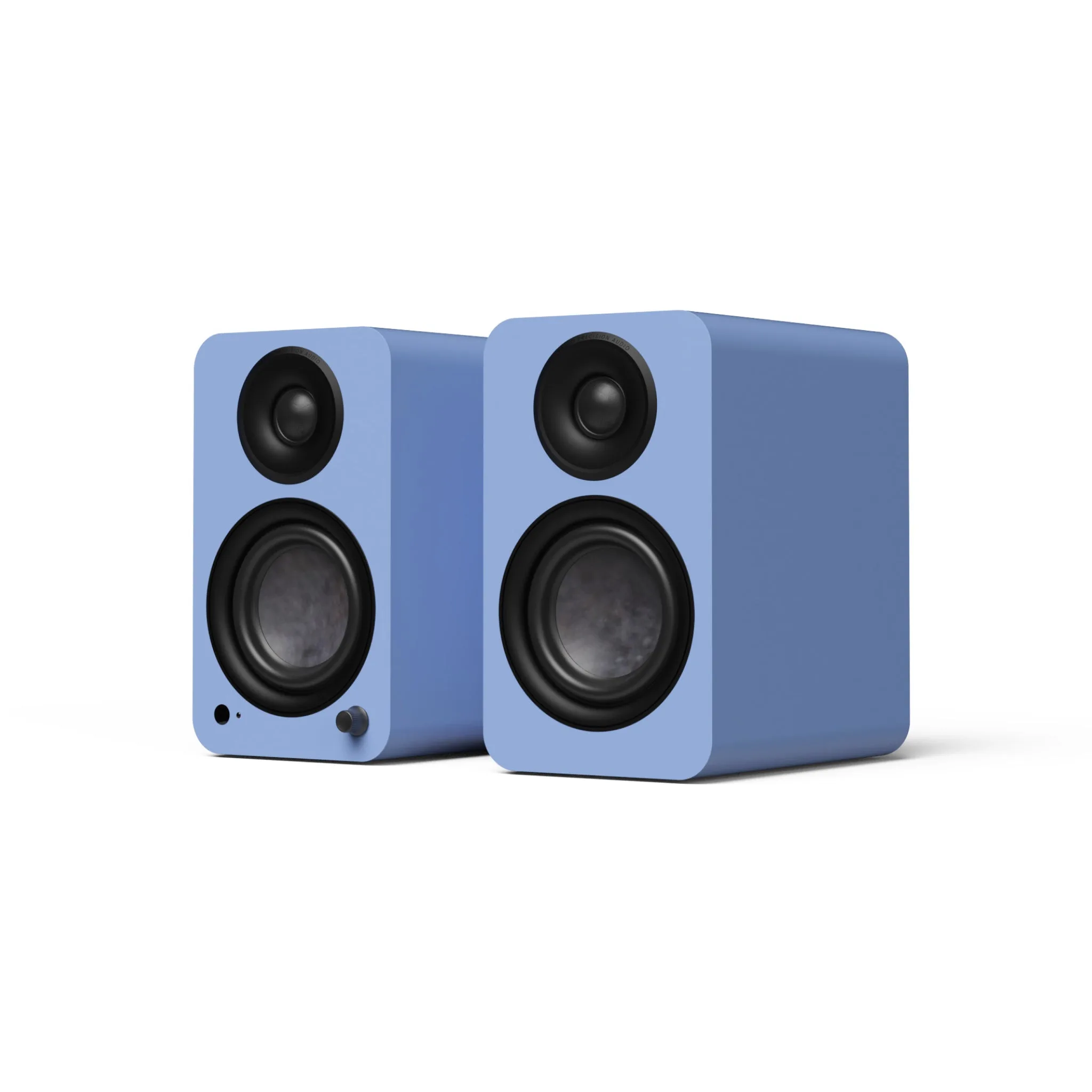
Best overall
1. Kanto YU4
Best for: Any turntable, with or without a preamp
Powered speakers with a phono preamp built in, Bluetooth and a remote, in bright colors.
See it at AmazonCheck the current price at the store.
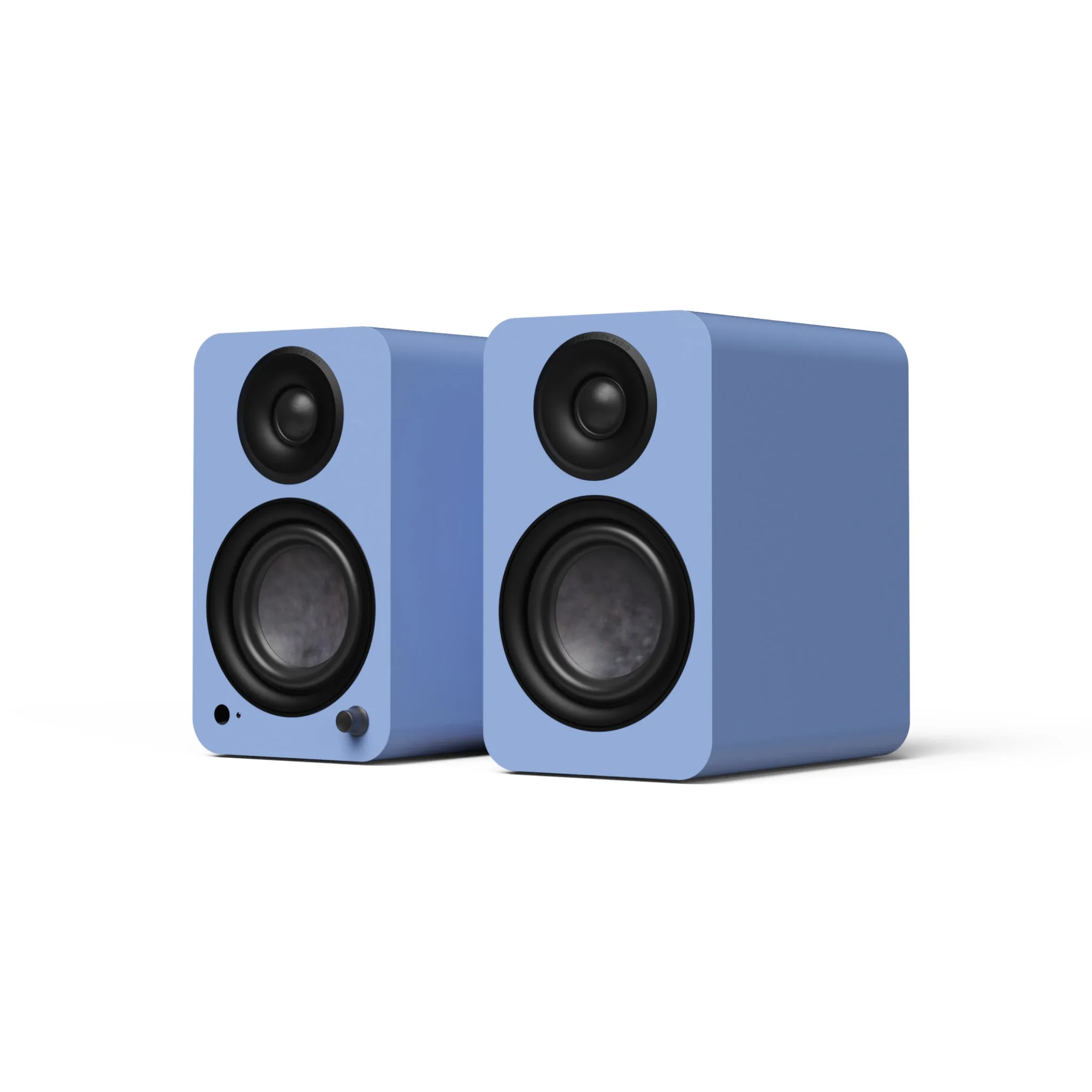
Kanto's YU4 is designed around a turntable: a switchable phono preamp on the back means any record player connects with one cable, and Bluetooth handles music from phones. It has a remote, a subwoofer output and comes in several colors. Kanto released a second generation this year ($499.99 list) with updated finishes; Amazon US still sells the original YU4, which also has the built-in phono preamp and Bluetooth.
The Kanto YU4 2nd Gen has 4-inch abaca paper woofers and 1-inch silk-dome tweeters, 110 watts RMS in total, RCA inputs with a selectable phono switch, a 3.5 mm AUX input, an optical input and a USB-C input (both up to 24-bit/96 kHz) and Bluetooth 5.3. Each speaker measures 14 x 20.5 x 23.3 cm (5.5 x 8.1 x 9.2 inches), according to Kanto's product sheet. It is the only pick in this guide with more power than the Edifier R1280DB and a phono input.
Who it's for: anyone with a new turntable who wants one simple setup. Keep in mind: check which generation the listing is; the Amazon listings we found were from third-party sellers, so the link opens a search.
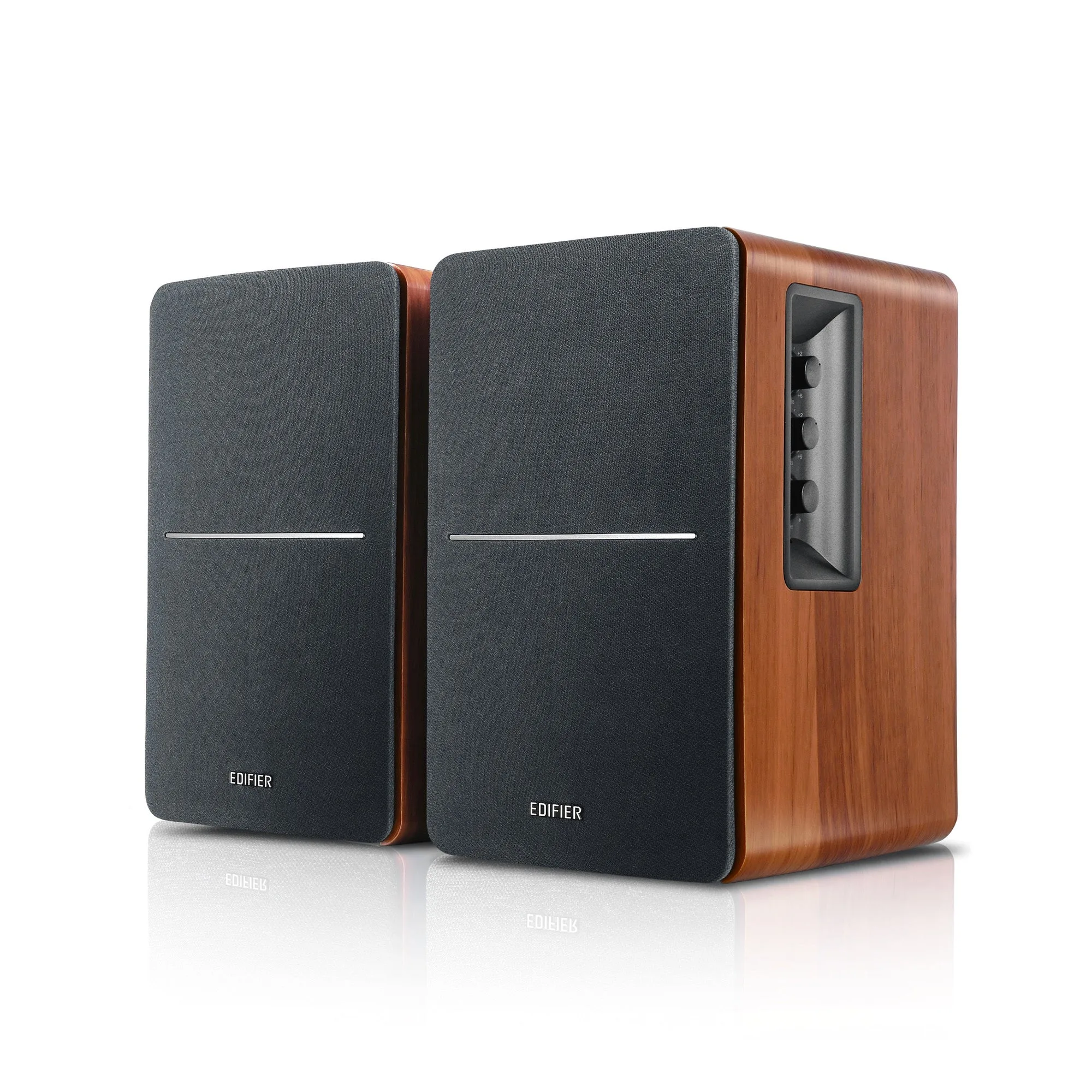
Best value
2. Edifier R1280DB
Best for: A turntable with a built-in preamp
The most recommended budget powered speakers, with Bluetooth, optical and two RCA inputs.
See it at AmazonCheck the current price at the store.
The Edifier R1280DB ($189.99 list) has 4-inch woofers and silk-dome tweeters, 42 watts in total, two RCA inputs, optical and coaxial inputs for a TV, Bluetooth 5.1 and a remote. The wood-effect sides and side-panel knobs give it a classic hi-fi look. It has no phono input, so the turntable must have a built-in preamp.
The Edifier R1280DB delivers 21 watts RMS per speaker, has a frequency response of 55 Hz to 20 kHz and measures 14.6 x 24.2 x 17.8 cm (5.7 x 9.5 x 7 inches) per speaker. The bass port is on the front, so the speakers can sit close to a wall or inside a bookshelf. Bass, treble and volume knobs are on the side of the right speaker. The Edifier R1280DB has no subwoofer output; Edifier's R1280DBs version adds one.
Who it's for: most beginner setups, and anyone who also wants better TV sound. Keep in mind: if the turntable lacks a preamp, add one for about $30 to $100. On Amazon US it is sold by Edifier's online store.
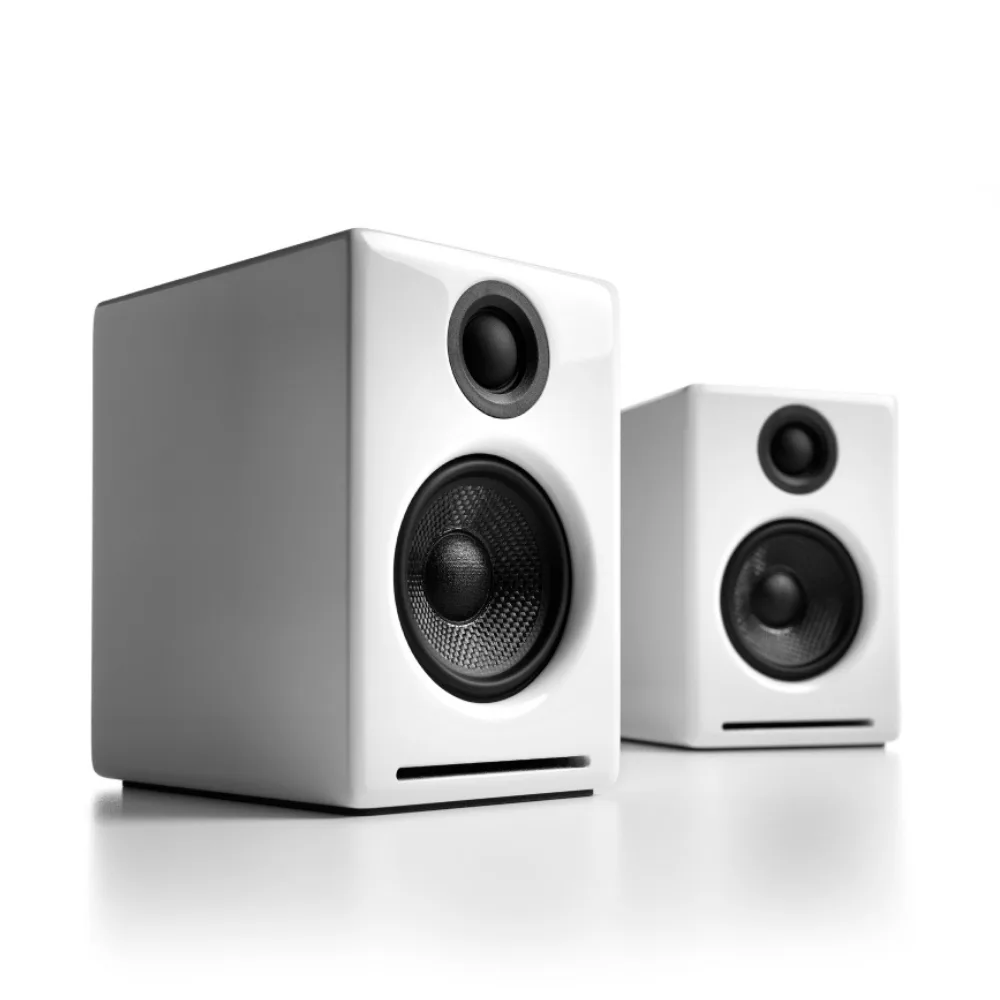
Most compact
3. Audioengine A2+
Best for: A desk or a small apartment
Small speakers with a big sound for their size, Bluetooth aptX Adaptive and a USB-C input.
See it at AmazonCheck the current price at the store.
The Audioengine A2+ Gen 3 ($299 list) is a compact pair with 2.75-inch aramid woofers and silk-dome tweeters, RCA and 3.5 mm inputs, a USB-C input for a computer, Bluetooth with aptX Adaptive and a subwoofer output. It is small enough for a desk next to a turntable.
Audioengine announced the A2+ Gen 3 in September 2026. It moved to Bluetooth 5.3, with a wireless range of up to 100 feet according to Audioengine, and its USB-C input accepts audio up to 96 kHz from a computer without a separate sound card. The cabinets are hand-finished wood fiberboard in several colors.
Who it's for: someone with limited space, or a turntable on a desk. Keep in mind: small woofers mean limited bass; add a subwoofer for a bigger room. It has no phono input. On Amazon US it is sold by Audioengine itself.
Is there anything cheaper?
Edifier's R1280T ($149.99 list) is the same speaker as the R1280DB without Bluetooth or the digital inputs, sold by Edifier's online store on Amazon. If the record player is the only source, it is all you need.
How do you know if a turntable has a built-in preamp?
Look for a switch marked PHONO/LINE on the back, or check the manual for 'built-in phono preamp' or 'phono equalizer'. Among popular models, the Audio-Technica AT-LP60X and AT-LP120XUSB and the Fluance RT81 have a preamp built in. The Pro-Ject Debut Carbon EVO and the Rega Planar 1 do not, so they need speakers with a phono input, like the Kanto YU4, or a separate preamp.
The sound also tells you. Very quiet, thin music with no bass means there is no preamp in the chain. Loud, harsh, distorted music means there are two: the turntable's switch is set to LINE and the speakers are also set to PHONO. Only one of the two should be doing the job.
How do you connect a turntable to powered speakers?
One speaker of the pair holds the amplifier and all the inputs; the other connects to it with the included speaker wire. Plug the turntable's red and white RCA cable into the matching RCA input on the powered speaker, then plug that speaker into the wall.
If the turntable has a thin separate ground wire and you are using a phono input, attach it to the screw marked GND on the speaker or preamp; leaving it loose causes a low hum. Set the turntable's switch to LINE for a normal RCA input, or to PHONO when the speakers have their own phono input switched on. Turn the volume down before the first record.
Where should you put the speakers?
Place the two speakers and your listening seat in a rough triangle with equal sides, with the tweeters at ear height and the speakers turned slightly toward you. Keep them 1.5 to 2.5 meters (5 to 8 feet) apart in a living room; on a desk, a little under 1 meter works.
Keep the speakers off the piece of furniture that holds the turntable. Bass makes the surface vibrate, the needle picks the vibration up and the result is a muddy sound or, at high volume, a howling feedback loop. A separate shelf, stands or foam pads under the speakers solve it.
Is Bluetooth good enough for records?
Some turntables send their sound by Bluetooth, and all three picks receive it. It works and saves a cable, but Bluetooth compresses the audio, and a record played through it loses some of the detail that makes vinyl worth the trouble. Use the RCA cable for the turntable and keep Bluetooth for music from the phone.
Do you need a subwoofer?
Not at first. Bookshelf speakers with 4-inch woofers give enough bass for most music in a normal room. If the person later wants more, the Kanto YU4 and the Audioengine A2+ have a subwoofer output that takes any powered subwoofer; the Edifier R1280DB does not.
Which one at each price?
Around $150: the Edifier R1280T, $149.99, if the record player is the only source.
Around $190: the Edifier R1280DB, $189.99, with Bluetooth and TV inputs, for a turntable with a preamp.
$300 to $500: the Audioengine A2+ Gen 3, $299, for a desk or a small room; or the Kanto YU4 2nd Gen, $499.99, for a turntable without a preamp.
Before you order
Look at the back of the turntable: a PHONO/LINE switch or a mention of a built-in preamp in the manual tells you whether you need speakers with a phono input. Most of these speakers include an RCA cable.
Amazon US usually extends its return window for gifts bought during the holidays; check the exact dates on the listing before you buy.
How to get it right
If the turntable has no preamp, the Kanto YU4; if it has one, the Edifier R1280DB; for a desk, the Audioengine A2+.