The studio system: when Hollywood made its stars to order
For three decades, a handful of studios owned their actors, chose their names and wrote their private lives. How the star factory worked, and how it fell.
Today's celebrities have agents, managers, publicists and social media accounts of their own. Between the 1920s and the 1950s, Hollywood's biggest names had something else: an employer that owned their contract, their schedule and often their public image. Studios chose their names, fixed their teeth, wrote their biographies and decided whom they would be seen with. This was the studio system, and much of what we still think of as celebrity was invented inside it.
This guide explains how the system worked, how stars were built, how actors fought back, why it collapsed, and what it left behind.
How Hollywood became Hollywood
In the first years of American cinema, most films were made on the East Coast, in New York and New Jersey. In the 1910s, producers increasingly moved to Southern California, attracted by sunshine that allowed filming all year round, varied landscapes within easy reach, cheap land and, according to film historians, distance from the patent company that tried to control film equipment in the East. A quiet suburb of Los Angeles called Hollywood gave its name to the whole industry.
Early films did not even name their actors, partly because producers feared that famous performers would demand more money. They were right. Audiences began writing in to ask about their favourite faces, and in 1910 the producer Carl Laemmle promoted the actress Florence Lawrence, previously known only as "the Biograph Girl", with a publicity stunt: a false newspaper story claiming she had died, followed by an announcement that she was alive and working for his company. It is often described as the birth of the star system. Within a few years, performers such as Mary Pickford and Charlie Chaplin were among the most famous people on earth, and highly paid.
In 1919, Pickford, Chaplin, Douglas Fairbanks and the director D. W. Griffith founded United Artists to distribute their own films and keep control of their work. As one studio head reportedly put it at the time, "the lunatics have taken over the asylum". The phrase captured the industry's fear of stars with power, a fear that shaped the system that followed.
Five big studios
By the 1930s, American film production was dominated by five companies, the Big Five: MGM, Paramount, Warner Bros., 20th Century Fox and RKO. Three smaller ones, Universal, Columbia and United Artists, were known as the Little Three.
The big studios were vertically integrated: they did everything themselves. They developed scripts, built sets on their own lots, employed actors, writers, directors, composers and craftspeople on long contracts, shot films, distributed them and owned many of the cinemas where they were shown. Through block booking, they often required independent cinemas to take a whole package of films, good and bad, to get the ones they wanted. A major studio could release around fifty films a year.
Each studio was run by powerful executives, often called moguls, such as Louis B. Mayer at MGM, Jack Warner at Warner Bros. and Harry Cohn at Columbia. And each had its own personality. MGM boasted of having "more stars than there are in heaven" and specialised in glamour and musicals. Warner Bros. made tough gangster films and social dramas. Universal became the home of horror, with Dracula and Frankenstein in 1931.
Even the Oscars were born inside the system. The Academy of Motion Picture Arts and Sciences was founded in 1927 at the initiative of MGM's Louis B. Mayer, partly as a way to handle labour disputes within the industry without unions. The first awards ceremony, in 1929, was a short private dinner. Over the following decades, the studios campaigned hard for their own films and stars, and an Oscar became one of the most valuable things a contract could produce.
The seven-year contract
Actors signed long contracts, usually for up to seven years. The catch was that the options belonged to the studio. Every six months or year, it could drop the actor or keep them, often with a raise, but the actor could not leave. Studios decided which films their stars made and which roles they played.
Studios could also lend their stars to other studios for a fee, often much higher than the actor's own salary. A famous example: in 1934 MGM lent Clark Gable to the smaller Columbia studio for It Happened One Night, reportedly as a kind of punishment. The comedy won the five main Academy Awards, including best actor for Gable.
If an actor refused a role, the studio could suspend them without pay. Time spent on suspension was often added to the end of the contract, so it could stretch on for years beyond the original seven.
Life on the lot
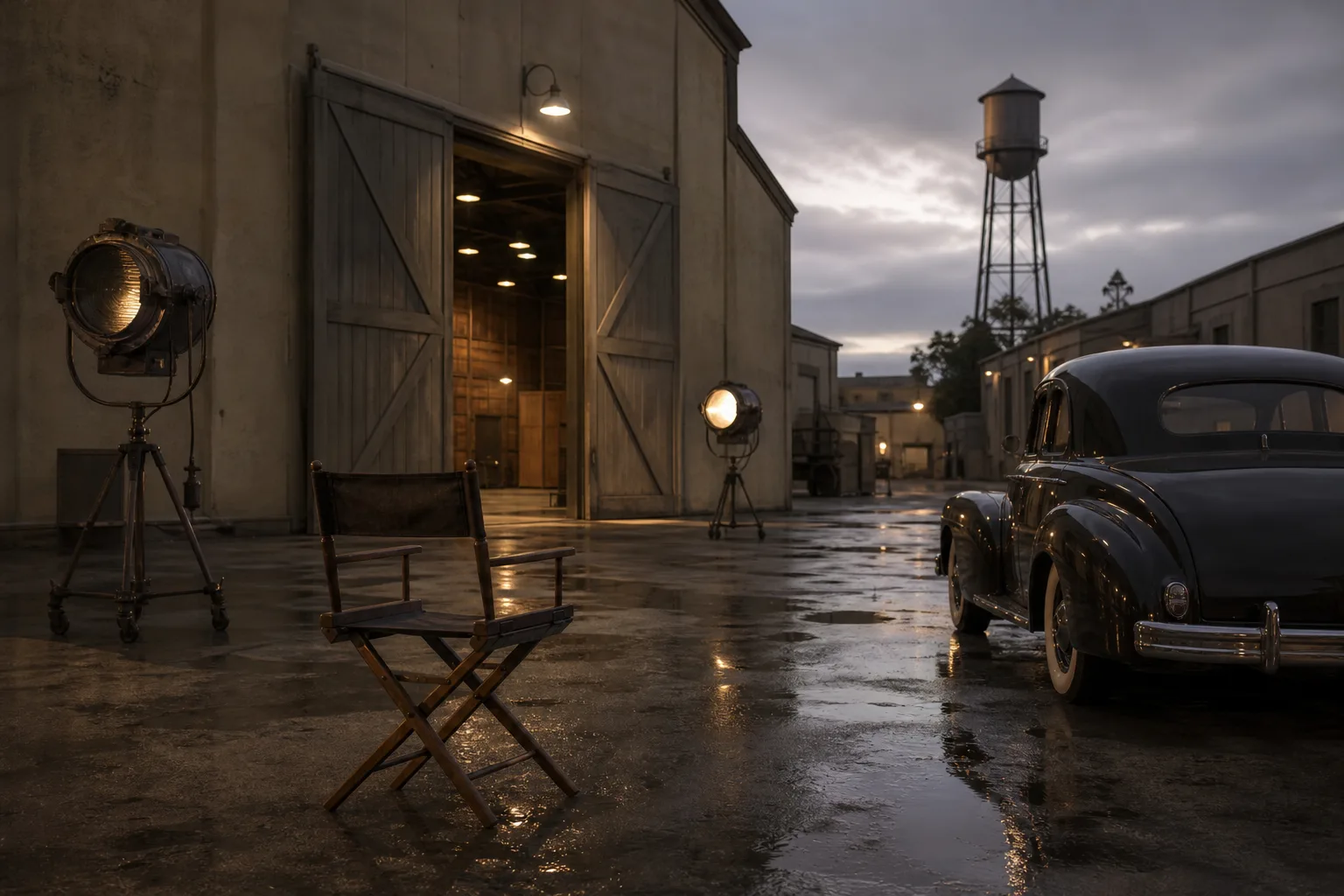
A major studio's lot was like a small city. MGM's grounds in Culver City had sound stages, standing sets of streets from different countries and centuries, workshops for carpentry, costumes and props, a school, a hospital, a fire department and a famous commissary where stars, writers and technicians ate lunch. Thousands of people worked there.
The working week was long. For much of the period, studios worked six days a week, and actors could be called to hair and makeup before dawn. A contract player might shoot several films a year, sometimes moving from one set to another with little rest. For supporting actors and minor players, the studio offered something rare in the acting profession: a steady salary. For stars, it offered fame, money and protection, but at the cost of control.
Writers and directors on the payroll
Actors were not the only contract employees. Studios kept large departments of screenwriters, who were assigned to projects, rewrote each other's work and often went uncredited. Celebrated novelists, including William Faulkner and F. Scott Fitzgerald, spent years writing for the studios, often unhappily. Directors were also employees: many were assigned films rather than choosing them, and the final edit usually belonged to the producers rather than the director. Some, such as Alfred Hitchcock, who arrived in Hollywood in 1939 under contract to the producer David O. Selznick, managed to keep a recognisable personal style within the system, and later critics celebrated them as true authors of their films.
Composers, cinematographers, costume designers and art directors worked in the same way, which helps explain why each studio's films often shared a distinctive look and sound.
Building a star
Studios ran their own talent departments, scouting young people in theatres, beauty contests and even drugstores, and putting them under contract cheaply. New actors were given screen tests and lessons in diction, singing, dancing, riding and fencing. Many were given new teeth, new hair colour, new eyebrows or, in some cases, a new hairline: Rita Hayworth underwent painful electrolysis to raise her forehead.
Very often they were also given a new name. Archibald Leach became Cary Grant, Marion Morrison became John Wayne, Norma Jeane Mortenson became Marilyn Monroe, Lucille LeSueur became Joan Crawford and Margarita Cansino, the daughter of a Spanish dancer from Seville, became Rita Hayworth. Names that sounded too foreign, too ethnic or too ordinary were changed to fit what the studios thought American audiences wanted.
The studios did not discover stars. They manufactured them, down to the eyebrows.
Inventing private lives
Publicity departments were as important as camera departments. They invented or polished biographies, organised photo shoots at home, arranged dates for the cameras and supplied stories to fan magazines such as Photoplay, which millions of readers bought to learn about their idols. Gossip columnists, above all Louella Parsons and Hedda Hopper, were enormously powerful, and studios fed them information in exchange for favourable coverage.
Studios often worked to hide anything they thought the public would not accept, from marriages and pregnancies to drinking and sexual orientation. Some gay actors were encouraged into arranged marriages or publicised romances. Young performers were placed under intense pressure: Judy Garland later spoke of being given pills to control her weight and keep her working long hours as a teenager at MGM.
The morality clause and the Production Code
After a series of scandals in the early 1920s, including the trial of the comedian Roscoe "Fatty" Arbuckle, who was eventually acquitted, studios added morality clauses to contracts, allowing them to fire actors whose private behaviour embarrassed the company.
The industry also regulated what appeared on screen. The Production Code, written in 1930 and strictly enforced from 1934, set out what Hollywood films could and could not show, on topics from crime and sexuality to religion. Studios needed the Code's seal of approval to release their films in the major cinemas. It remained in force, gradually weakened, until 1968, when it was replaced by the age-based rating system.
Child stars
Children were part of the machine. Shirley Temple, under contract to Fox, was one of the biggest box-office attractions in the world in the mid-1930s, while still under ten years old. Studios ran schools on their lots so that child actors could study between takes. The pressures on young performers, and questions about who controlled their earnings, led California to pass a law in 1939, known as the Coogan Act, after the child star Jackie Coogan discovered that his parents had spent most of his fortune. It required part of a child actor's earnings to be set aside in trust.
The actors who fought back
Stars did not accept the system quietly. In 1933, actors founded the Screen Actors Guild to negotiate for better conditions. In 1936, Bette Davis tried to break her contract with Warner Bros. by working in Britain, and the studio sued her in a British court. She lost, but returned to Hollywood with more respect and better roles.
In 1943, Olivia de Havilland sued the same studio over the extra time added to her contract for her suspensions. In 1944, a California court ruled in her favour: a personal services contract could not be enforced for more than seven calendar years, whatever the suspensions. The decision, still known as the De Havilland Law, freed many actors and weakened the studios' hold.
The end of the system
The decisive blow came from the government. Since the late 1930s, the United States had pursued an antitrust case against the major studios. In 1948, in the case known as the Paramount decision, the Supreme Court ruled against their control of cinemas and practices such as block booking. The studios were forced to sell their cinema chains, and with them the guaranteed outlet for their films.
Television arrived at the same time, and cinema audiences fell sharply in the late 1940s and 1950s. Long contracts for hundreds of employees became too expensive. Stars began to work film by film, represented by powerful agents who negotiated for them. In 1950, the agent Lew Wasserman negotiated a deal for James Stewart to receive a share of the profits from the western Winchester '73 instead of a large fee, a model that made stars partners rather than employees.
Star factories elsewhere
Hollywood was not the only star factory. In Germany, the giant UFA studio at Babelsberg near Berlin produced stars and spectacles in the 1920s and 1930s; Marlene Dietrich became famous with The Blue Angel in 1930 before moving to Paramount. Under the Nazis, UFA was brought under state control and used for propaganda. In Mexico, the golden age of cinema, roughly from the mid-1930s to the late 1950s, created idols such as María Félix, Dolores del Río, Pedro Infante and Jorge Negrete, whose fame spread across the Spanish-speaking world. In Spain, the studio CIFESA dominated production in the 1940s with historical epics and its own contracted stars.
What is left of it
The system disappeared, but its tools did not. Image consultants, carefully managed love stories, controlled interviews, publicists, stylists and media training are all inheritances from the old studios. Some observers see a modern echo in the K-pop industry, where entertainment agencies in South Korea recruit and train young performers for years and manage their image closely; long contracts there became so controversial that, in 2009, the Korean competition authority introduced standard contracts limiting them to seven years, the same limit California had set for Hollywood decades earlier.
The difference is that most of today's stars hire their image-makers themselves, and can fire them. The question of who owns a famous face, its voice, its name and its story has not gone away. It has simply moved from the studio lot to the negotiating table, and now to social media, where stars build their own image without waiting for a studio to invent it.