What a game engine is: Unity, Unreal and the rest
Most video games are built on software that someone else made. What an engine does, the big names behind today's games, and why studios fight over licences.
Every video game has to solve the same problems: draw the world on screen, make objects fall and collide, play sounds, read the controller, load the next level and save your progress. Writing all that from scratch for every game would take years. So most studios build on a game engine, a set of software tools that handles the basics so the team can focus on what makes their game unique.
This guide explains what an engine does, how engines became a business, the big names behind today's games, why some studios build their own, and why choosing an engine has become one of the most important decisions in game development.
What an engine does
An engine is not a single program but a collection of systems that work together.
1. **Rendering**: draws 3D or 2D graphics, lighting, shadows, reflections and effects, dozens of times per second.
2. **Physics**: calculates gravity, collisions, how objects move, bounce and break.
3. **Animation**: blends the movements of characters so they walk, run, jump and react smoothly.
4. **Audio**: places sounds in space so footsteps come from the right direction and echo in a cave.
5. **Scripting and logic**: lets designers define what happens in the game, from a door that opens to an enemy that chases you.
6. **Artificial intelligence**: tools to make non-player characters find paths, take cover or follow the player.
7. **Input and platforms**: reads keyboards, controllers and touch screens, and exports the game to PC, consoles and phones, each with different hardware.
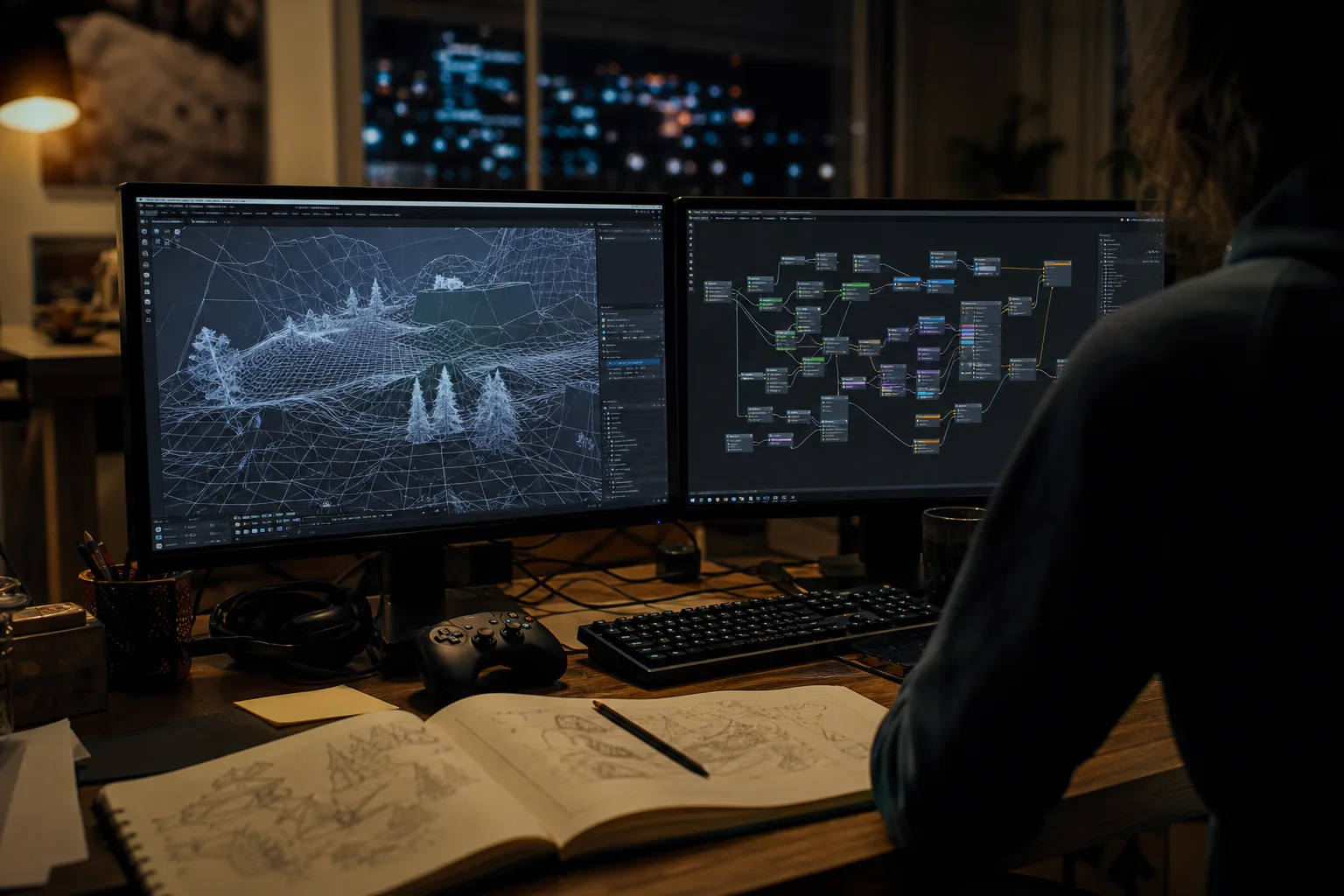
8. **Editor**: the visual workshop where designers build levels, place characters, adjust lights and test the game instantly.
A good engine lets an artist drop a model into a scene and see it lit and animated within seconds, and lets a designer change a jump height and try it without waiting for a programmer.
Sixty times a second
To understand what an engine does, it helps to follow a single frame, one of the still images that make up the moving picture on screen. A game running at 60 frames per second has about 16 milliseconds to produce each one; at 30 frames per second, about 33.
In that tiny window, the engine reads the controller to see what you pressed, updates the game's logic, moves every character and object, checks for collisions, decides what the enemies will do, updates the sounds and then tells the graphics card what to draw: which models, from which angle, with which lights and shadows. The graphics card then calculates the colour of millions of pixels. If any step takes too long, the frame arrives late, and players notice it as stutter or slowdown.
Much of an engine's design is about doing this efficiently: drawing only what the camera can see, using simpler models for distant objects, loading the world in pieces as the player moves through it, and spreading work across the many cores of modern processors.
Before engines
In the early decades of video games, most titles were written from scratch, often in low-level code tailored to a single machine. Hardware was limited and varied wildly, so programmers squeezed every byte of memory and every processor cycle. Reusing code was common within a studio, but there was no general-purpose engine you could buy.
Some studios built tools for their own series. LucasArts created a system called SCUMM, short for Script Creation Utility for Maniac Mansion, for its 1987 adventure game Maniac Mansion. It was reused for a string of classic adventures, including The Secret of Monkey Island, and allowed designers to write scenes and puzzles without dealing with the machine directly. Decades later, fans built a program called ScummVM that lets those games run on modern computers.
Engines for hire
The idea of selling an engine took off in the 1990s. The American studio id Software, creators of Doom in 1993 and Quake in 1996, began licensing the technology behind its games to other developers. Half-Life, released by Valve in 1998, was built on a heavily modified version of the Quake engine. That same year, Epic Games released Unreal and with it the first Unreal Engine, which it also licensed to other studios.
Alongside full engines, a market grew for middleware: specialised components that plug into an engine. Havok provided physics, SpeedTree generated realistic trees and forests, and tools such as FMOD and Wwise handled interactive sound. Many games list these technologies in their opening logos.
An engine is to a game what a camera and editing suite are to a film: it doesn't tell the story, but it shapes how the story can be told.
The big names today
9. **Unreal Engine**, from Epic Games: known for high-end graphics and used for *Fortnite* and many big-budget games, as well as in film and television production. Its current version, Unreal Engine 5, released in 2022, introduced systems for extremely detailed geometry and realistic real-time lighting. Its standard licence is free to start, with a 5 percent royalty on a game's gross revenue above the first million dollars.
10. **Unity**: launched in 2005 and very popular with independent and mobile developers, thanks to its accessibility and its support for many platforms. Games such as *Hollow Knight*, *Cuphead*, *Pokémon Go* and *Genshin Impact* were made with it. In 2023 Unity announced a new fee charged per installation of a game, which angered developers, who feared unpredictable costs; after months of protest, the company cancelled the fee in 2024.
11. **Godot**: free and open source, released publicly in 2014 under a permissive licence, with no fees or royalties at all. It was created by the Argentine developers Juan Linietsky and Ariel Manzur, and is now maintained by a community and a non-profit foundation. Its popularity grew quickly after Unity's controversy.
12. **GameMaker** and **RPG Maker**: simpler tools aimed at 2D games, beloved by solo creators. *Undertale*, the 2015 hit by Toby Fox, was made with GameMaker.
Engines that studios keep for themselves
Many large studios develop in-house engines, tuned for the kind of game they make.
13. **Frostbite**, created by the Swedish studio DICE for the *Battlefield* series, is used across many games published by EA, including its football series.
14. **RE Engine**, built by Capcom for *Resident Evil 7* in 2017, now powers many of its games, from *Resident Evil* remakes to *Street Fighter 6*.
15. **Decima**, created by Guerrilla Games for *Horizon Zero Dawn*, was shared with Kojima Productions for *Death Stranding*.
16. **RAGE**, Rockstar's engine, has powered the *Grand Theft Auto* series since *GTA IV*.
17. **CryEngine**, developed by Crytek in Frankfurt, became famous for the photorealistic graphics of *Far Cry* in 2004 and *Crysis* in 2007, which was so demanding that "But can it run *Crysis*?" became a running joke among PC gamers.
Owning an engine means no royalties, total control and technology tailored to your needs. But it also means paying a large team of engineers to maintain it, update it for new hardware and train new staff to use it. Some studios have decided the cost is too high. In 2022, CD Projekt, which built its own REDengine for The Witcher 3 and Cyberpunk 2077, announced that its next Witcher game would be made with Unreal Engine 5.
Mods, platforms and the players as builders
Engines are not only for professionals. Many games ship with their own editing tools, allowing players to build new levels, characters and even entirely new games, known as mods. Some mods became famous in their own right. Counter-Strike began in 1999 as a fan-made modification of Half-Life before Valve hired its creators and turned it into one of the most played competitive games in the world. Bethesda's role-playing games, such as Skyrim, have attracted tens of thousands of fan modifications, and Minecraft has inspired an entire culture of modding and building.
Some platforms go further and put a simplified engine at the heart of the product. Roblox lets millions of users, many of them young, create and share their own games inside a single platform, and some of those creators earn money from their work. In these cases, the line between playing a game and making one almost disappears.
Graphics, hardware and the race for realism
Engines also sit between the game and the hardware. They talk to graphics cards through standard interfaces such as DirectX on Windows and Xbox, Vulkan on many platforms and Metal on Apple devices, so that developers do not have to write separate code for every chip. Each new generation of consoles and graphics cards brings new possibilities that engines must support. Since 2018, consumer graphics cards have offered ray tracing, a technique that simulates how light rays bounce around a scene, producing more realistic reflections and shadows, and engines have gradually adopted it.
Why the choice matters
Choosing an engine is a long-term commitment. A game can take years to make, and changing engines halfway through is extremely costly. Studios weigh several factors:
18. **The type of game**: some engines excel at realistic 3D worlds, others at 2D or mobile games.
19. **The team's skills**: programmers and artists who already know an engine are faster with it, and job markets reflect this.
20. **Platforms**: not every engine supports every console equally well.
21. **Cost and licence**: royalties, subscriptions and fees can make a huge difference to a small studio's finances.
22. **Control and trust**: the Unity controversy reminded developers that the terms of a commercial engine can change. That has made open-source options more attractive, because no company can change the rules unilaterally.
Engines beyond games
Game engines have escaped the games industry. Film and television productions use them for virtual production: instead of a green screen, actors perform in front of giant LED walls displaying a digital world rendered in real time by an engine. The technique became famous with The Mandalorian in 2019 and is now widely used. Architects use engines to let clients walk through buildings before they are built, car makers to create online configurators, and engineers and city planners to build digital twins, real-time simulations of factories, airports or entire cities. Training simulators for pilots, surgeons and drivers often run on game engines too.
How to spot an engine
Engines leave clues. The logos at the start of a game often name the engine and the middleware. Experienced players also recognise visual signatures: the way light bounces, the look of skin and materials, the feel of character movement. Games made with the same engine can share a certain look, although talented teams can push any engine far beyond its default style. Hobbyists sometimes identify an engine simply from the structure of a game's files.
Engines as a door into game-making
For anyone curious about making games, engines have never been more accessible. Unity, Unreal and Godot are all free to download and learn, with huge libraries of tutorials, sample projects and assets. Game jams, events where people make a game in a weekend around a theme, are a popular way to start; the Global Game Jam, held every year since 2009, brings together thousands of participants around the world. Many professional developers began by tinkering with an engine at home.
Engines have also created their own professions. Engine programmers work on the core systems, such as rendering and physics. Tools programmers build the editors and pipelines that the rest of the team uses every day. Technical artists sit between art and code, writing the shaders that define how materials look and making sure that beautiful models still run fast enough. Job listings in the games industry often name a specific engine, and experience with Unreal or Unity has become a qualification in its own right, valued even outside games, in film, architecture and industry.
Why it matters to players
Engines explain a lot about the games we play. They help explain why games on the same engine often share a certain look or feel, and why an engine's strengths, such as big open worlds or detailed faces, guide what studios attempt. They explain why small teams can now make games that once required hundreds of people, and why a single company's licensing decision can shake an entire industry. Next time a game starts, watch the logos before the title screen: one of them is likely the engine underneath, the invisible foundation on which the whole world you are about to explore was built.