Why clothing sizes never match, and how to find yours
A 38 in one shop, a 42 in another, an M online. Where clothing sizes came from, why they drift, and the measurements that actually help.
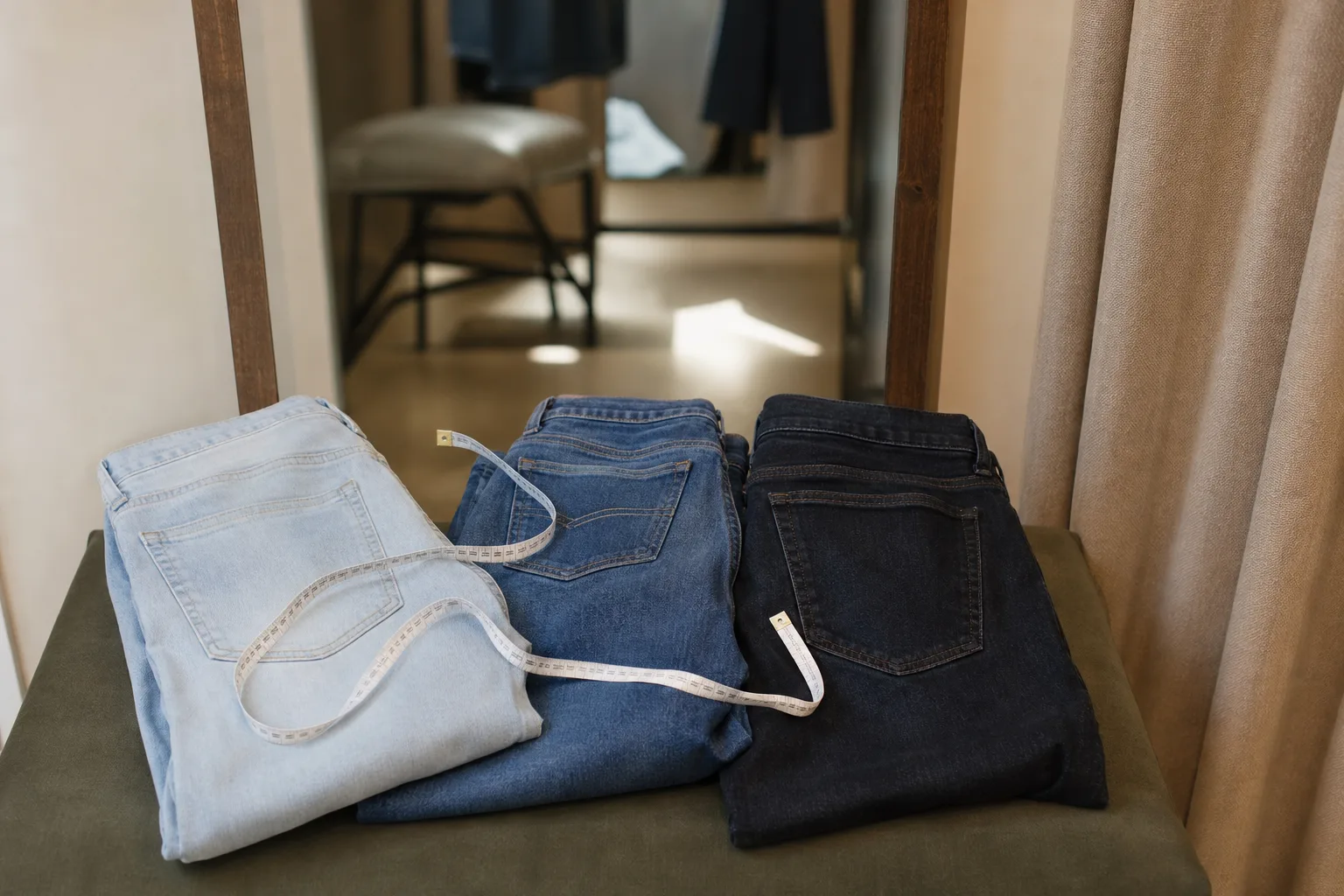
If you have ever taken three sizes of the same trousers into a fitting room, you are not alone. Clothing sizes are not a measurement in the way centimetres are. They are a promise each brand makes in its own way, and the promise keeps changing from shop to shop, from country to country and from decade to decade. A 38 in one store can be a 42 in another and an M online, and all three may fit you the same.
This guide explains where clothing sizes came from, why every country counts differently, why the numbers drift over time, and the measurements that actually help you buy clothes that fit.
Before sizes existed
For most of history, clothes were made to measure or sewn at home. A tailor or dressmaker took the customer's measurements and cut the fabric for that one body. Ready-made garments existed, especially simple items such as shirts and workwear, but most people's clothes were either handmade for them or handed down and altered.
Standard sizes arrived with mass production in the 19th and 20th centuries. Factories needed a set of patterns that would fit as many customers as possible, and shops needed a way to label them. Men's ready-made clothing developed earlier, helped in part by the need to make large numbers of military uniforms; women's clothing followed later, because fashions were more complex and fitted.
The first sizing studies
The first systematic attempts to create standard women's sizes came in the United States. In 1939 and 1940, a government study led by Ruth O'Brien and Meyer Shelton measured around 15,000 women across several states, taking dozens of body measurements from each. The aim was to create a sizing system based on real bodies rather than guesswork.
The data had flaws. Volunteers were paid a small fee, so poorer women were over-represented, and the sample included few women of colour. Still, the study became the basis for a national commercial standard published in 1958. The standard was revised but eventually withdrawn in 1983, and since then American brands have been free to set their own charts. Many countries went through similar processes, creating national standards that brands followed loosely or not at all.
Why every country counts differently
Europe never agreed on one system either, so the same dress has several numbers.
1. A German 38 is roughly a French or Spanish 40, an Italian 44, a British 12 and an American 8.
2. German women's sizes also come in **short sizes**, numbered by halving the normal size, so a 20 is a 40 for shorter women, and **tall sizes**, numbered by doubling, so an 80 is a 40 for taller women.
3. German men's sizes such as 50 roughly correspond to half the chest circumference in centimetres.
4. American and British men's shirts and jackets are labelled by chest or neck measurements in inches, and jeans often by waist and inside leg, as in W32 L34.
5. Children's clothes in much of Europe are sized by the child's height in centimetres, such as 116 or 128, a far more practical system.
6. Letters such as S, M and L mean nothing fixed at all: they depend entirely on the brand, and an M from an Asian brand may be an S from a European one.
Europe has a standard, EN 13402, which recommends labelling clothes with a simple pictogram showing the key body measurements in centimetres, such as chest, waist and height. Some brands print it on the label, but most still use their traditional numbers, often alongside a table of conversions.
Tailoring for men: suits, shirts and trousers
Men's clothing is often said to be simpler, because many items are labelled with actual measurements. That is only partly true. A suit jacket in Britain or the United States may be labelled 40R, meaning a 40-inch chest and a regular length, with S for short and L for long. In Germany, the same jacket might be a 50, or a 25 in the stockier short range, or a 98 in the slim long range. Shirts are sold by collar size, in inches in English-speaking countries and in centimetres in much of Europe, often with a sleeve length as well.
Trousers seem straightforward, with a waist and an inside-leg measurement, but even here vanity sizing has crept in: independent measurements of trousers labelled with a 34-inch waist have found many that were noticeably larger. And suits raise another issue, the drop: the difference between the jacket size and the trouser waist, which assumes a particular body shape and rarely matches athletic or heavier builds. That is why many men end up altering suits, or buying jackets and trousers separately.
Measuring whole populations
Since sizing depends on real bodies, several countries have carried out large modern measuring campaigns using 3D body scanners, which capture hundreds of measurements in seconds. Britain's SizeUK survey scanned around 11,000 people in the early 2000s, and SizeUSA a similar number shortly afterwards. In Germany, the SizeGERMANY study scanned around 13,000 people between 2007 and 2009. In Spain, the government organised a study that measured about 10,000 women in 2007 and 2008, with the goal of harmonising sizes among major brands.
These surveys confirmed what shoppers suspected: populations have changed since the old standards were set, people are on average taller and heavier, and bodies vary much more in shape than in size. A system with one number per size cannot capture that variety, which is why some researchers argue that sizes should be based on several measurements and body shapes, not just one.
Sizes beyond Europe and America
Clothing from Asian brands, which now reaches customers everywhere through online marketplaces, adds another layer of confusion. Japan, China and South Korea have their own national sizing standards, often based on height and chest or bust measurements, and garments made for those markets tend to run smaller than European or American equivalents with the same letter. Many experienced online shoppers buy one or two sizes larger from such brands, or ignore the label entirely and go straight to the measurements in centimetres.
Shoes: another maze
Shoes have their own systems, with equally strange origins. The British and American system is traditionally traced to the barleycorn, an old unit of a third of an inch, with each full size one barleycorn longer than the last. Continental European sizes use the Paris point, two thirds of a centimetre. Mexico and some other countries use sizes that roughly correspond to the length of the foot in centimetres, so a Mexican 25 fits a foot of about 25 centimetres, which is perhaps the most logical system of all. Because brands also use different shapes of last, the mould on which a shoe is built, the same size can still fit very differently.
Vanity sizing
Over the decades, many brands have made garments larger while keeping the same number on the label, so customers feel they wear a smaller size. This is called vanity sizing. It is why a size 10 today can be considerably bigger than a size 10 from the 1970s, why vintage clothes often run small, and why some brands now offer sizes such as 0 or even 00, which did not exist a few decades ago.
The practice is not mysterious. Shoppers often feel better buying a smaller number, and brands compete for their loyalty. But the result is a system where numbers have drifted so much that they carry little real information, especially when comparing brands.
The number on the label is marketing. The measurements in centimetres are information.
The body each brand imagines
Brands design for a fit model, a real person whose body is used to test every pattern before production. The patterns for other sizes are then created by grading: enlarging and reducing the base pattern by set amounts. But bodies do not grow in neat, even steps. If your proportions differ from the fit model's, for example if you have broader shoulders, a longer torso or wider hips relative to your waist, the brand's clothes may fit you badly in every size.
That is why many people find one label that always works and another that never does. It is not your body that is wrong; it is the match between your shape and the shape the brand imagined. Brands that target different customers, from teenagers to older adults, often use quite different fit models.
Size and the debate about bodies
Clothing sizes are also part of wider debates about body image. In 2006, Madrid's fashion week became one of the first to ban models below a minimum body mass index, after concerns about extremely thin models. Many brands have since expanded their size ranges and use models of different shapes in their advertising, although critics argue that plus sizes are still harder to find in shops and often cost more.
Size labels can carry emotional weight, and research on shopping behaviour suggests that a size number can affect how people feel about a garment, even when the fit is identical. Remembering that sizes are arbitrary industrial codes can take some of the sting out of a fitting room.
The cost of getting it wrong
Online shopping made the problem expensive. A large share of clothes bought online are returned, and poor fit is one of the most common reasons. Some customers order the same item in two or three sizes, keep one and send the rest back, a habit that creates costs, packaging waste and transport emissions. Germany is often cited as a country with particularly high return rates for online fashion.
Retailers have responded with size recommendation tools, which compare your past purchases, your height and weight or even a body scan with data from other customers. Results vary, but the best tools can reduce guesswork, especially within a single brand.
Vintage, second-hand and made to measure
Second-hand shopping, now hugely popular through charity shops and resale apps, makes sizes even less reliable. A dress from the 1960s labelled 14 may fit someone who wears an 8 or 10 today, and a garment may have been altered by a previous owner. Experienced vintage buyers ignore the label completely and compare the garment's measurements, taken flat, with a piece they already own. Good sellers list those measurements; if they do not, it is worth asking.
At the other end of the market, technology is bringing back an old idea: made to measure. Some brands now cut garments from a customer's own measurements, entered online or captured with a phone camera, at prices far below traditional tailoring. It is still a niche, but it points to a future in which the garment adapts to the body rather than the body to a number. For now, the most reliable tailor remains the one in your neighbourhood, who can turn an almost-right garment into a perfect one.
How to find your size
7. **Measure yourself once**, with a soft tape and in light clothing: chest or bust at the fullest point, natural waist, hips at the widest point, inside leg from the crotch to the floor, and, for shirts, neck circumference.
8. **Write the numbers down** and keep them on your phone. Update them every year or so.
9. **Always read the size chart** in centimetres, not the letter or number, especially when buying online.
10. **Check the fabric**: anything with elastane forgives a little; linen, non-stretch denim and wool do not. Knitwear and jersey stretch with wear.
11. **Measure a garment you love** lying flat, and compare it with the garment measurements in the product listing, if the shop gives them. This is often more reliable than body measurements, because it shows the intended ease and cut.
12. **Read the reviews** for comments such as "runs small" or "runs large", which are often more useful than the chart.
13. **Consider alterations**: a tailor can take in a waist or shorten trousers cheaply. Buying to fit the widest part of your body and adjusting the rest often gives better results than forcing a size.
Size is not a verdict
A size is a production code, not a judgement. Cut the label out if it bothers you; nobody can see it once you wear the clothes. What matters is how they fit: whether you can move, sit and breathe comfortably, whether the shoulders sit where your shoulders are, and whether you feel like yourself. Only the mirror and a measuring tape can tell you that, and with a few numbers in your pocket, every shop becomes a little easier to navigate.