All of Van Eyck's portraits, together for the first time in London
From November 21 the National Gallery gathers the surviving portraits by the Flemish painter who changed how we look at a face.
On November 21 London's National Gallery opens Van Eyck: The Portraits, an exhibition that brings together for the first time the surviving painted portraits by Jan van Eyck. It runs until April 11, 2027, according to the museum.
There are nine of them, gathered from across Europe, and together they make up half of all the works by Van Eyck known to survive. The museum presents the show as a one-off: the first and only time these panels can be seen side by side, in the ground-floor galleries.
Why it is an event
Very few works survive by Van Eyck, who was active in Bruges until his death in 1441. His portraits are spread among museums in several countries and almost never travel: they are small, fragile and immensely valuable panels.
Some are smaller than a sheet of paper, painted on oak with a precision that is best appreciated from a few centimeters away. Seeing them together allows something that has never been possible before: comparing how the painter solved the same problem — a face, a hand, a piece of fabric — over the course of a decade, and noticing the small repeated tricks, such as the painted frames that imitate stone or the inscriptions that look carved.
What Van Eyck changed
Before him, portraits were idealized profiles. Van Eyck turned his sitters three-quarters toward the viewer and painted what he saw: wrinkles, two-day stubble, veins at the temples. He perfected the technique of oil painting, applying very thin, transparent layers that give skin and cloth a glow tempera could not.
He also changed who was painted. The sitters in this exhibition are not, for the most part, kings and queens, but successful craftsmen, merchants and members of his own family. One of the most striking is the portrait of his wife, Margaret van Eyck (1439), who looks directly at us with a slightly skeptical expression; Van Eyck wrote on the frame that he had finished it when she was 33. Another, the Portrait of a Man in a Red Turban (1433), may be a self-portrait: the motto Als ich can appears on its frame.
Six centuries later, his sitters still look like people who have just stopped talking.
The most famous work
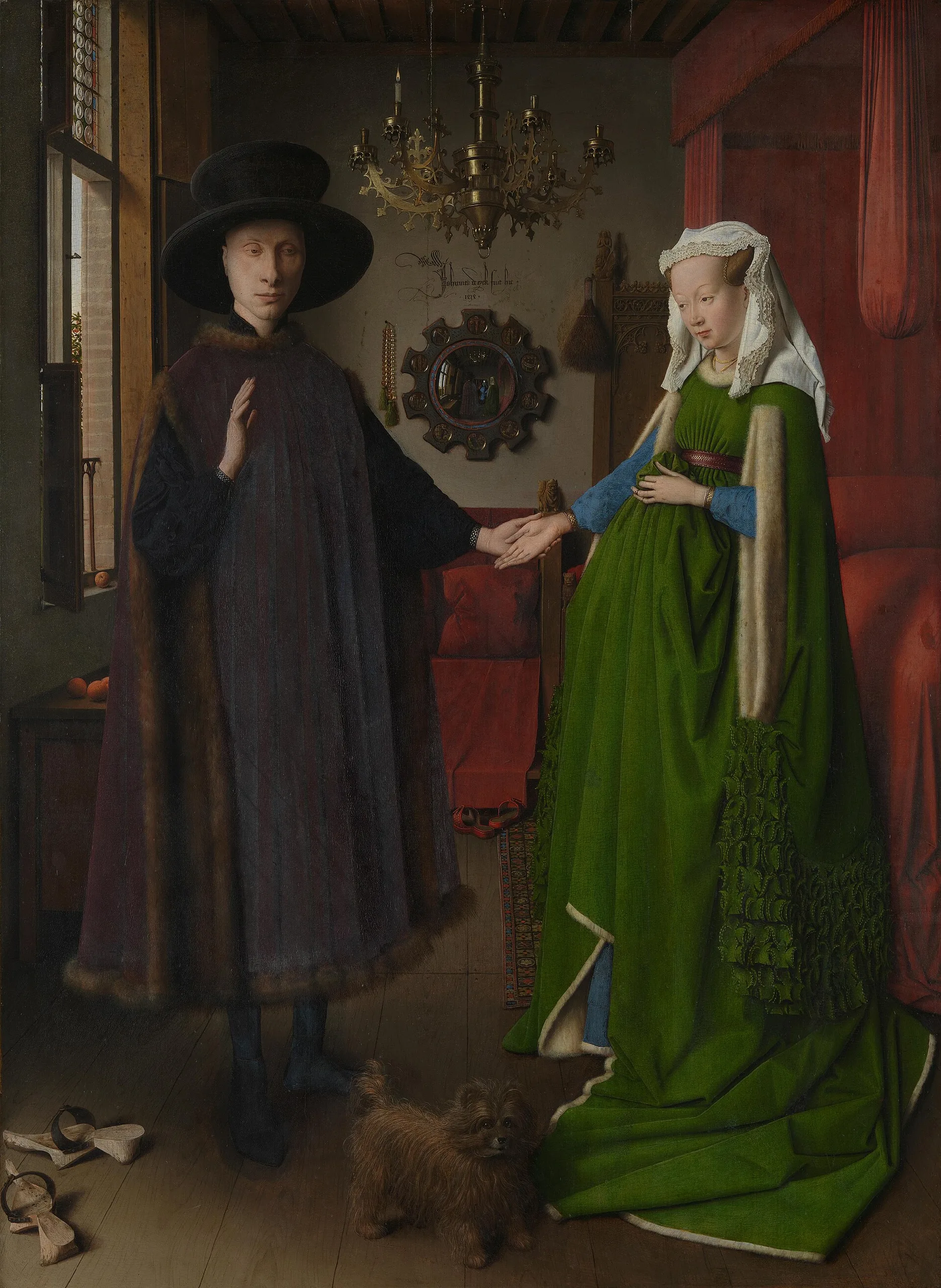
The Arnolfini Portrait (1434), from the National Gallery's own collection, shows a couple in a room in Bruges. Two more figures are reflected in the mirror at the back; above it, the painter wrote: "Jan van Eyck was here."
The painting has been the subject of endless theories: whether it records a marriage, a betrothal or simply a portrait of prosperity, and who the two figures in the mirror are. What no one disputes is its detail: the dog's fur, the oranges on the windowsill, the single lit candle in the chandelier and the convex mirror, which reflects the whole room in miniature. Seeing it next to the individual portraits helps explain how Van Eyck worked on such a small scale.
Before you go
It is wise to book a timed ticket: the museum expects high demand.
Standard admission costs £18 and includes an audio guide; under-18s go free, and National Gallery members do not pay. Bring patience, or a pair of reading glasses: many visitors spend long minutes in front of each panel, and the best details are tiny. The catalogue includes new research on the painter's technique, for those who want to go further.
Who he was
Jan van Eyck worked in Bruges as court painter to Philip the Good, Duke of Burgundy, for whom he also made diplomatic journeys. He died in 1441 and barely twenty of his works survive. He was among the first to sign and date his pictures, sometimes with a modest motto: Als ich can, "as I can." For centuries he was credited with inventing oil painting; he did not invent it, but he took it to a level no one had reached.
His other great work, the Ghent Altarpiece, which he completed in 1432 and is associated with his brother Hubert, is still in St Bavo's Cathedral in Ghent and does not travel. For anyone who falls for the portraits in London, a trip to Bruges and Ghent is the logical next step: the two cities keep the rest of the story.