'The Garden of Earthly Delights': a guide to not getting lost in Bosch
What happens in each panel of The Garden of Earthly Delights, which details to hunt for at the Prado, and why Bosch's triptych still resists a single meaning.
Culturera may earn a commission if you buy through the links on this page. As an Amazon Associate I earn from qualifying purchases. The selection is ours alone.
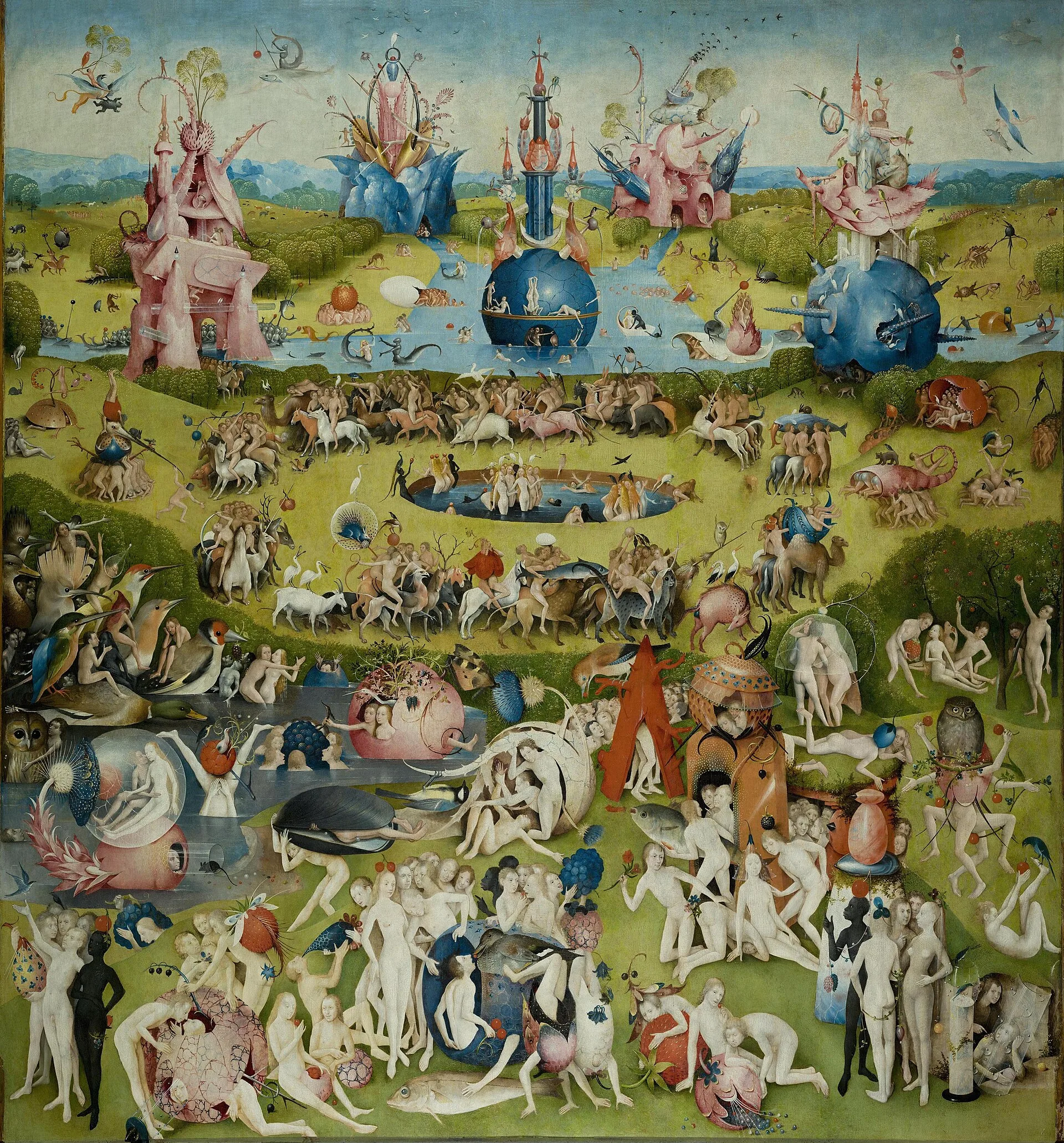
Bosch's The Garden of Earthly Delights is an oil-on-oak triptych painted around 1490–1500 and housed at the Museo del Prado in Madrid. Opened flat, it measures 220 by 389 centimetres, packing hundreds of tiny naked figures, oversized fruit, giant birds, and strange pink and blue structures across three folding boards.
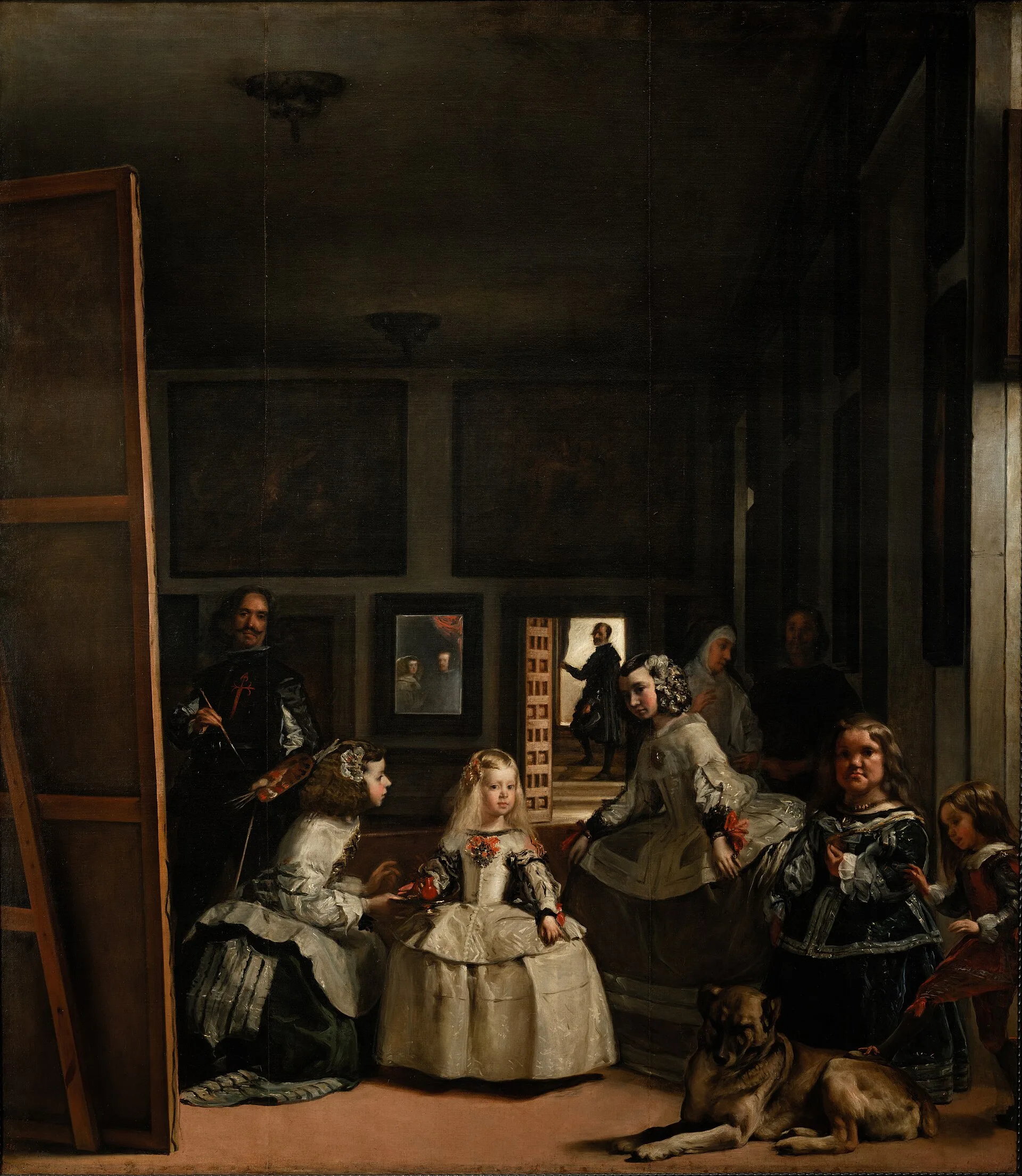
Unlike other famous works in the same museum, such as *Las Meninas*, Bosch gives the eye no single focal point to hold onto. Dozens of small episodes unfold at once across three worlds with sharply different moods. Without a rough map, it is easy to stand in front of the triptych for ten minutes and still wonder where to begin.
Key facts
Artist: Jheronimus (Hieronymus) Bosch, born Jheronimus van Aken (c. 1450–1516), who took his name from his home town of 's-Hertogenbosch in the Netherlands.
Date: The Prado dates it to 1490–1500. Scholars have argued for dates anywhere from c. 1480 to 1515, while dendrochronology dates the oak boards' wood to 1460–1466, establishing only the earliest possible window.
Medium: Oil on oak panel, with the exterior painted in grisaille (shades of grey).
Dimensions: 220 × 389 cm open. The centre panel measures 220 × 195 cm, and each wing measures roughly 220 × 97 cm, painted on both sides so they fold shut over the middle.
Location: Museo Nacional del Prado, Madrid, room 56A in the Villanueva Building. It entered the Prado in 1939 as a deposit from Patrimonio Nacional.
Closed: the grisaille exterior
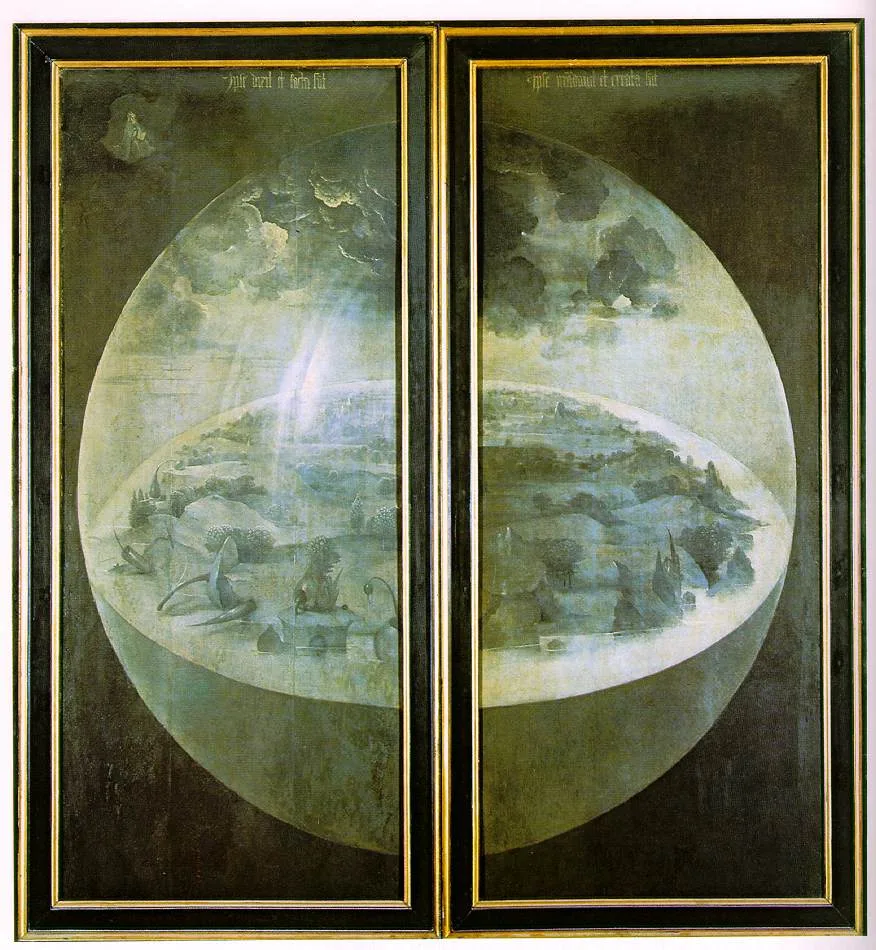
Close the two side wings over the centre and all the colour vanishes. What remains is a quiet, grey-green grisaille showing Earth as a flat disc of land, trees, rocks, and water sealed inside a transparent sphere under heavy clouds.
The exterior is usually read as the third day of Creation, a young world of plants and minerals with no people or animals yet, painted in greys because neither sun nor moon has been made. In the top-left corner, a tiny God wearing a tiara holds a book beneath Latin verses from Psalms 33 and 148: "Ipse dixit et facta sunt" ("He spoke and they were made") and "Ipse mandavit et creata sunt" ("He commanded and they were created"). Some scholars read the sphere differently, seeing the Earth after the Flood instead.
Left panel: Paradise
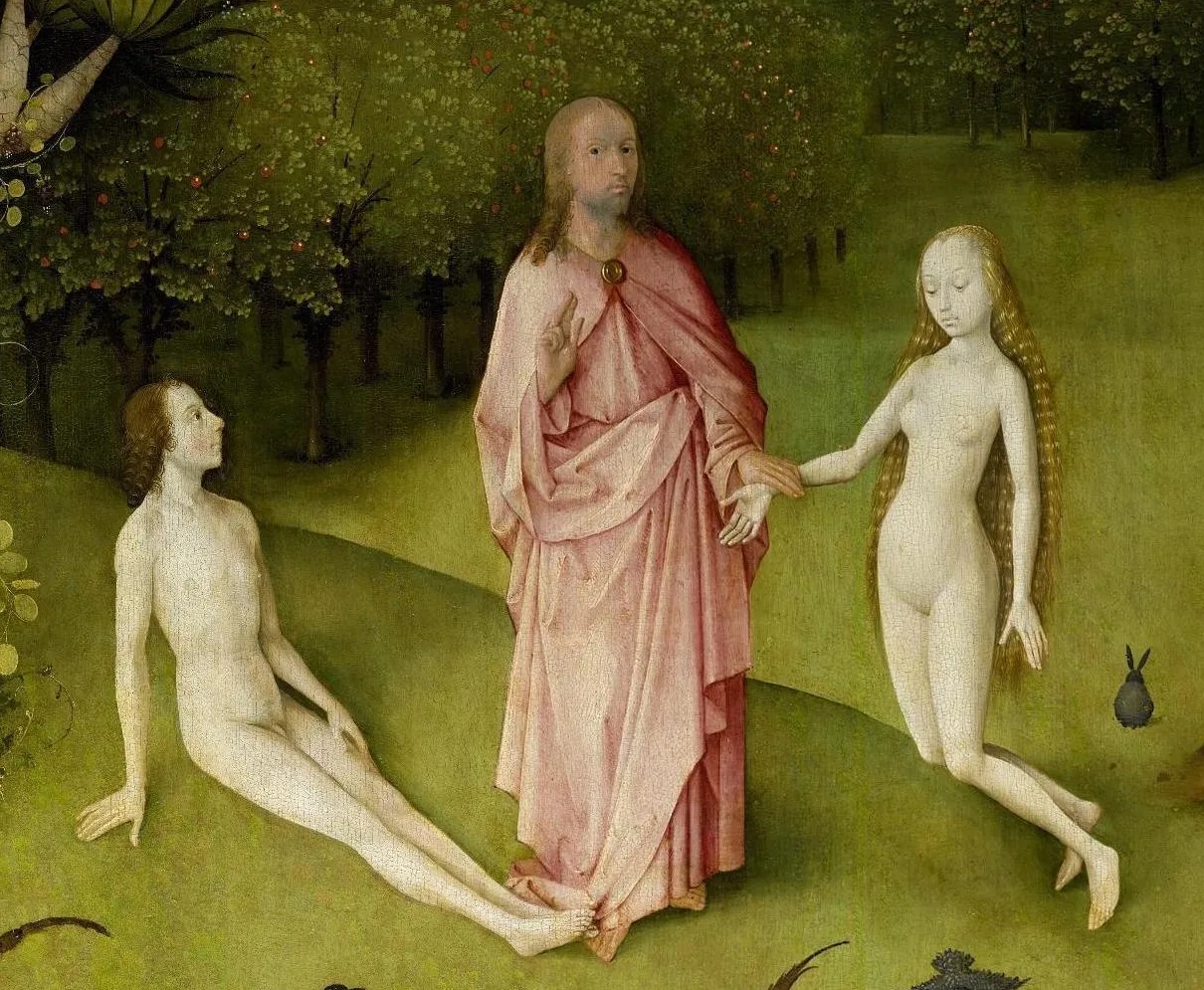
Open the wings and the left panel greets you with a bright green Eden. In the foreground, God, painted with Christ's features in a long pink-red robe, presents the newly created Eve to an awake, reclining Adam. Holding Eve by the wrist is an unusual touch with no source in Genesis. Beside them stands a dragon tree representing the Tree of Life, and behind them rises a palm wrapped with the serpent, the Tree of Knowledge.
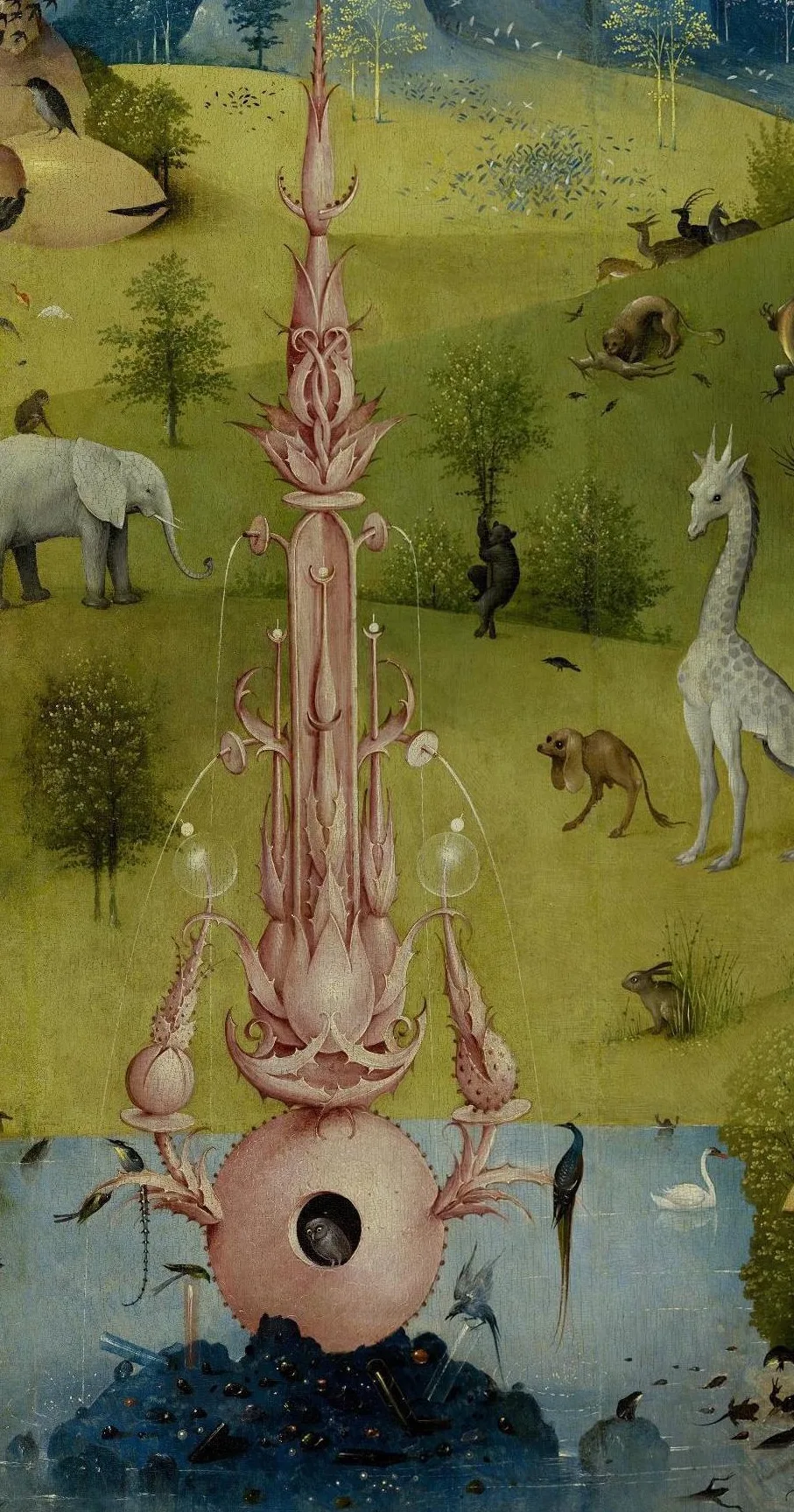
At the centre of the panel rises the pink, plant-like Fountain of Life, standing in a pond surrounded by exotic animals Bosch could only have known from books and prints, including an elephant and a white giraffe. Even here, paradise is not entirely peaceful. A lion kills a deer, creatures eat one another, a rock to the right of the fountain forms a hidden face, and an owl stares out from a hole in the fountain's base, a bird commonly read as a symbol of heresy or malice that also appears in The Haywain.
Centre panel: the garden
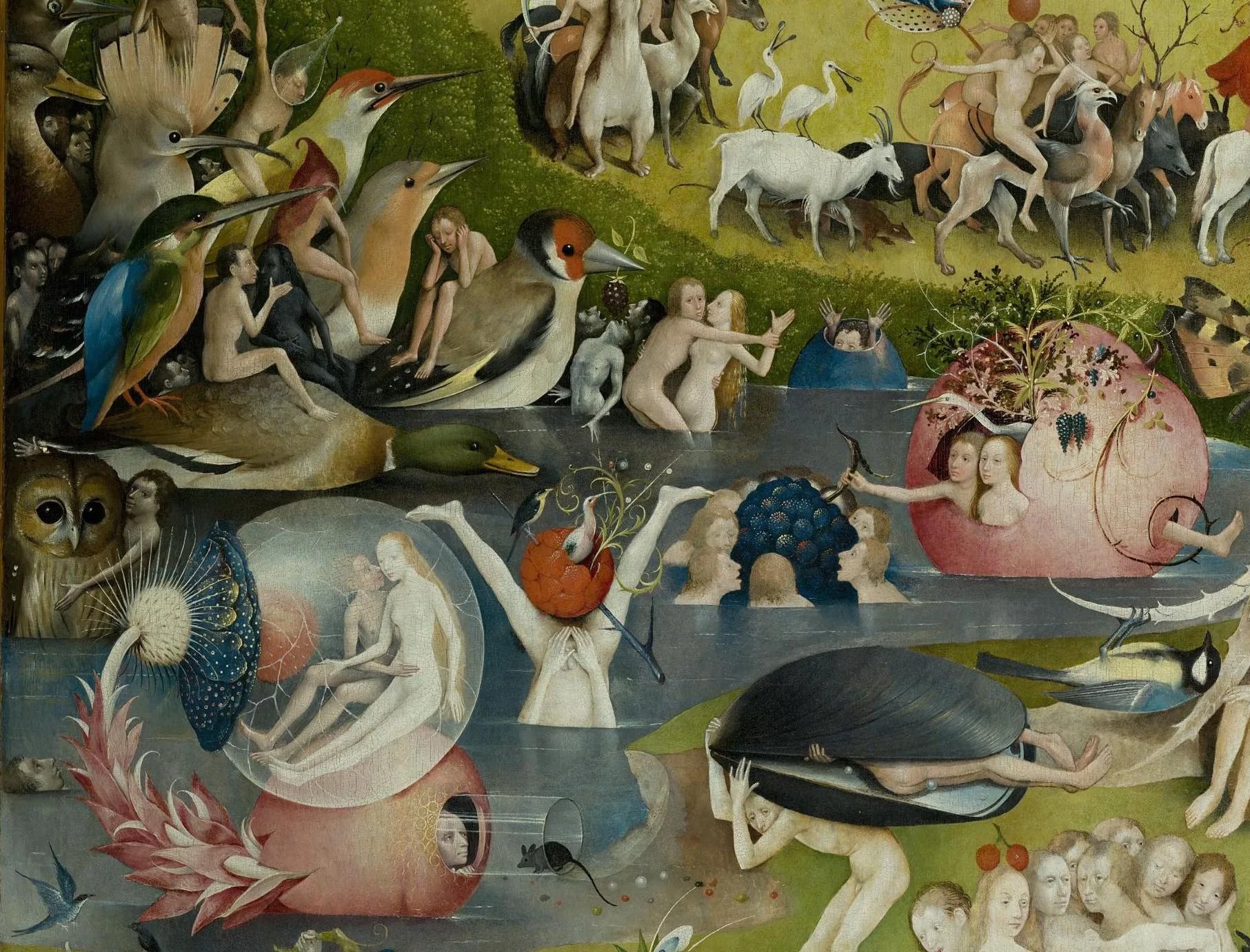
The broad centre panel swarms with hundreds of naked men and women, both Black and white. There are no children, no elderly people, no work, and no illness anywhere in sight. At the top, a pond crowned by a blue globe feeds four rivers, read as the four rivers of Paradise. Below it, a ring of naked men rides horses, bears, unicorns, camels, deer, a boar, and griffins around a central pond where women bathe.
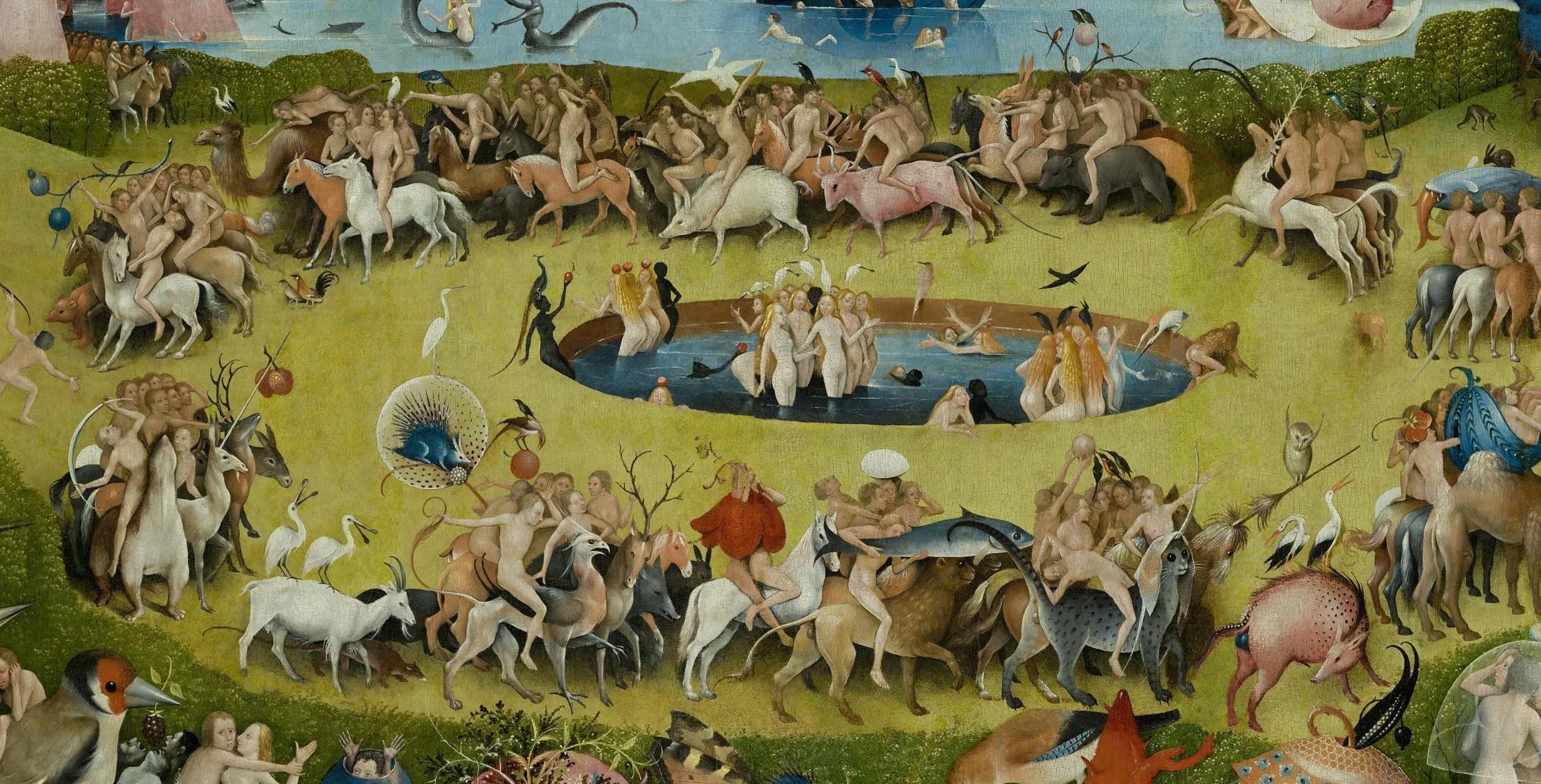
Giant birds perch beside tiny figures, and people cluster around enormous strawberries, cherries, raspberries, grapes, and strawberry-tree berries. In medieval speech, "picking fruit" could mean sex, and fruit also spoils fast, making it an apt emblem of fleeting pleasure. Couples slip inside transparent bubbles, mussel shells, and glass structures that recall alchemical flasks. Animals dwarfing humans and figures flipped upside down echo the "world upside down" motif found in Sebastian Brant's Ship of Fools and Erasmus's Praise of Folly.
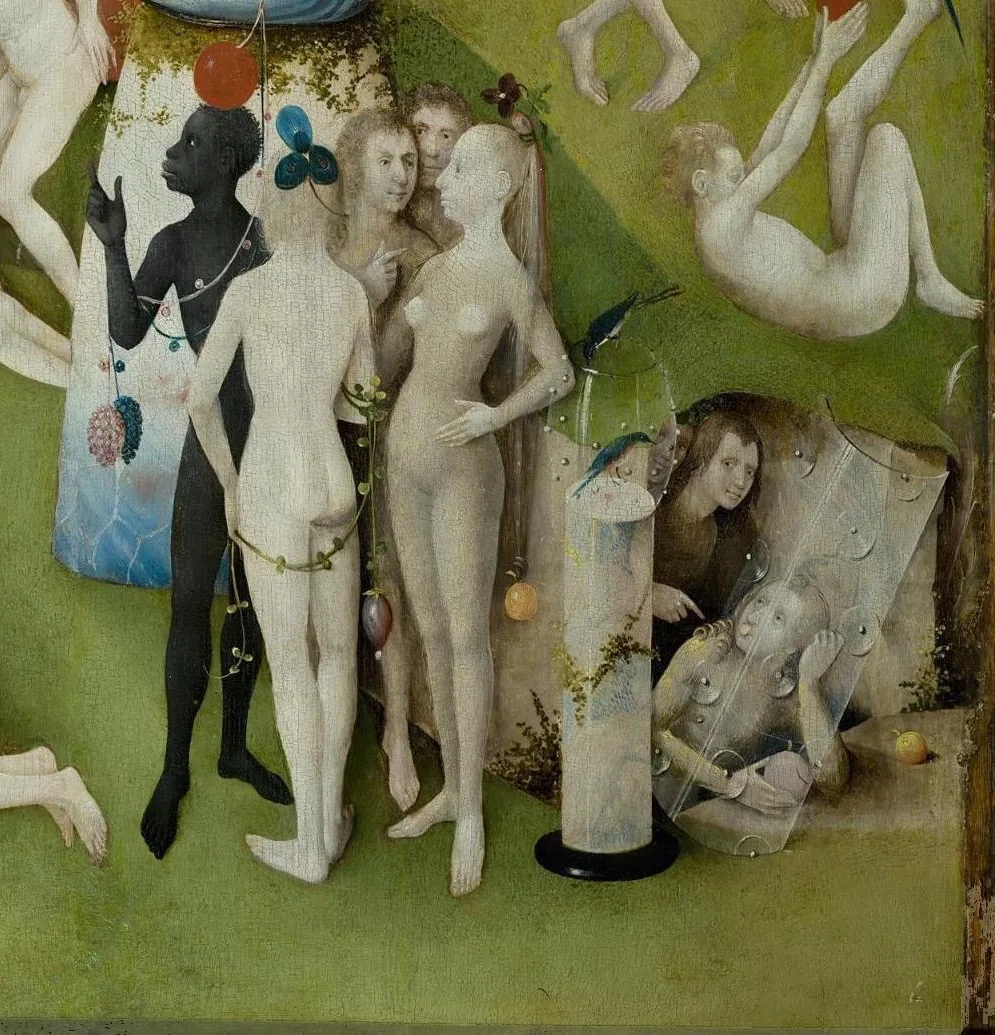
Down in the bottom-right corner, the crowd gives way to a pointed, quieter riddle. From the mouth of a cave, a man, the only clothed figure in the entire panel, looks straight out at the viewer while pointing at a woman sheltered behind a glass pane who may be Eve. Scholars have proposed that he is Adam or John the Baptist.
Right panel: Hell
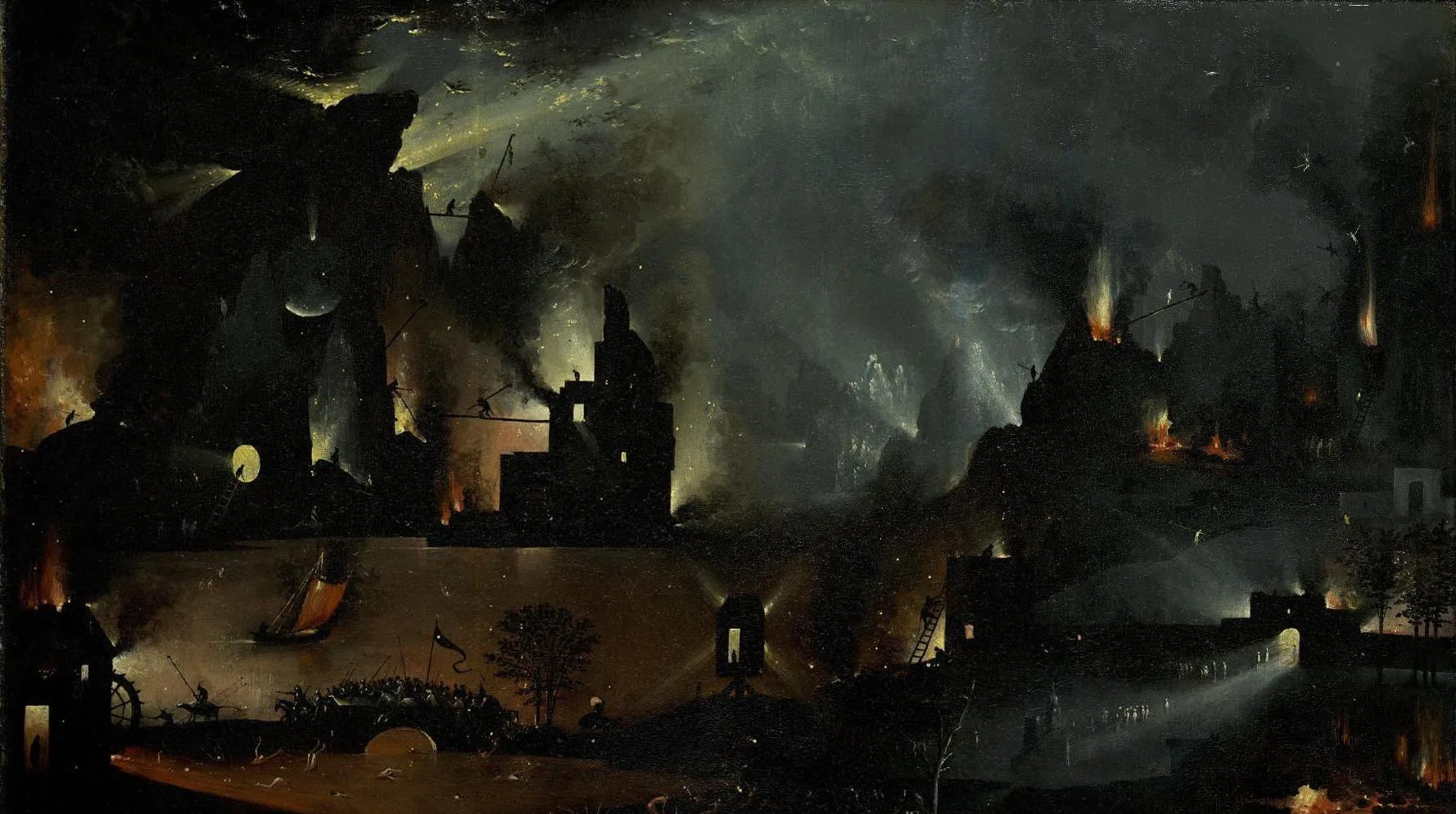
The right wing, often called the "musical hell", plunges the triptych into night. Along the top, a dark city burns with fires and sharp beams of light.
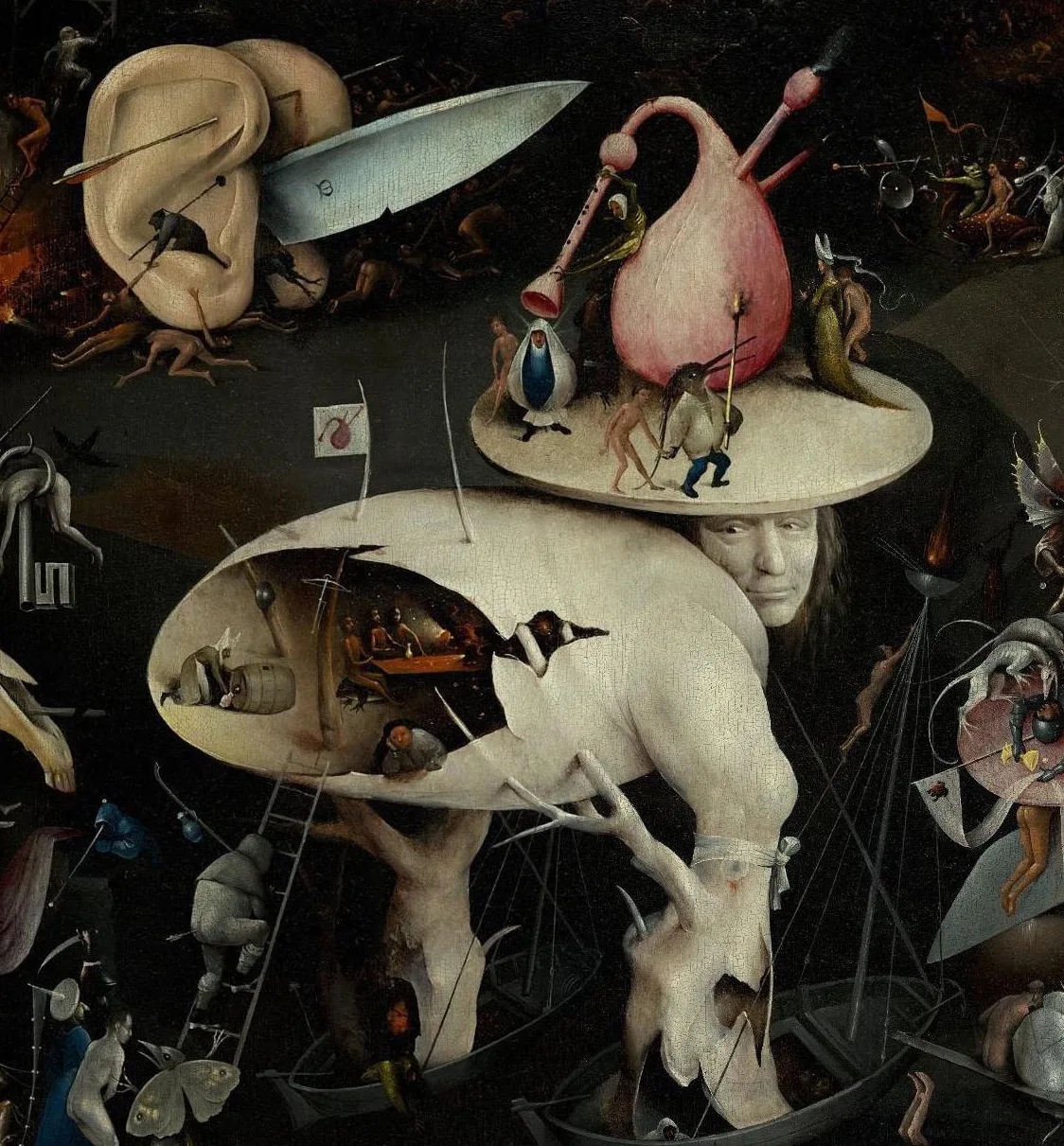
Controlling the middle of the panel is the Tree-Man, whose pale, hollow torso resembles a cracked eggshell housing a tavern inside. His legs are tree trunks planted in boats, small figures dance around a pink bagpipe on a disc balanced on his head, and his face looks back toward the viewer, an expression often read as a possible self-portrait, though unproven. To his left, two giant ears advance with an arrow piercing them and a knife blade wedged between them. Beneath him, the damned skate across a frozen lake and plunge through the ice, pairing heat with biting cold.
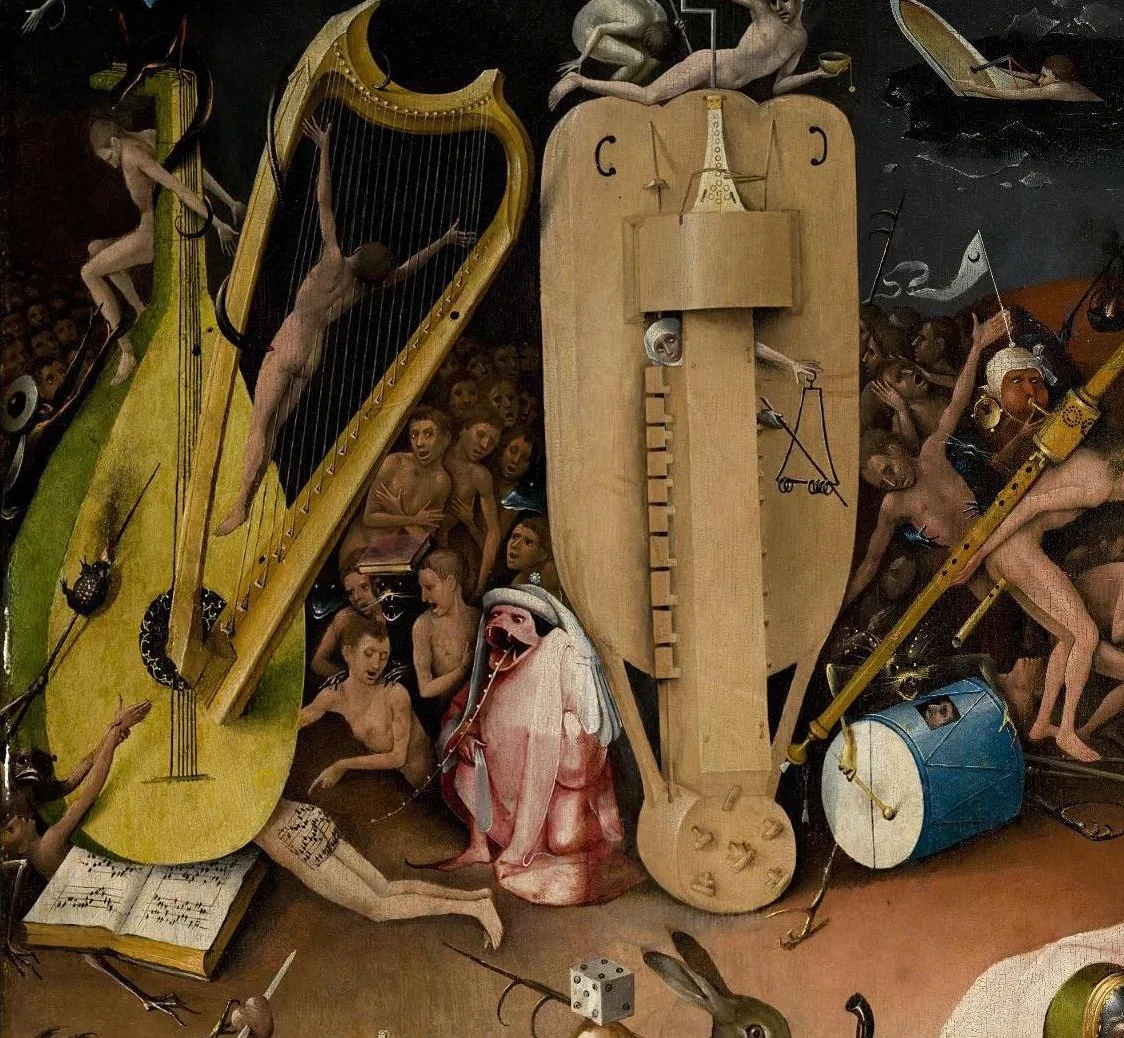
Lower down, giant musical instruments serve as torture devices: a harp with a body stretched across its strings, a lute, a hurdy-gurdy, and a drum. Beneath the lute, a sinner lies face down with musical notes painted across his buttocks beside an open music book. In February 2014, Amelia Hamrick, a student at Oklahoma Christian University, transcribed the "butt music" into modern notation and posted a recording that went viral. Music historian Ian Pittaway (Early Music Muse, 2021) argues that it is not a playable piece in the notation of Bosch's period, so the "600-year-old song" is best heard as a modern reading rather than Bosch's own composition.
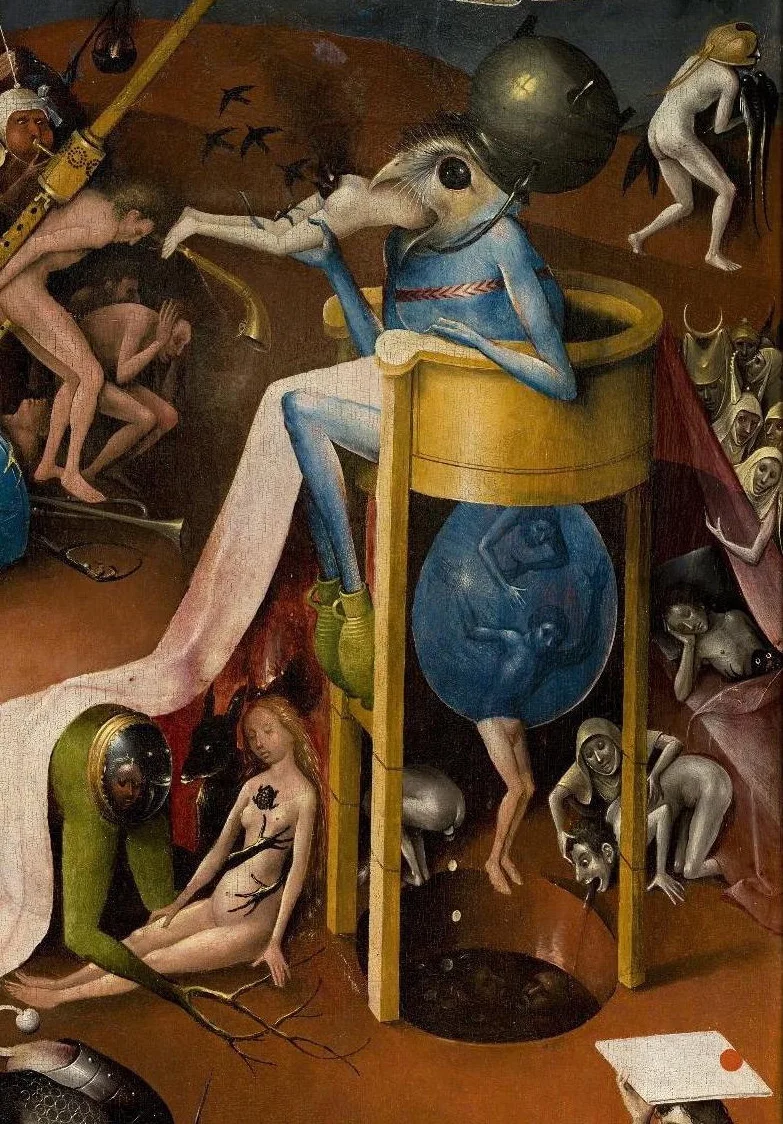
In the lower right sits a blue bird-headed monster wearing a cauldron on its head and perched on a high close-stool, often called the "Prince of Hell" or read as Satan. It swallows sinners whole and expels them into a dark pit below. Elsewhere in Hell, Bosch assigns targeted punishments: a woman is forced to stare at her reflection in a convex mirror on a demon's backside for pride, gamblers are tormented amid dice, cards, and a backgammon board, and a pig in a nun's veil embraces a man.
Eight details to look for
Whether you are standing in the gallery or zooming in on a screen, these eight spots make a good trail across the work:
1. The tiny Creator on the outer wings. Check the top-left corner of the closed grisaille exterior to find God in a tiara holding a book above the globe.
2. The owl inside the pink fountain. Near the middle of the left panel, look closely at the circular opening in the Fountain of Life's base where an owl peers straight out.
3. The face hidden in stone. Just to the right of that fountain in Paradise, a craggy rock subtly forms a human face.
4. The four rivers at the summit. Along the top edge of the centre panel, four streams spill outward from a pond topped with a blue sphere.
5. The only dressed figure in the garden. Look to the bottom-right corner of the centre panel for the lone clothed man looking out of a cave toward the viewer.
6. The blade wedged between giant ears. Midway down the right panel, directly to the left of the Tree-Man, an arrow pierces two huge ears flanking a knife.
7. Skaters breaking through the ice. Beneath the Tree-Man in the Hell panel, tiny figures glide over a frozen lake and drop through cracks in the surface.
8. The musical notes under the lute. At the bottom left of Hell's instrument cluster, right beside an open score, a prone sinner carries a stave painted across his skin.
What does it mean?
The earliest writer to analyse the triptych was Fray José de Sigüenza in 1605. He described Bosch's work as "a painted satire of the sins and follies of men" and laid down the traditional left-to-right reading: Creation, humanity lost in lust, and eternal punishment.
"Others tried to paint man as he looks from outside; he alone dared to paint him as he is inside." (Fray José de Sigüenza, 1605)
Modern scholarship has pulled the centre panel in very different directions. Wilhelm Fraenger argued that it celebrated the ideals of the heretical Adamite sect, a reading no longer accepted today. In 2001, Paul Vandenbroeck interpreted the garden as the "Mountain of Venus", a false paradise, while Juan Antonio Ramírez read it as Paradise as it would have been had the Fall never happened.
For Reindert Falkenburg, cited by the Prado, the triptych's overarching subject is the fate of humanity, much like The Haywain. After five centuries, there is still no scholarly consensus, and that refusal to settle into a single moral diagram is part of why people keep returning to it.
How it reached the Prado
The triptych was probably painted for Henry III of Nassau-Breda, a conjecture going back to Gibson and followed by Hans Belting. In 1517, Antonio de Beatis saw it in the Nassau palace in Brussels while travelling with Cardinal Luis de Aragón, noting "things so pleasing and fantastic that they could never be described to anyone who had not seen them". It passed by inheritance to René of Châlon and then to William of Orange.
Confiscated by the Duke of Alba (recorded in an inventory of 20 January 1568), it went to his son Don Fernando de Toledo, prior of the Order of St John. Philip II, who acquired nine works by Bosch in all, bought it at the sale of Don Fernando's estate and sent it to El Escorial on 8 July 1593. Today's title is not Bosch's: the 1593 inventory called it a painting "de la variedad del mundo... que llaman Del Madroño" (the strawberry-tree painting), a 1700 listing called it "de la creación del mundo", and in 1857 Vicente Poleró named it "De los deleites carnales", from which the modern title derives. Moved to the Prado in 1939 at the end of the Spanish Civil War for restoration, it never returned to El Escorial.
What we don't know about Bosch
The basic record of Bosch's life is strikingly thin. Born Jheronimus van Aken around 1450 in 's-Hertogenbosch and dead by 1516, he left behind no letters, no written explanations, and not a single dated painting.
That silence is why scholars still debate whether The Garden of Earthly Delights belongs to his youth or his late career. What we do know is that he was copied and imitated early on, clear proof that his strange visual language found an eager audience in his own lifetime.
Seeing it at the Prado
The triptych hangs in room 56A of the Prado's Villanueva Building alongside Bosch's The Haywain and the Table of the Seven Deadly Sins. The renovated Bosch room features new supports for three triptychs, updated lighting, and a screen showing enlarged details, which helps when small passages sit out of easy range. According to the museum, standard hours are Monday to Saturday 10:00–20:00 and Sundays and holidays 10:00–19:00; check the Prado's official website for current hours, tickets, and free-entry times before you go.
If you'd rather skip the ticket line or have someone walk you through the rooms, GetYourGuide sells Prado tickets and guided tours, including a guided tour with a skip-the-line ticket. Before you book, check the description to see whether the route includes the Bosch room.
Arrive early or late in the day if you want breathing room, and pick one panel to explore properly instead of trying to decode all three at once. If you plan to pair Bosch with other intense stops in the museum, like Goya's Black Paintings, our guide on how to visit a museum without ending up exhausted will help you pace the afternoon.
The Garden of Earthly Delights opens up the moment you stop treating it as a puzzle with one neat key. Pick a single corner, follow the small joke or threat next to it, and let Bosch keep the rest of his secrets.