Dubbing or subtitles: why each country chose a side
In Madrid and Berlin, Hollywood stars speak the local language. In Lisbon and Amsterdam, they keep their own voices. The history behind the split.
Watch a Hollywood film in Madrid, Mexico City, Berlin and Amsterdam on the same evening and you will have four different experiences. In Madrid and Berlin, the actors will almost certainly speak Spanish and German, with voices that locals have known for decades. In Mexico City, you will probably be asked at the ticket office whether you want the dubbed or the subtitled version. In Amsterdam, you will hear the original English and read Dutch subtitles at the bottom of the screen.
These differences are not accidents of taste. They grew out of economics, politics and history, and they continue to shape how millions of people experience films and series, and even how well they speak foreign languages.
Three ways to cross a language barrier
There are three main ways to make a film understandable in another language.
1. **Dubbing**: the original dialogue is replaced by a new recording in the local language, performed by voice actors and timed to match the lip movements on screen as closely as possible.
2. **Subtitling**: the original sound stays, and a written translation appears at the bottom of the screen.
3. **Voice-over**: the original sound is lowered, and a narrator reads a translation on top of it, often with the original still faintly audible. In Poland, a single narrator, known as the **lektor**, traditionally reads every line for every character in films and series shown on television.
Each approach has defenders and critics. Dubbing lets viewers watch the images without reading, but replaces the actors' voices. Subtitles keep the original performance, but force the eye to the bottom of the screen and condense the dialogue. Voice-over is cheap and quick, but most outsiders find it strange.
The arrival of sound
The question did not exist in the silent era. Intertitles, the cards of text between scenes, could simply be replaced with translated cards, and a film could travel anywhere. Then, at the end of the 1920s, sound arrived, and suddenly the actors spoke a particular language.
Hollywood's first answer was to shoot multiple-language versions: the same film, on the same sets, re-filmed with different casts speaking Spanish, French or German. A famous example is the Spanish-language version of Dracula from 1931, shot at night on the same sets as the English version with Bela Lugosi. The method was expensive and short-lived. Within a few years, technology made it possible to record new dialogue and mix it with the original music and sound effects, and dubbing as we know it was born.
Why some countries dub
A common rule of thumb in the industry is that dubbing costs many times more than subtitling. A full dub requires translators, adapters who rewrite the lines to fit the lip movements, a dubbing director, studio time and a cast of actors. Only large language markets can recover that cost through ticket sales and broadcasting. That is why the biggest dubbing countries in Europe are the ones with the largest audiences: Germany, France, Italy and Spain, sometimes grouped together in the industry as the FIGS markets.
Politics also played a role. In the 1930s and 1940s, several authoritarian governments saw dubbing as a tool to protect the national language and to control what audiences heard.
4. **Italy**: in 1930, Mussolini's government banned the screening of films spoken in foreign languages, which made dubbing the norm.
5. **Spain**: in 1941, an order from Franco's government made it compulsory to dub foreign films into Spanish. The obligation was relaxed within a few years, but by then the industry, the audience and a generation of voice actors were built around dubbing.
6. **Germany**: dubbing was already established in the 1930s, and after the Second World War it became the standard way to show the many American films that reached West Germany.
Dubbing also made censorship easy. In Spain, the most famous example is the 1953 film Mogambo: to avoid showing adultery, the Spanish dialogue turned a married couple into siblings, which made the story far more disturbing than the original. In West Germany, the first dubbed version of Casablanca, released in 1952, removed every reference to the Nazis. A complete, faithful German version was recorded only in 1975.
Dubbing began as a technical solution and became, in some places, a political one. The habit outlived the politics.
Why other countries subtitle
Smaller language markets made the opposite choice, mostly for economic reasons. In the Netherlands, Belgium's Flemish region, the Nordic countries, Portugal and Greece, the audience for any single film was too small to justify the cost of dubbing, so subtitles became the norm in cinemas and on television. Children's films and cartoons are the main exception, because young children cannot yet read quickly.
Portugal is a revealing case. Despite being a dictatorship for much of the 20th century, it moved away from dubbing and became a subtitling country, partly, according to many historians, to protect Portuguese from the influence of the Spanish dubbed versions that could easily cross the border.
Latin America: a bit of both
Latin America has its own tradition. Mexico became the region's main dubbing centre from the mid-20th century, producing Spanish versions of films, cartoons and series for the whole continent in a deliberately neutral accent, sometimes called español neutro. Generations of viewers grew up with the same Mexican voices for cartoon characters, film stars and anime heroes. Argentina, Venezuela, Colombia and Chile also developed important dubbing industries.
At the same time, cinemas in Mexico and much of Latin America show many films for adults in the original language with subtitles, and offer dubbed screenings alongside them, especially for family films and blockbusters. Mexican film law has long stated that films should be shown in their original version with subtitles, while allowing dubbing for children's films and educational documentaries; in practice, audiences now choose between both options for most big releases.
The famous voices
In dubbing countries, voice actors can become celebrities in their own right, even if their faces are unknown. For decades, German audiences heard Arnold Schwarzenegger and Sylvester Stallone speak with the same voice, that of Thomas Danneberg, which led to the odd situation of the two action heroes sharing a voice when they appeared together. Christian Brückner has been Robert De Niro's German voice for many films. In Spain, the deep voice of Constantino Romero gave life to Darth Vader and to Clint Eastwood.
When a familiar voice changes, audiences notice. In Latin America, when the actor who had voiced Homer Simpson for many years was replaced in 2005 after a labour dispute, many fans complained that the character no longer sounded like himself. For many viewers, the dubbed voice is not a substitute: it is the character.
The craft of dubbing
Good dubbing is much harder than it looks. The translated line must sound natural, mean the same thing, fit the length of the original and, in close-ups, match the movement of the lips. Sounds such as p, b and m, which close the lips, are especially tricky: if the actor on screen closes their mouth, the dubbed line ideally has a similar sound at that moment. Adapters juggle these constraints, sometimes rewriting jokes completely so they still work in another language.
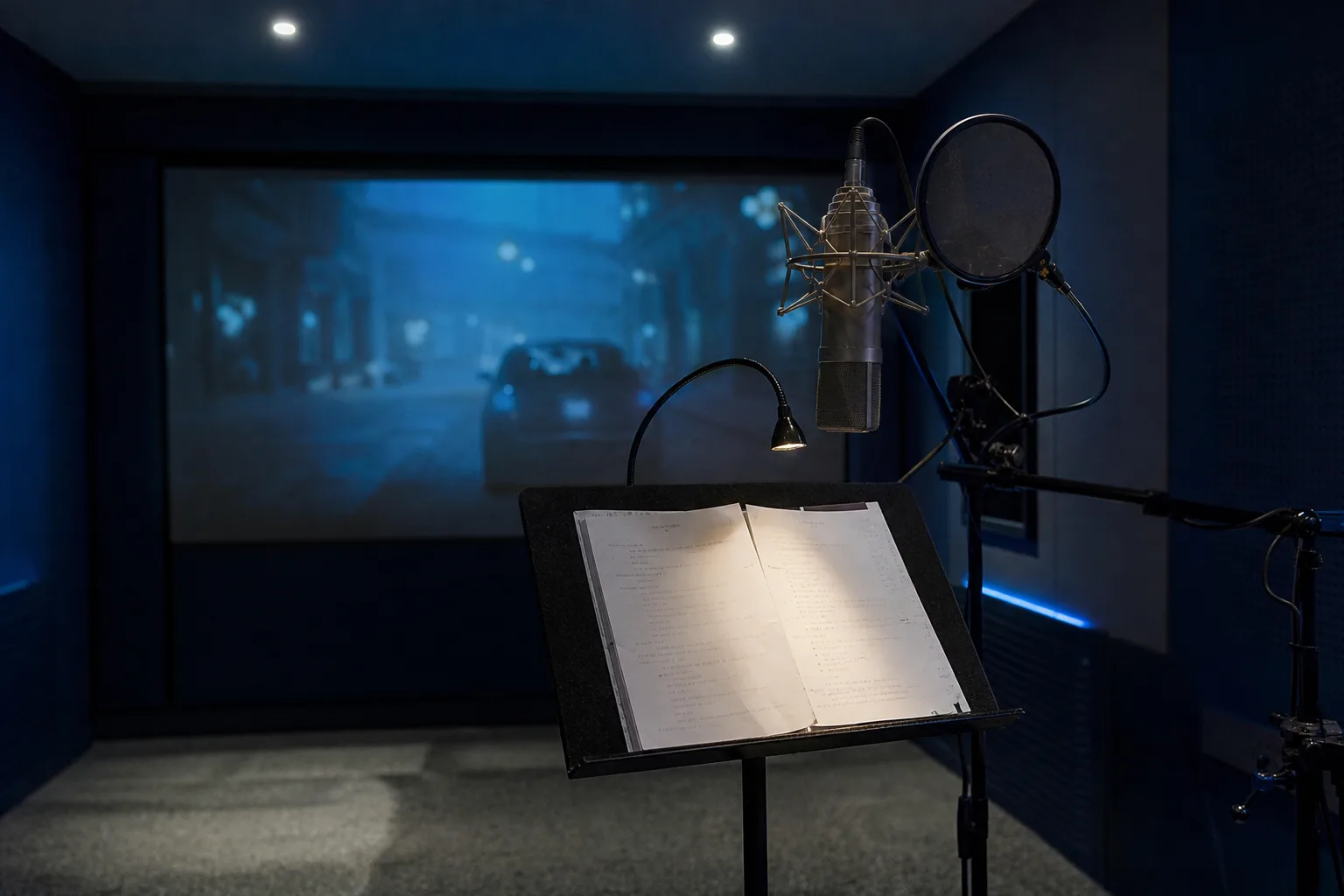
Voice actors then record their lines in short loops, often without the other actors in the room, watching the scene on a screen and listening to the original through headphones. A skilled dubbing actor can match breathing, pauses and emotional pitch so precisely that viewers forget they are watching a translation.
Animation, songs and local stars
Animation is the one area where almost every country dubs, because the audience includes children who cannot read subtitles. It is also where dubbing becomes most creative. Since there are no real lips to match, only drawn or animated mouths, adapters have more freedom, and jokes, puns and cultural references are often rewritten for each market.
Songs are a special challenge. In big animated musicals, the songs are usually translated and recorded again by local singers, who must fit new lyrics to the same melody and, where possible, to the same mouth shapes. When Frozen became a global hit in 2013, Disney released a video of its song Let It Go stitched together from versions in 25 languages, showing how many different voices had given life to the same character.
Studios also often hire local celebrities to voice animated characters, from popular actors to television presenters and comedians, because a familiar name helps sell tickets. Professional voice actors sometimes criticise the practice, arguing that fame is no substitute for training, but it has become a standard part of marketing family films in many countries.
The craft of subtitling
Subtitling has its own rules. Subtitles usually have a maximum of two lines, and professional guidelines limit the number of characters per line, often to around 40. They also limit reading speed, so that viewers have time to read each subtitle and still watch the image. As a result, subtitles almost always condense dialogue: people speak faster than they can comfortably read, so repetitions, hesitations and some details disappear.
Subtitlers also have to decide how to handle jokes, songs, slang and signs in the image. A good subtitle is invisible: it gives you what you need and lets you go back to the faces on screen.
Does subtitling help you learn languages?
It is often said that people in countries that subtitle speak better English, and international rankings of English proficiency do tend to place the Netherlands and the Nordic countries near the top. Researchers agree that daily exposure to the original sound helps, especially for listening and pronunciation. But they also point out that many other factors play a role, from how English is taught in schools to how similar the local language is to English, and how useful English is in daily life in a small country.
What most language teachers agree on is that watching something you enjoy in the original version, with subtitles in your own language or in the language you are learning, is one of the most pleasant ways to improve.
What streaming changed
Streaming platforms have shaken up old habits. Services such as Netflix release films and series in many languages at once, often with dubbing and subtitles in dozens of languages, and let each viewer choose. For the first time, a viewer in a dubbing country can easily watch in the original, and a viewer in a subtitling country can choose a dubbed version.
Platforms have also discovered that dubbing helps non-English series travel. Spanish, Korean and German productions have reached global audiences in part because viewers who dislike reading subtitles could watch them dubbed into English. The success of Money Heist, Dark and Squid Game encouraged huge investment in dubbing studios around the world. Translation quality has become a public topic too: viewers now compare subtitles and dubs online and point out errors quickly.
More recently, companies have begun to test synthetic voices generated by artificial intelligence for dubbing. Voice actors' unions in several countries have warned about the risks for their profession and called for consent and fair payment when their voices are used to train or create such systems. The debate is still open.
How to choose
At the cinema or on your sofa, the choice is yours. Some practical tips:
7. **Check the listings**: in Spain, look for **VOSE**, original version with Spanish subtitles; in Germany, **OmU**, original with German subtitles, or **OV**, original version; in Mexico, cinemas mark screenings as **subtitulada** or **doblada**.
8. **Try both**: watch the same scene dubbed and subtitled. You may be surprised how differently the performance comes across.
9. **Use subtitles in the original language**: if you understand some of the language, same-language subtitles help you follow fast dialogue.
10. **Respect the voice actors**: a good dub is a performance in its own right, and the people who make it deserve credit.
Two traditions, one goal
Dubbing and subtitles are two answers to the same question: how to let people enjoy a story told in a language they do not speak. Each country's answer reflects its size, its history and the habits of generations of viewers. Neither is simply right. What matters is that more people than ever can now choose for themselves, and that the craft behind both, often invisible, keeps the world's stories moving across borders.