Galápagos: how to visit the islands without harming them
Giant tortoises, marine iguanas and strict rules. What to know before traveling to Darwin's laboratory: fees, cruise or land, which island to choose, and a week-long plan.
Culturera may earn a commission if you buy through the links on this page. As an Amazon Associate I earn from qualifying purchases. The selection is ours alone.
The short version: the Galápagos can be visited without a cruise, in seven to eight days, sleeping on three inhabited islands and taking day trips from each. In 2026 a foreign adult pays US$200 to enter the national park, plus US$20 for a transit card, before spending anything on boats. What you get in exchange is the only place on Earth where a sea lion will fall asleep on your towel and a tortoise older than your grandparents will block the road. The condition is that you leave it as you found it.
About a thousand kilometers off the coast of Ecuador, the Galápagos Islands were, in 1978, among the first places inscribed on the World Heritage list. Charles Darwin spent five weeks here in 1835; what he observed in its finches and mockingbirds fed, years later, the theory of evolution.
This guide explains what the trip costs, how to choose between a cruise and a land-based stay, which island suits you, and how to behave once you are there. Almost every excursion in the park requires a licensed guide, so where an organized tour is the only way to see something, we link options on GetYourGuide. We have not taken these tours: they are chosen for what they cover.
What makes them unique?
Isolated in the middle of the Pacific, the islands have species found nowhere else: giant tortoises, marine iguanas, the only ones in the world that feed in the sea, blue-footed boobies, penguins on the equator. And the animals are not afraid of people.
The reason is geology and distance. The islands are the tips of volcanoes that rose from the seabed and were never joined to the continent. Everything that lives here arrived by accident, flying, swimming or drifting on rafts of vegetation, and then changed in isolation. Reptiles, which can survive weeks without fresh water, made the crossing more easily than mammals; that is why the large animals here are tortoises and iguanas, not deer or cats. With no land predators, they never learned fear.
Three cold and warm ocean currents meet around the archipelago, which explains the oddest neighbors: penguins and fur seals, animals of cold water, living beside tropical fish and corals, on islands crossed by the equator.
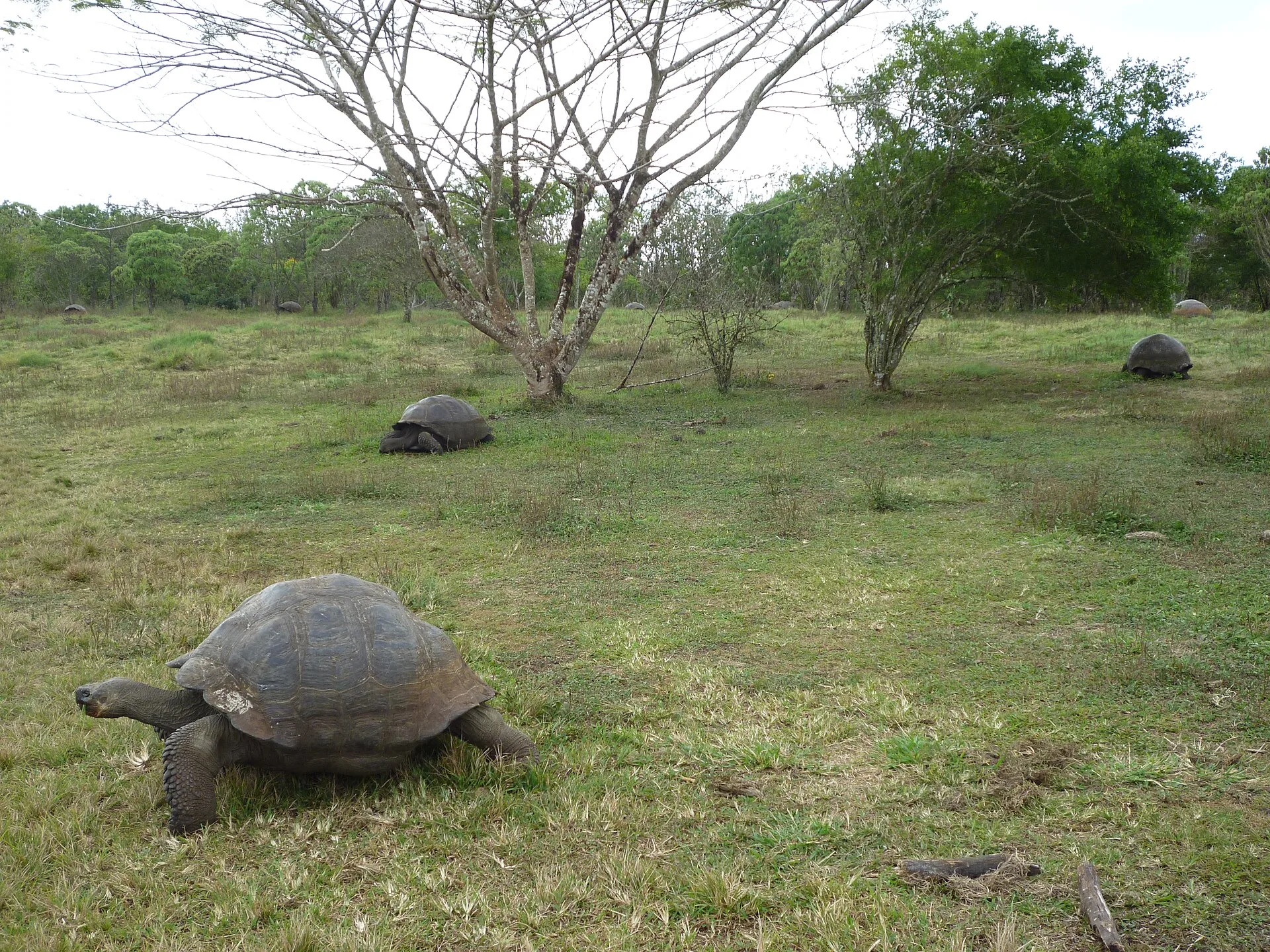
And each island went its own way. The tortoises of dry islands developed a shell raised at the front, like a saddle, to reach tall cactus; those of the humid highlands kept a dome and graze on the ground. Spanish sailors named the archipelago for that saddle: galápago. The finches Darwin collected differ, island by island, in the shape of the beak. He did not understand what he had seen until he was back in England; the tags on his specimens did not even say which island each bird came from.
How much does it cost to get in?
More than almost any other national park in the world, and the fees are not optional.
Park entry fee. Since August 1, 2024, international visitors over 12 pay US$200, and children under 12 pay US$100. Citizens of the Andean Community and Mercosur countries pay a reduced rate, and Ecuadorians less still. Park rangers collect it at the airport on arrival, in Baltra or San Cristóbal. Bring it in cash, in US dollars, which is the currency of Ecuador.
Transit Control Card. Before checking in for the flight, at the airport in Quito or Guayaquil, every traveler buys this card at the desk of the Galápagos government council. It costs US$20. Keep it: it is asked for again when you leave.
Luggage inspection. At the same airport, bags are scanned and sealed by the biosecurity agency. Fresh fruit, seeds, plants and soil on your boots are not allowed in; an introduced seed or insect is the main threat the islands face.
Add to that a return flight from the mainland, which usually costs more than a domestic flight of that length would anywhere else, and the price of the excursions. The Galápagos is not a destination for a tight budget, but the difference between the cheapest and the most expensive way of doing it is enormous, and it depends mostly on one decision.
Cruise or land: which should you choose?
Cruise: small boats touring several islands over four to eight days. It is the way to reach the most remote spots. Land-based: stay on Santa Cruz, San Cristóbal or Isabela and take day trips. It is cheaper and leaves more money in the local community.
A cruise in the Galápagos is not a floating hotel. Almost all the boats carry between 16 and 100 passengers; the park does not allow larger ships to land visitors. You sail at night and wake up at a different island each morning, with two landings and one or two snorkels a day, always with a naturalist guide. It is the only way to see the far islands: Genovesa, with its colonies of red-footed boobies and frigatebirds; Fernandina, the youngest and most pristine; Española, where the waved albatross nests from April to December. It is also expensive, at several hundred dollars a day per person on even a modest boat, and you spend your nights at sea.
A land-based trip, often called island hopping, means sleeping in a hotel or guesthouse in one of the three main towns and going out each day: on foot or by bicycle to the sites you can visit on your own, and by boat on guided day trips to the rest. You see fewer islands, but the essential animals are all within reach: tortoises, sea lions, marine iguanas, boobies, penguins, sharks, sea turtles. You eat in local restaurants, you choose your own pace, and your money goes to families who live in the archipelago rather than to a company based on the continent.
A simple rule. If birds are your passion, or if this is the trip of a lifetime and the budget allows it, take a cruise, and make it at least five days. If you want the Galápagos for half the price or less, if you get seasick, or if you travel with small children, stay on land.
There is a middle way that many travelers use: four or five days on a cruise and three or four on land before or after.
Which island should you choose?
If you can visit only one or two: Santa Cruz has the largest population, the Charles Darwin Research Station and giant tortoises roaming free in the highlands. San Cristóbal is the best for sea lions, which sleep on the benches along the waterfront. Isabela, the largest and quietest, offers volcanoes, penguins and streets of sand. Speedboats link them, in crossings of about two hours.
With a week, visit all three. With four or five days, choose Santa Cruz and one more: San Cristóbal if you prefer the sea and an easy logistics, since it has its own airport; Isabela if you want silence and landscape.
What do you see on Santa Cruz?
Puerto Ayora, the largest town of the islands, is where most trips begin. It has the widest choice of hotels, restaurants, dive shops and agencies, and a fish market where pelicans and a sea lion or two wait at the counter for scraps, like regular customers.
Charles Darwin Research Station. A twenty-minute walk from the pier. This is where giant tortoises are bred to be returned to their islands of origin: you see the hatchlings, the size of a hand, in numbered pens, and the adults a few meters on. The embalmed body of Lonesome George, the last tortoise of Pinta Island, who died in 2012 without descendants, is kept in a climate-controlled room. He is the best explanation of what all the rules are for.
Tortuga Bay. A paved path of two and a half kilometers through a forest of cactus leads to a long white beach where marine iguanas cross the sand in single file. The first beach has strong currents and is for walking; at the far end, a sheltered lagoon is good for swimming and kayaking. It is free and needs no guide; you sign in at the entrance, and the path closes in the late afternoon.
Las Grietas. A crevice of clear water, half fresh and half salt, between walls of lava, reached by a short water-taxi ride across the harbor and a walk. Go early. A local guide is now required to enter. Several boat outings combine it with a snorkel around the bay, where the cliffs hold blue-footed boobies and the channel sometimes has small sharks, such as this half-day bay tour with snorkeling and Las Grietas.
The highlands. Half an hour inland, the island turns green and damp, and this is where the tortoises live in freedom. On private ranches at the edge of the park, such as El Chato, they wander between the pastures and the ponds, and you walk among them, at a distance, in rubber boots. The same visit usually includes a walk through a lava tunnel, a tube hundreds of meters long left by a river of lava whose crust cooled while the inside went on flowing, and a stop at Los Gemelos, two great pits where the ground collapsed, surrounded by a forest of Scalesia trees hung with moss. You can go by taxi, agreeing a price for the half day, or with a guide who explains what you are looking at.
Day trips by boat. From Santa Cruz, boats go out to uninhabited islands with a guide and a limited number of passengers. The best known are North Seymour, for frigatebirds with their red throat pouches inflated and blue-footed boobies dancing; Bartolomé, for the classic view of a volcanic pinnacle over two bays, and penguins; Santa Fe, for its own species of land iguana and a turquoise cove; and Pinzón, only for snorkeling. These trips are the most expensive part of a land-based stay, and in high season they fill up days ahead. Book the one you care about most before you arrive.
The main rule: two meters away from any animal, even if it is the one coming closer.
What do you see on San Cristóbal?
Puerto Baquerizo Moreno is the capital of the province and a quieter town than Puerto Ayora. Its waterfront belongs to the sea lions: they sleep on the benches, on the steps of the piers, under the slides of the playground, and at night their barking carries through the streets. The smell goes with it.
On foot from town, with no guide and no fee, you reach more than on any other island. The Interpretation Center tells the natural and human history of the archipelago, and it is a good first stop of the trip. Behind it, paths climb to Cerro Tijeretas, a hill named for the frigatebirds that nest on it, with a statue of Darwin overlooking the cove where the Beagle first anchored. The water below is one of the best places to snorkel from the shore: sea lions come to play, and sea turtles graze on the rocks. Playa Mann, opposite the university, is the town beach, and La Lobería, a half-hour walk or a short taxi ride past the airport, has a sea lion nursery and large marine iguanas.
In the highlands, a road crosses the island to El Junco, a crater lake where frigatebirds come to rinse the salt from their feathers, a tortoise breeding center, and the beach of Puerto Chino. A taxi does the circuit in half a day.
The excursion that brings people to San Cristóbal is at sea. Kicker Rock, or León Dormido, is the remains of a volcanic cone, two walls of rock rising almost vertically from deep water, split by a narrow channel. You snorkel or dive along the walls and through the channel, over sea turtles, rays and, with luck, Galápagos sharks and hammerheads far below. The water is cold and the sea can be choppy; it is not a place for a first snorkel. Longer trips go all the way around the island, with stops at beaches that can only be reached by boat and at a point with colonies of seabirds, like this full-day 360 tour of San Cristóbal, which includes Kicker Rock.
What do you see on Isabela?
Isabela is larger than all the other islands together, was formed by six volcanoes joined at the base, and has one small town, Puerto Villamil, with streets of sand, a beach three kilometers long in front of it and flamingos in the lagoons behind. There are fewer cars, fewer people and fewer cash machines than anywhere else you will go on this trip: bring enough dollars from Santa Cruz. On arrival at the pier, visitors pay a small municipal fee.
Concha de Perla. A boardwalk through the mangroves, beside the pier, ends at a calm lagoon where you can snorkel on your own with sea lions, rays and, sometimes, penguins. It is free.
The Wall of Tears. A path of some six kilometers along the coast, on foot or on a rented bicycle, passes beaches, lagoons, lava tunnels and wild tortoises on the way to a wall of volcanic rock a hundred meters long. It was built stone by stone, for no purpose, by the prisoners of a penal colony that existed here between 1946 and 1959. The island has kept it as a memorial.
Las Tintoreras. A group of islets of black lava a few minutes from the pier. From the boat you see the penguins and boobies on the rocks; on foot, a trail crosses a field of lava where hundreds of marine iguanas nest and a channel where white-tipped reef sharks, the tintoreras, rest at low tide; then you snorkel in the bay. It takes a morning or an afternoon, as on this half-day tour of Las Tintoreras.
Los Túneles. Forty-five minutes south by fast boat, lava flows that reached the sea formed arches and tunnels, half above the water and half below. You walk over the arches among cactus and blue-footed boobies, and then snorkel in the shallow, clear water of a nearby site, among sea turtles the size of a table, seahorses and sharks asleep in the caves. For many travelers it is the best snorkel of the whole trip. The entrance through the breaking waves is rough, and the sea decides whether boats go out; allow a spare day. This is the kind of excursion: a day tour to Los Túneles.
Sierra Negra. One of the most active volcanoes in the archipelago and one with the widest calderas of any on Earth, some ten kilometers across. A van takes you up to the trailhead, and from there a guided walk of about 16 kilometers, there and back, follows the rim and continues to Volcán Chico, a landscape of recent lava, red and black, with a view across to the other volcanoes. It is long but not steep; the morning is often misty on the rim and clear beyond. Guided walks such as this hike to the Sierra Negra volcano leave early from Puerto Villamil.
How do you plan a week?
Day 1. Fly to Baltra, cross to Santa Cruz and stop in the highlands on the way to Puerto Ayora: tortoises, lava tunnel, Los Gemelos. Fish market at dusk.
Day 2. Santa Cruz. Tortuga Bay in the morning, the Darwin Station and Las Grietas in the afternoon.
Day 3. A day trip by boat to an uninhabited island: North Seymour or Bartolomé.
Day 4. Morning boat to Isabela. Concha de Perla, the lagoons of flamingos and sunset on the beach.
Day 5. Isabela. Los Túneles, or Sierra Negra if you prefer walking to swimming.
Day 6. Las Tintoreras in the morning; afternoon boat back to Santa Cruz.
Day 7. Early boat to San Cristóbal. Interpretation Center, Cerro Tijeretas and a snorkel in the cove.
Day 8. Kicker Rock or the highlands, and fly out from San Cristóbal the following morning.
With five days, drop Isabela or San Cristóbal. Flying into one airport and out of the other, as in this plan, saves a crossing and half a day.
How do you get there and move between islands?
There are no international flights to the Galápagos. All flights leave from Quito or Guayaquil, on the mainland, and most from Quito stop in Guayaquil. The flight from Guayaquil takes just under two hours. The islands are one hour behind the mainland.
There are two airports. Baltra, a small flat island north of Santa Cruz, is the busiest. From its terminal a bus takes you to the Itabaca channel, a ferry crosses it in five minutes, and on the other side taxis and buses cover the 42 kilometers to Puerto Ayora in about 45 minutes. San Cristóbal's airport is at the edge of town, a short taxi ride or even a walk from the hotels.
Between the inhabited islands, the public transport is the speedboat that locals call the ferry: an open-sea boat for 20 to 30 passengers, with powerful outboard engines. In 2026 the crossing between Santa Cruz and Isabela costs US$55, takes about two and a half hours and leaves Santa Cruz at 7:00 and 15:00, and Isabela at 6:00 and 15:00. Between Santa Cruz and San Cristóbal the crossing is similar; confirm times and price when you book. There is no direct boat between Isabela and San Cristóbal: you change in Santa Cruz, and it costs a day.
The crossings are the hard part of a land-based trip. The boats slam into the swell, above all from June to November and in the afternoon. Take a seasickness tablet half an hour before, sit at the back, where the movement is less, and look at the horizon. Bags are inspected at each pier so that nothing travels from one island to another, and a water taxi takes you from the pier to the boat for a dollar or so in coins. Small planes also fly between the three islands in about half an hour, for considerably more money and with a tight luggage limit.
On each island you walk, rent a bicycle or take a taxi, which is always a white pickup truck.
What are the rules, and why do they matter?
Ninety-seven percent of the land area is national park. Almost every site is entered with a licensed guide. No touching or feeding animals, no leaving the trails and no bringing in fresh food or seeds.
The full list is handed to you on the plane, and it is short enough to remember.
Keep two meters from every animal. If a sea lion pup comes to sniff you, step back. A pup that smells of people can be rejected by its mother.
Do not touch, do not feed. Not the iguanas, not the finches that land on your table.
Stay on the marked trails. The ground beside them is full of nests and burrows you cannot see.
No flash. And no drones without a permit from the park.
Take nothing. No shells, no sand, no lava stones, no bones. Do not buy souvenirs made of black coral, shell or wood from the islands.
Bring nothing alive. No fruit, seeds or plants, and clean the soles of your shoes before you fly and between islands.
Do not smoke or light fires in the park, and carry all your rubbish back.
Use sunscreen that does not harm the reef, and less of it: a long-sleeved swim shirt does the job better.
These rules are the reason the islands still look the way they do. The damage to the Galápagos did not come from visitors who touched a tortoise; it came from what people brought with them. Whalers and pirates carried off tortoises by the tens of thousands, as live food that would keep for months in a ship's hold. Settlers brought goats, pigs, rats, cats, blackberry and guava, which ate the eggs, the young and the vegetation. Three of the tortoise species are gone. In recent decades the park has removed goats from whole islands and bred tortoises back from a handful of survivors, in one of the most successful restoration efforts anywhere. Every seed stuck to a sock is a small step in the other direction.
The other pressure is the number of people. Some 30,000 residents live on the islands, and visitors now number several hundred thousand a year. Water is scarce, almost everything is brought by ship, and all the rubbish has to be dealt with on the spot. You can help in small, real ways: refill a bottle instead of buying plastic, eat the local fish rather than what is flown in, choose locally owned hotels and boats, and accept that showers are short.
When should you go?
December to May: warm sea and brief rains. June to November: cold water and more marine life.
There is no bad season, only two different ones.
The warm season, December to May. Air and water are warm, the sea is calmer, and the sky is blue between short, heavy showers that turn the lowlands green. It is the best time for swimming, for calm crossings and for seeing land birds nesting, sea turtles laying their eggs on the beaches and tortoises in the lowlands.
The cool season, June to November. A cold current arrives from the south and brings food: this is when the sea is richest, with more activity among sea lions, penguins, boobies and whales. The sky is often overcast, a fine mist called garúa wets the highlands, the water calls for a wetsuit, and the crossings are rougher.
The busiest and most expensive weeks are mid-December to mid-January, Easter, and July and August. April, May, September and October are quieter, although some boats go into maintenance in September.
What should you pack?
Light clothes that dry fast, a warm layer and a rain jacket for the highlands and for the boats, and a hat with a strap. Shoes with a closed toe for walking on lava, which cuts like glass, and sandals that can get wet for landings on beaches. A long-sleeved swim shirt, reef-friendly sunscreen and sunglasses: on the equator the sun burns even through cloud. Seasickness tablets. A dry bag for the boats and a reusable water bottle. Cash in small US dollar bills, since cards are not accepted everywhere and cash machines sometimes run out. Binoculars if you have them.
Agencies lend or rent a mask, snorkel and fins, and in the cool season a wetsuit; if you have a mask that fits you, bring it. An inexpensive underwater camera or a waterproof case for your phone will be the most used thing in your bag.
Where should you stay, and what will you eat?
All three towns have accommodation at every level, from family guesthouses to small hotels with a view of the bay; there are no large resorts, and outside the towns there is almost nothing. In Puerto Ayora, staying near the waterfront puts you close to the piers for early departures. In Puerto Villamil, everything is within a few streets of the beach.
The food is fish. Look for brujo, scorpionfish, grilled whole; tuna and wahoo; ceviche, which in Ecuador comes in its own juice, with popcorn and plantain chips on the side; and encocado, fish in coconut sauce. In Puerto Ayora, one street of simple restaurants, known as the street of the kiosks, puts its tables outside every evening and grills the catch of the day; it is the liveliest and best-value dinner on the islands. The set lunch, the almuerzo, of soup, a main dish and juice, is what locals eat and costs a fraction of anything on the waterfront. Lobster has a closed season for part of the year: if it is offered out of season, say no. Tap water is not drinkable on any island.
Is it a trip for children, and for people who do not swim?
For children it may be the best wildlife trip there is, from about six years old: the animals are close, they do not run away, and half of them are in water shallow enough to stand in. Choose a land-based stay, keep the boat crossings to a minimum by concentrating on one or two islands, and explain the two-meter rule before you arrive rather than on the beach.
Those who do not swim miss less than they fear. Tortoises, iguanas, boobies, frigatebirds, sea lions and penguins are all seen from land or from the boat, and life jackets are provided for anyone who wants to float over a calm bay. Travelers with limited mobility should know that landings are often from a small boat onto rocks or a beach, and that the paths are uneven; Santa Cruz and San Cristóbal, with their paved waterfronts and taxi tours, are the easiest islands.
What mistakes should you avoid?
Arriving without cash. The park fee, the water taxis, the dock fees and many small restaurants want dollars in bills.
Booking the first boat after your flight. Flights are delayed and the afternoon boat does not wait. Sleep on the island where you land.
Planning Isabela and San Cristóbal back to back. There is no direct boat between them.
Leaving the day trips for the last minute in high season. The boats have a fixed number of seats.
Flying out on the same day as a dive. Leave a full day between your last dive and your flight.
Skipping the highlands. The tortoises are there, not on the coast.
Getting close for the photograph. Use the zoom. The animal's calm is the whole point.
Underestimating the sun and the sea. Both are stronger than they look.
Quick answers
How much is the Galápagos entry fee in 2026? US$200 for international visitors over 12 and US$100 for children under 12, paid on arrival, plus a US$20 Transit Control Card bought at the airport on the mainland.
Can you visit without a cruise? Yes. You stay on Santa Cruz, San Cristóbal or Isabela and take day trips.
How many days do you need? At least five; seven or eight to see the three inhabited islands.
Which island is best? Santa Cruz for tortoises and day trips, San Cristóbal for sea lions and snorkeling from the shore, Isabela for penguins, volcanoes and quiet.
How do you get between islands? By speedboat, about two and a half hours and US$55 between Santa Cruz and Isabela. There is no direct boat between Isabela and San Cristóbal.
When is the best time? December to May for warm, calm water; June to November for marine life.
Do you need a guide? For most sites in the national park, yes. Some beaches and trails close to the towns can be visited on your own.
How close can you get to the animals? Two meters, and no closer.
Fees and boat schedules in this guide were checked in November 2026 with the Galápagos National Park, the Galápagos government council and the boat operators. Confirm them before you travel.