Ilulissat: what to see in the city of icebergs now that it is easier to reach
The new international airport brings Greenland's icefjord closer. A guide to a destination that demands respect: the trails, the boats, the seasons, the costs and a four-day plan.
Culturera may earn a commission if you buy through the links on this page. As an Amazon Associate I earn from qualifying purchases. The selection is ours alone.
The short version: since October 29, 2026, Ilulissat has an international airport, and you can fly there directly from Copenhagen instead of changing planes twice. Plan four days, because the weather cancels things; walk the free trails along the icefjord on the first one; take a boat among the icebergs in the evening light; and choose your season carefully, because summer and winter here are two different trips. It is expensive, it is small, and nothing you have seen prepares you for the ice.
With the opening of its international airport in late October, Ilulissat is no longer a destination of several connections. This town of about 4,700 people, on Greenland's west coast and about 250 kilometers north of the Arctic Circle, lives beside one of the most impressive natural spectacles on the planet.
This guide explains how to get there, what to do in each season, what it costs and how to visit a small Arctic community without being a burden on it. Most excursions are sold by a handful of local operators and hotels, directly. A few are also on GetYourGuide, and we link those where they fit. We have not taken these tours: they are chosen for what they cover.
What has changed with the new airport?
Until now, reaching Ilulissat meant flying from Copenhagen to Kangerlussuaq, a former American air base at the end of a fjord, or more recently to Nuuk, and changing there to a small propeller plane that landed on a runway of 845 meters. A day of fog anywhere along the way could add a night or two to the journey.
The new airport has a runway of 2,200 meters, long enough for larger passenger jets. Scheduled flights from Copenhagen began in November 2026, operated through the winter by the Danish airline Jettime on behalf of Air Greenland; from April 2027, Air Greenland flies the route with its own aircraft. The flight takes around four and a half hours. Ilulissat is the last piece of a plan that also gave Nuuk, the capital, an international runway in 2024 and is building a regional airport at Qaqortoq, in the south.
For a traveler, three things follow. The trip is shorter and less exposed to missed connections. Prices have not collapsed: Greenland remains a costly place to fly to, and seats in summer still sell out early. And the town itself has not grown with the runway. Ilulissat has a limited number of hotel beds, boats and guides, and in July they are all taken. The airport makes it easier to arrive, not easier to improvise.
What is the icefjord?
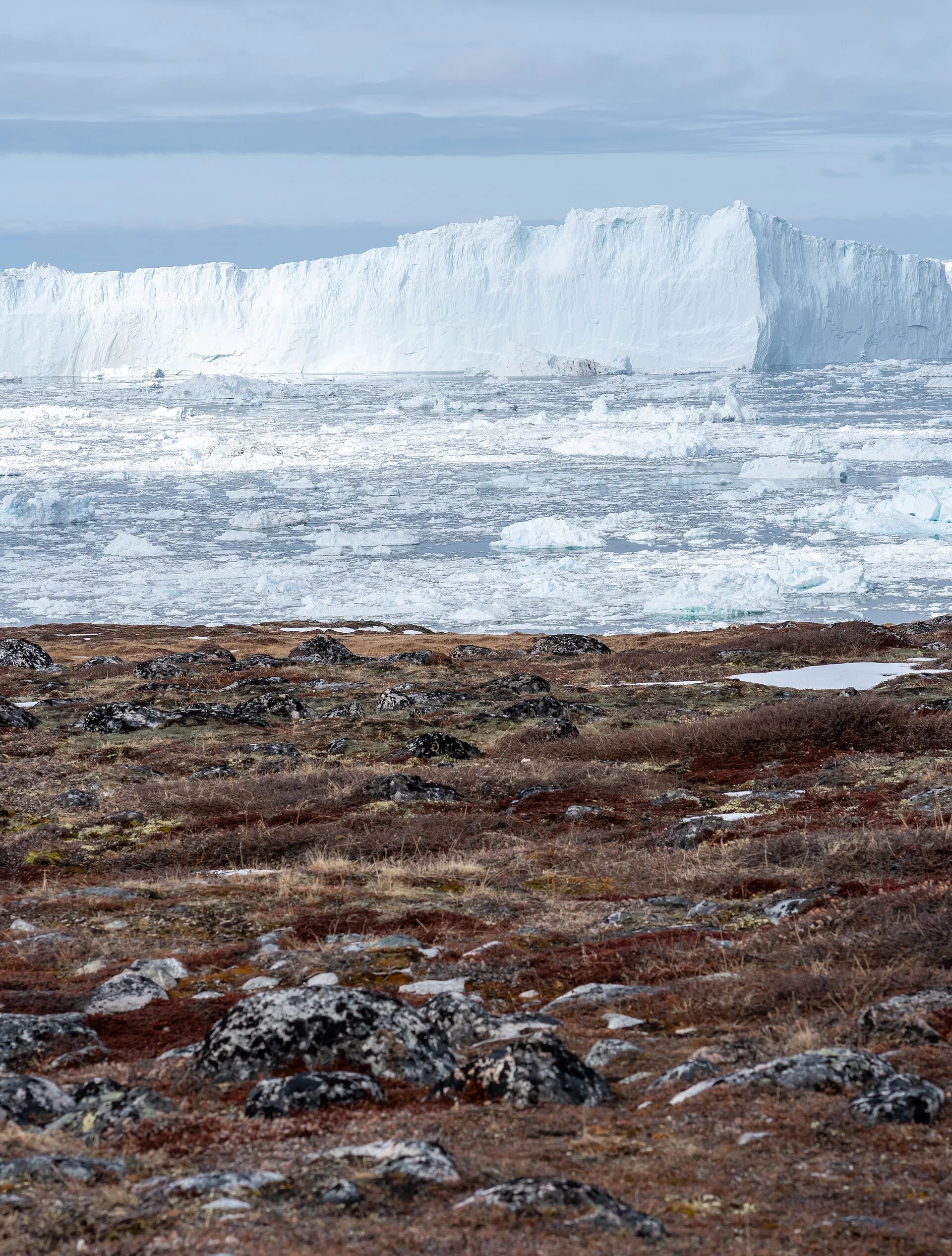
The Ilulissat Icefjord, a World Heritage site since 2004, is the outlet of the Sermeq Kujalleq glacier, one of the fastest and most active in the world. It sheds icebergs the size of buildings, which run aground at the mouth of the fjord before drifting out into Disko Bay.
The numbers are hard to picture. The glacier, also known by its Danish name, Jakobshavn Isbræ, drains a basin that covers several percent of the whole Greenland ice sheet. Its front moves tens of meters a day, far faster than an alpine glacier moves in a month, and it calves more ice into the sea than any other glacier outside Antarctica: by the usual estimate, about a tenth of all the icebergs Greenland produces.
The fjord is more than fifty kilometers long and completely packed with ice from wall to wall, so that from the shore it looks less like water than like a white mountain range lying on its side. The icebergs travel down it for months. At the mouth, a bank of rock and sediment left by the glacier in the past, only a couple of hundred meters below the surface, stops the largest ones. They sit there, some rising more than a hundred meters above the water with several times that below, until they melt enough, break or are pushed over the sill by the ice behind. Then they sail out into Disko Bay and north and south with the currents, down the coast of Canada and into the Atlantic. It is often said that the iceberg that sank the Titanic was born here; it cannot be proved, but it is plausible.
The glacier is also one of the most closely watched pieces of ice on Earth. Its front retreated by many kilometers in the first years of this century, and scientists read its speed and thickness as a thermometer of the ice sheet behind it. Standing in front of the fjord, you are looking at one of the places where the rise of the sea is being decided.
Ilulissat simply means "icebergs" in Greenlandic.
How do you see it on foot?
On foot: from the edge of town, a wooden boardwalk crosses the tundra to the old settlement of Sermermiut, with direct views of the ice. There are marked trails of different lengths.
Everything starts at the Icefjord Centre, a twenty-minute walk or a short taxi ride from the center of town, past the old heliport. From there:
The boardwalk to Sermermiut. A little over a kilometer of wooden planks, almost flat, laid over the tundra to protect it. It ends at a grassy slope above a small bay, facing the wall of grounded icebergs. Anyone who can walk a kilometer can do it, and it is accessible for most of its length to wheelchairs and strollers. Go once by day and once late in the evening.
Sermermiut. The slope at the end of the boardwalk was inhabited, with interruptions, for about four thousand years, by three successive Arctic cultures: the Saqqaq, the Dorset and the Thule, the ancestors of today's Greenlanders. They came for the same reason as the fishermen now: the nutrients stirred up by the ice make the mouth of the fjord extraordinarily rich in seals and fish. The last families left around 1850 and moved into town. You can still see the low mounds of the turf houses. Do not walk on them, and do not pick up anything.
The yellow trail. About 2.7 kilometers, from the old heliport along the coast and back over the rocks, with views of the open bay and the icebergs leaving the fjord. It is the best short walk for sunset.
The blue trail. About seven kilometers, the classic half-day hike: from Sermermiut it climbs along the edge of the fjord, high above the ice, and returns to town through a quiet valley and past an old quarry. The ground is rock, moss and bog, marked with painted dots on stones; wear boots, carry water and a windproof layer, and allow three hours with stops.
The red trail. A short link of about a kilometer between the centre and the viewpoint over the fjord, for those who want height without the full blue route.
The trails are free and open all year. In winter they are covered by snow, and the boardwalk is the only part that is easy to follow.
Stay away from the shoreline facing the ice: when an iceberg breaks or rolls over, it can raise sudden waves.
The warning in that quote is serious. Signs at Sermermiut forbid going down to the beach, because calving and rolling icebergs have sent waves several meters up the shore without notice. Stay on the grass above the marked line.
Is the Icefjord Centre worth it?
Yes, and visit it before you walk. The building, by the Danish architect Dorte Mandrup, opened in 2021: a twisted wooden structure that lies in the landscape like a snowdrift or the wing of an owl, with a roof you can walk over for a first view of the fjord. Inside, an exhibition tells the story of ice, from snowflake to iceberg, with real cores drilled from the ice sheet that contain air tens of thousands of years old, and the story of the people who have lived beside it. There is a café with a terrace and a small shop.
In 2026 the ticket costs 150 Danish kroner for adults and 100 for children from 7 to 15. The centre does not accept cash. Opening hours follow the seasons: every day from 10:00 to 17:00 from mid-June to mid-September, shorter days from Wednesday to Sunday for most of the rest of the year, and it closes in January. Check the calendar on its website for your dates.
How do you see it by boat?
By boat: sailing among the icebergs at sunset, or under the midnight sun in summer, is the classic excursion.
From the water you understand the scale. Boats leave from the harbor, crowded with fishing vessels and small open boats, and in fifteen minutes they are moving slowly along the front of the grounded icebergs at the mouth of the fjord: walls, arches, towers and tables of ice, white, turquoise and, where old compressed ice shows, a deep glassy blue. The captains keep their distance, because ice breaks and rolls. Trips last two to three hours.
Which departure to choose matters more than which boat. In summer, the evening sailings, from around nine or ten at night, have the low golden and pink light of a sun that grazes the horizon without setting; they sell out first. By day the light is harder and the colors are colder. In spring and autumn, a real sunset replaces the midnight sun. In deep winter, the harbor is often still open, and boats sail at midday in the blue twilight.
Wear everything you have. Even in July, the air above the ice is near freezing once the boat moves, and most operators lend thermal suits.
Icefjord sailings are sold by the local operators and through the hotels, and in July and August you should reserve them when you book your flights. The longer boat days described below are booked the same way.
What else is there to do in summer?
Whales. From June to September, humpback whales feed in Disko Bay, often close to town and sometimes among the icebergs, which gives the most unlikely photograph of the trip: a tail fluke against a wall of ice. Fin and minke whales also pass. Boats go out for a few hours, and sightings are frequent in high summer, though never guaranteed.
Eqi, the calving glacier. About eighty kilometers north, the glacier Eqip Sermia ends in a front several kilometers wide that drops ice into the sea all day, with a noise like distant artillery. Boats stop in front of it, at a safe distance, for an hour or two. It is a full day on the water, between six and twelve hours depending on the vessel, and it is the excursion people remember most after the icefjord itself. A group of cabins facing the glacier allows you to stay the night.
The settlements. Greenland's small villages are a different world from the town. Oqaatsut, about twenty kilometers to the north, has a few dozen inhabitants, drying racks of fish, and a restaurant in an old warehouse; you reach it by boat or, for strong walkers, on a marked day hike over the hills. Ilimanaq, across the mouth of the fjord to the south, has brightly painted houses, two restored 18th-century buildings and a view back to the ice. Some visits include a kaffemik, the Greenlandic open house where a family receives guests with coffee and a table full of cakes, like this visit to the settlement of Ilimanaq with a kaffemik.
Kayak. The kayak is a Greenlandic invention, the qajaq, and paddling among small pieces of ice in the bay on a calm evening is the quietest way to be on the water. Outings are guided, in dry suits, and suitable for beginners in good weather.
Disko Island. The big island on the horizon, with basalt mountains unlike anything on the mainland, is reached by a passenger boat in a couple of hours. Its town, Qeqertarsuaq, has black sand beaches, whale bones and, on the glacier above, dog sledding in summer.
The ice sheet and the air. Flights by small plane or helicopter over the fjord to the front of the glacier show what cannot be seen from town: the place where the ice sheet breaks. They are the most expensive hour of the trip and the first to be canceled by weather.
What is there to do in winter?
From November to March: polar night, northern lights and dog sleds.
In Ilulissat the sun does not rise from about November 30 to January 11. It is not total darkness: for a few hours around midday the sky turns blue, pink and orange, and the snow and the icebergs glow. On January 13 the town climbs the hill of Holms Bakke to greet the first sun of the year, with songs and coffee.
Northern lights. They are visible on clear nights from September to early April. You do not need a tour to see them: walk ten minutes out of town, to the old heliport or the start of the boardwalk, and wait. A tour helps if you want a guide, a warm tent and help with the camera.
Dog sledding. North of the Arctic Circle, the sled is still a means of transport and a tool for fishing through the ice, and the Greenland sled dog is a breed kept pure by law: no other dogs are allowed here. Drivers take visitors out for two hours or a full day, sitting on a wooden sled behind a fan of twelve or more dogs, over the hills behind town. The season depends on snow, usually from February to April. It is cold, bumpy and unforgettable.
Snowmobiles. The modern alternative covers more ground, up to viewpoints over the frozen fjord, as on this guided snowmobile outing.
Snowshoes and skis. The trails along the icefjord can be walked on snowshoes with a guide, and in March and April, with long days and hard snow, conditions are at their best.
Winter is cheaper than summer, far quieter, and colder than most visitors have ever known: temperatures between ten and twenty-five degrees below zero are normal, and wind makes them worse. The operators rent sealskin or expedition clothing for the sled trips. Take it.
When should you go?
From June to August there is light around the clock and mild temperatures.
Summer, June to August. The midnight sun lasts from about May 20 to July 23. Temperatures run from five to fifteen degrees, the sea is open, the whales are in the bay, and every excursion operates. It is also high season: the most expensive, the fullest, and the time of the mosquitoes, from late June to early August.
Autumn, September and October. The tundra turns red and yellow, the mosquitoes are gone, the nights are dark again and the northern lights return while the boats still sail. For many who know the town, September is the best month of all.
Winter, November to January. The dark season: twilight, auroras, few visitors. Snow for sledding is not yet reliable.
Spring, February to April. The Arctic winter of the postcards: deep snow, bright sun, long days, sleds and skis, and cold. Bowhead whales pass through the bay in spring.
May and early June are in between: the snow is melting, the trails are wet, and the sea ice can still hinder boats, but the light is endless and the prices are lower.
How do you plan four days?
Day 1. Arrive, walk through the town to the Icefjord Centre, see the exhibition and follow the boardwalk to Sermermiut. In summer, come back late in the evening for the light.
Day 2. The blue trail in the morning. A boat among the icebergs in the evening.
Day 3. A full day at sea: the Eqi glacier, or a whale safari and a visit to a settlement. In winter, dog sledding.
Day 4. A spare day for whatever the weather canceled; if nothing was, the town museum, the yellow trail and the harbor.
Do not plan fewer than three nights. Flights and boats are canceled by fog, wind and ice often enough that a tight schedule is a gamble, and travel insurance that covers delays is not a luxury here.
What is there to see in town?
Ilulissat was founded as a Danish trading post in 1741 and is today Greenland's third-largest town and its fishing capital: the halibut and shrimp landed in its harbor are the country's main export. It is a working town of colored wooden houses on bare rock, with a fish factory, a hospital, schools, two supermarkets and a rush hour of taxis.
The Zion Church. A dark wooden church from the late 18th century on the shore, with icebergs behind it. It is the picture of the town.
The Ilulissat Museum. In the red house where the polar explorer Knud Rasmussen was born in 1879. The son of a Danish missionary and a part-Greenlandic mother, he grew up speaking Greenlandic and driving dogs, and crossed the whole Arctic of North America by sled, recording the stories of the Inuit. The museum covers his expeditions and the history of the town.
The art museum. In the old colonial manager's house, with paintings of Greenland by Emanuel A. Petersen.
The harbor. Small boats come in with seal, halibut and, in season, whale, and the catch is sold at the open market, the brættet, a few steps away. Ask before photographing people at work.
The dogs. The sled dogs live in large areas on the edges of town, chained in summer beside their kennels. More on them below.
How do you travel well here?
It is a small, fragile place. Book with local operators, stay on the trails and remember that sled dogs are working animals, not pets.
The dogs. Do not approach, pet or feed them, and keep children away from the chains. They are not aggressive by nature, but they are half-wild pack animals, and accidents happen every year. Puppies run free and are friendly; their mothers may not be.
The ground. Arctic vegetation grows a few millimeters a year, and a footprint in the moss lasts for decades. Stay on the marked trails and the boardwalk. Take nothing from archaeological sites, and leave stones, bones and plants where they are.
Hunting. Seal, whale and reindeer are food here, hunted under quotas, and part of the culture and the household economy. You will see meat and skins at the market. You do not have to eat them; you should not lecture anyone about them. Note that importing sealskin and whale products is restricted or banned in many countries: check your own before buying.
People. Around nine out of ten inhabitants are Inuit. Greenlandic, Kalaallisut, is the language of the street; Danish is widely spoken, English by those who work with visitors. Ask before you photograph anyone, and do not walk into gardens or up to windows for a better angle: people live in the colored houses.
Money that stays. Choose locally owned boats, guides and guesthouses where you can. The debate about how much tourism the town wants, and who benefits from it, is open in Ilulissat, and the new airport has sharpened it.
Drones. The icefjord is a protected area with helicopters and planes in the air. Rules restrict where you may fly; ask at the Icefjord Centre before you launch anything.
What does it cost?
Greenland uses the Danish krone, and prices are those of Scandinavia plus the cost of bringing everything by ship or plane. Expect hotel rooms, restaurant meals and excursions to cost clearly more than in Copenhagen. A boat trip of a few hours costs about what a full day's tour costs in most of Europe, and the long days, the Eqi glacier or a helicopter flight, are among the biggest expenses of the trip after the flights.
You can soften it. Guesthouses, hostels and apartments with a kitchen cost much less than the four-star hotels on the hill. The supermarkets are well stocked, if not cheap, and sell good bread, smoked halibut and dried fish. The trails, the best thing in Ilulissat, cost nothing. And outside July and August, prices for rooms fall.
Cards are accepted almost everywhere, including taxis. There are cash machines in town. Tipping is not expected.
Where should you stay, and what will you eat?
The town has a handful of hotels, the best of them with rooms facing the bay and its icebergs, several guesthouses and a hostel. Everything is within a half-hour walk, and taxis are easy to find. In summer, book as early as you book the flights; in the darkest months, some places close.
The food is what the sea and the hills provide. Greenland halibut, smoked, cured or fried, is the local specialty; so are snow crab, shrimp, musk ox, reindeer and lamb from the south. Suaasat is the national dish, a thick soup of seal, whale or reindeer with rice and onion. Mattak, raw whale skin with a layer of blubber, is a delicacy offered to guests. Hotel restaurants serve tasting menus of Greenlandic produce at high prices; the cafés in the center serve burgers of musk ox, fish and chips and Thai food, since Greenland has a sizable Thai community. Alcohol is expensive. Tap water is excellent, and many boats will chip you a piece of iceberg for your glass.
How does Ilulissat fit into a longer trip?
There are no roads between towns in Greenland: every journey is by air or by sea, and that shapes any itinerary.
Ilulissat alone. With the direct flight from Copenhagen, a stay of four to six days is now a complete trip in itself, and for a first visit to Greenland it is the obvious choice.
With Nuuk. The capital, an hour and a quarter south by plane, has the national museum, with the mummies of Qilakitsoq, a cultural center, good restaurants and a fjord system of its own. Two or three days there show the modern, urban Greenland that Ilulissat does not.
By coastal ferry. In the ice-free months, a passenger ship sails the west coast between the south and Ilulissat, calling at towns and settlements along the way. It is slow, sociable and the cheapest way to see how the country lives; cabins sell out early, and bunks in shared couchettes cost much less.
With Iceland. In summer there are flights between Iceland and several Greenlandic towns, which makes it possible to combine both countries without passing through Denmark. Check the current season's schedule, because these routes change from year to year.
Is it a trip for children, or for people who walk with difficulty?
For children old enough to remember it, from seven or eight, it is a strong trip: icebergs, whales, puppies, a sun that does not set. The boardwalk is easy, boats lend suits in children's sizes, and Greenlandic towns are relaxed places where children play outside at all hours of the bright night. The limits are the cold on the water, the length of the full-day boat trips, which are too long for small children, and the price, since few excursions offer more than a modest discount.
Travelers who walk with difficulty can see more than they might expect. The boardwalk to Sermermiut is nearly level and brings you in front of the ice without any climbing; the Icefjord Centre is fully accessible; and the best hotels have the icebergs outside the window. Boats are boarded from floating piers by a step or a short ladder, so ask the operator which vessel suits you. The streets are steep in places and icy from October to May.
What should you pack?
Even in summer, the weather changes in minutes. Dress in layers: a thermal base, a fleece and a waterproof windbreaker. A hat and gloves for boat trips, where the air coming off the ice bites. Sunglasses and sunscreen, because light bounces off the water and snow. And in July and August, a head net: the tundra's mosquitoes are legendary.
Add waterproof hiking boots with a good sole, a sleep mask for the nights without darkness, a power bank, since cold drains batteries, and binoculars for whales and for ice. In winter, bring a proper down jacket, insulated trousers, mittens over gloves, a face covering and boots rated for deep cold, or rent the outer layer in town.
What mistakes should you avoid?
Coming for two nights. One canceled flight or boat and you have seen nothing.
Booking excursions on arrival in July. They are sold out.
Taking the midday boat when there is an evening one. The light is the point.
Going down to the shore at Sermermiut. The waves from the ice are real.
Petting the sled dogs. They are not pets.
Underdressing for the boat. It is winter out there in any month.
Expecting the airport to have made it cheap. It made it simpler.
Leaving the trails for a photograph. The moss will remember it for longer than you will.
Quick answers
How do you get to Ilulissat? By direct flight from Copenhagen to the international airport that opened on October 29, 2026, in about four and a half hours, or with a domestic flight from Nuuk. In summer, a coastal ferry sails up from Nuuk in a couple of days.
How many days do you need? Four, with one spare day for weather. Three nights is the minimum.
Is the icefjord free? Yes. The trails and the boardwalk are free and always open. The Icefjord Centre costs 150 Danish kroner for adults in 2026 and does not take cash.
When is the midnight sun? From about May 20 to July 23.
When can you see the northern lights? On clear nights from September to early April.
When is the polar night? From about November 30 to January 11.
Can you see whales? From June to September, humpbacks feed in Disko Bay, often near the town.
Is Ilulissat expensive? Yes: count on Scandinavian prices and more, with excursions as the main cost after flights.
Flight information, prices and opening hours in this guide were checked in November 2026 with Greenland Airports, Air Greenland and the Ilulissat Icefjord Centre. Confirm them before you travel.