Petra: a guide to walking the city carved in rock
The Treasury is only the first stop. How to organize one, two or three days in the Nabataean capital: 2026 tickets and the Jordan Pass, the trails, the Monastery, Petra by Night and Wadi Rum.
Culturera may earn a commission if you buy through the links on this page. As an Amazon Associate I earn from qualifying purchases. The selection is ours alone.
Give Petra two days, sleep in the town at its gate, and be at the entrance at 6:00, when it opens. On the first day walk the main trail from the Siq to the Treasury and on to the Monastery; on the second, climb to the High Place of Sacrifice or to the viewpoint above the Treasury. Buy the Jordan Pass before you fly: it includes Petra and waives the visa fee, and it almost always works out cheaper than paying for the two separately.
For centuries, only the local Bedouin knew where it was. In 1812, the Swiss explorer Johann Ludwig Burckhardt entered the valley in disguise and made the city of Petra, in southern Jordan, known in Europe.
Petra is much bigger than its photographs suggest. The famous facade stands at the end of a gorge, and most visitors on day trips see it, take the picture and turn around. Behind it lie a whole valley of tombs, a theater, temples, a paved Roman street and, an hour's climb away, a second great facade that many people never reach. This guide is about seeing that part too. Where a tour or a transfer makes the trip easier, we link options on GetYourGuide. We have not taken these tours: they are chosen for what they cover.
Who built it
The Nabataeans, an Arab people of traders who controlled the caravan routes for incense and spices. They made Petra their capital more than two thousand years ago and carved tombs and temples straight into the sandstone. They also mastered water, with dams, channels and cisterns in the middle of the desert.
They began as nomads and grew rich as middlemen: frankincense and myrrh from southern Arabia, spices from India and silk from further east crossed the desert on camels, and every caravan paid for water, protection and passage. At its height, around the time of Christ, Petra may have had 20,000 or 30,000 inhabitants. What you see carved in the cliffs are mostly their tombs; the houses, built of stone in the valley floor, fell in the earthquakes.
The style is a mixture, and that is the charm of it. The Nabataeans traded with everyone and borrowed from everyone: Greek columns and pediments, Egyptian obelisks, Mesopotamian stepped battlements, all cut from the top down into living rock by masons who could not afford a mistake.
Rome annexed the kingdom in the year 106, and the city went on prospering for a while under the empire. Then the trade moved to the sea routes, a great earthquake struck in 363, and Petra slowly emptied. By the time the Crusaders built a small fort here, it was a village. After them, it disappeared from European maps for six hundred years, until Burckhardt, traveling as a Muslim scholar under the name Sheikh Ibrahim, persuaded a guide to take him to sacrifice a goat at a nearby tomb, and saw the ruins on the way.
How much does Petra cost in 2026, and is the Jordan Pass worth it?
Petra is one of the most expensive monuments in the world, and the prices are designed to reward those who stay in Jordan.
If you sleep at least one night in Jordan: 50 dinars for one day, 55 for two consecutive days and 60 for three. The Jordanian dinar is pegged to the US dollar, so 50 dinars is about US$70. The second day costs five dinars more; that alone is a reason to stay.
If you enter and leave Jordan the same day, for example on a day trip from a neighboring country or a cruise ship: 90 dinars.
Children under 12 enter free by day. Everyone must show a passport at the ticket office, which is in the visitor center and accepts cards.
The Jordan Pass is a package sold online by the Ministry of Tourism. It comes in three versions, which include one, two or three days in Petra, and it adds entry to some 40 other sites, among them Wadi Rum, Jerash and the citadel of Amman. Its real advantage is another: if you buy it before arriving and stay at least two nights in the country, you do not pay the tourist visa, which costs 40 dinars on its own. Add up 40 for the visa and 55 for two days in Petra, and compare the total with the current price of the pass on its official site: the pass usually wins.
The pass does not include Petra by Night, guides or any transport inside the site.
How many days do you need?
One day is enough for the main trail and the Monastery if you start at dawn and walk well: about 16 kilometers in all, with some 800 steps in the middle. You will be tired, and you will not see anything off the valley floor.
Two days is what we recommend. The first for the classic route. The second for one of the high trails, the Royal Tombs in the afternoon light and the museum.
Three days suit walkers, photographers and anyone who wants to add Little Petra and the back trail to the Monastery, or simply to sit and look.
The site opens at 6:00 all year and closes around sunset: about 18:00 in summer and 16:00 in winter.
What does a two-day plan look like?
Day 1, 6:00. Through the Siq while it is empty; the Treasury in the first light. Walk on without stopping too long, past the theater and along the Colonnaded Street, and start up to the Monastery by 9:00, before the steps are in full sun. Tea at the top, the viewpoints, and down again for lunch near the Qasr al-Bint. In the afternoon, the Byzantine church, the Great Temple and the Royal Tombs, which catch the late sun. Walk out slowly through the Siq around 16:00. In the evening, Petra by Night if it is one of its days.
Day 2, 6:30. Take the stair to the High Place of Sacrifice while it is cool, and come down through Wadi Farasa to the center: about three hours. After a rest, climb the Al-Khubtha trail to look down on the Treasury, or, if your legs say no, visit the museum and Little Petra by taxi instead. Leave for Wadi Rum in the late afternoon and you will arrive in time for dinner in the desert.
With only one day, do day 1, skip the church and the temple if you are short of time, and do not give up the Monastery: it is the part people remember.
The route
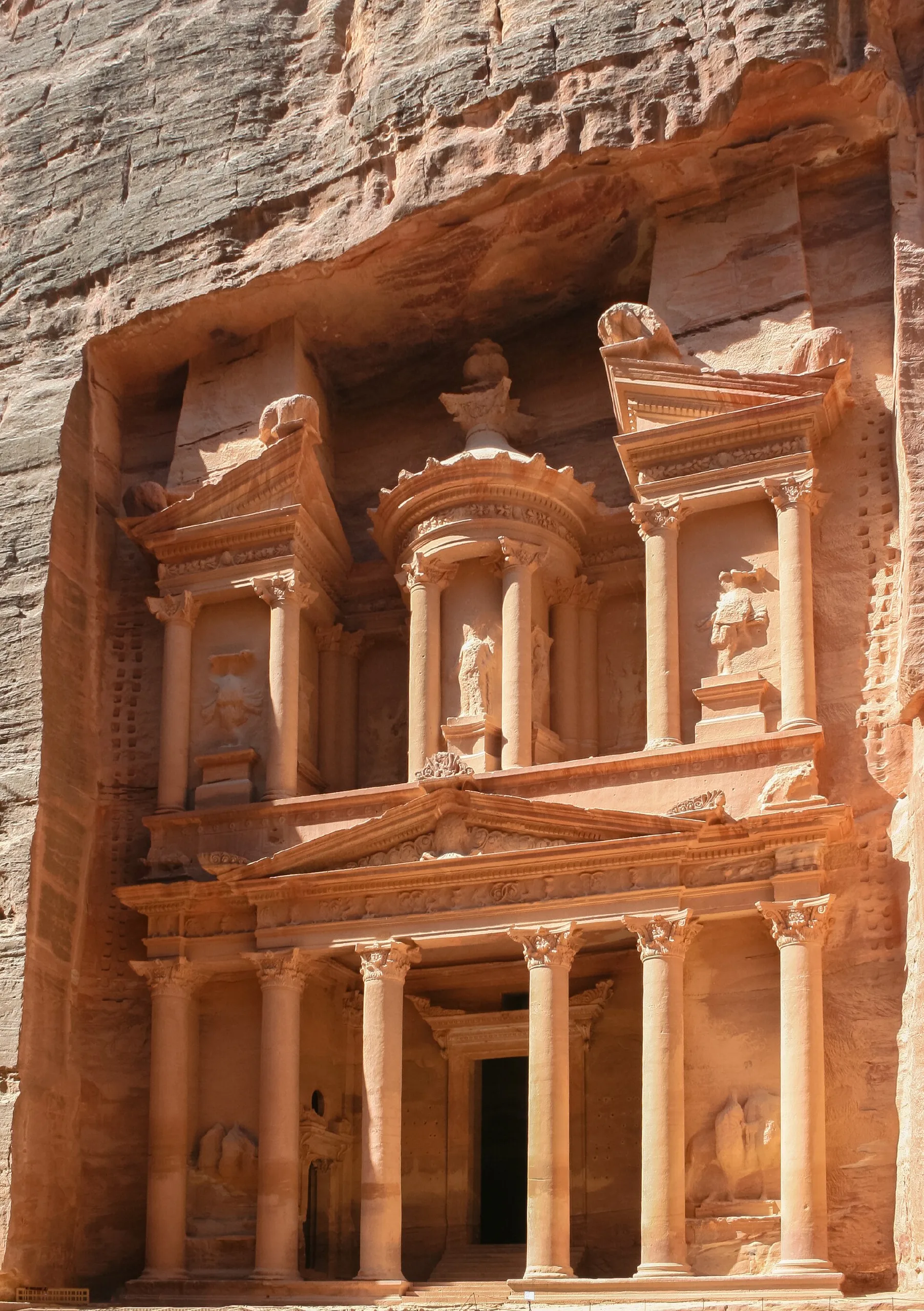
You enter through the Siq, a gorge more than a kilometer long between walls up to eighty meters high. At the end, through a crack, the Treasury (Al-Khazneh) appears, almost forty meters tall: in fact a royal tomb. From there the valley opens up: the Street of Facades, the theater, the Royal Tombs.
Here is the main trail in the order you walk it. From the visitor center to the far end of the valley it is about four kilometers, nearly flat, one way.
Before the Siq. The first 800 meters run down an open valley. Look to the right for the Djinn Blocks, great cubes of rock whose purpose nobody knows, and to the left for the Obelisk Tomb, with four pyramids on its front.
The Siq. It is not a canyon cut by a river but a crack opened by the movement of the earth, which is why the two walls match. Follow the channels cut along both sides at waist height: they carried drinking water into the city, in clay pipes on one side and an open gutter on the other. Parts of the Roman paving survive underfoot. The walk takes about half an hour, and the light is best early, when the walls glow and the tour groups have not arrived.
The Treasury. It was carved in the first century, probably as the tomb of a Nabataean king. The name comes from a Bedouin legend that a pharaoh had hidden his gold in the stone urn at the top; the bullet marks on the urn are from those who tried to shoot it open. You cannot go inside, and there is little to see: a plain square chamber. In 2024 archaeologists announced the discovery of a hidden tomb with twelve skeletons under the forecourt, a reminder of how much of Petra is still buried. The facade is in full sun from about 9:00 to 11:00.
The Street of Facades and the theater. Beyond the Treasury the gorge widens and the cliffs fill with dozens of tombs in rows. The theater, cut into the rock in Nabataean times and enlarged by the Romans, seated several thousand; its builders sliced through older tombs to make room, and you can see the holes at the back.
The Royal Tombs. A stair on the right climbs to four enormous facades side by side. The Urn Tomb has a courtyard on vaults and was turned into a church in the fifth century. The Silk Tomb is the most striking: the rock itself is banded in red, white, yellow and gray, like watered silk. They face west, so they are at their best in the late afternoon.
The city center. The Colonnaded Street was the main avenue of the Roman city. To its left rises the Great Temple, a vast complex with a small theater inside; at its end stands the Qasr al-Bint, the only large free-standing building that survived the earthquakes. On the slope to the right, under a modern roof, a Byzantine church keeps a floor of sixth-century mosaics with animals, seasons and people at work.
Almost everyone turns back at the Treasury. The best part starts after it.
The Monastery
At the far end of the site, some 800 carved steps climb to Ad Deir, the Monastery, larger than the Treasury and far less crowded. Allow an hour for the climb.
It is the largest facade in Petra, nearly fifty meters wide and almost as tall, cut into a mountaintop in the first century. It was probably a meeting hall for a religious brotherhood; the crosses scratched inside by later Christians gave it its name. The path starts behind the restaurant at the end of the main trail and climbs through a side gorge with views that get better at every turn. Go in the afternoon: the facade faces west and is in shadow until midday. A café in a cave opposite sells tea and cold drinks, and you will have earned them.
Do not stop at the facade. Signs point to viewpoints ten minutes further on, at the edge of the plateau, where the mountains drop to the Wadi Araba, the great rift valley that runs from the Dead Sea to the Red Sea.
Which other trails are worth the effort?
Two, and they are what make a second day worthwhile.
The High Place of Sacrifice. A stair cut in the rock starts near the theater and climbs for about 45 minutes to a mountaintop where the Nabataeans leveled a platform, carved an altar and channels for the blood of the offerings, and left two obelisks seven meters high by cutting away the whole summit around them. The view covers the entire valley. Instead of returning the same way, go down the far side through Wadi Farasa: you pass a lion carved in the rock that was once a fountain, the Garden Tomb and the Roman Soldier's Tomb, and come out near the city center. It is the best walk in Petra.
Al-Khubtha, the Treasury from above. Behind the Royal Tombs, a stairway of several hundred steps leads in about an hour to a ledge directly over the Treasury, with a Bedouin tent selling tea at the edge. This is the official route to the famous photograph from above. The shorter scramble that starts beside the Treasury itself is restricted, and the men offering to guide you up it are not authorized.
Can you enter by the back door?
Yes, and it is a good idea on the second day. Little Petra, eight kilometers to the north, is a miniature of the main site, a short gorge with tombs, cisterns and dining halls where the caravans are thought to have lodged; one room keeps rare Nabataean ceiling paintings of vines and birds. It is free.
From there, a trail of about two hours crosses the mountains to the Monastery, so that you arrive at the top without climbing the 800 steps and then walk down through the whole site with the slope in your favor. The site's own shuttle goes from the visitor center to the start of the trail; you pay about 5 dinars for the off-road vehicle that covers the last stretch. You need a valid Petra ticket, bought beforehand at the visitor center, because none are sold at that end.
Is Petra by Night worth it?
It depends on what you expect. From Sunday to Thursday, at 20:30, visitors walk down the Siq by the light of candles in paper bags and sit on mats in front of the Treasury, lit by many hundreds more, for music on a Bedouin flute and a story. It lasts about two hours and costs 30 dinars in 2026, on top of the day ticket; children under ten are free.
In its favor: the walk through the dark gorge is memorable, and the first sight of the facade by candlelight is beautiful. Against: it is crowded, people talk and use their phones, and colored spotlights now accompany the candles. It is touristy, but seeing the facade by firelight is impressive. Go if you are staying two nights; do not rearrange a trip for it.
Should you hire a guide, or ride an animal?
A licensed guide for the main trail costs 50 dinars at the visitor center, for a group, and is worth it on the first morning: there are almost no explanatory signs, and a good guide makes the stones talk. For the high trails you do not need one; they are marked.
If you cannot or do not want to walk, electric carts run from the visitor center to the Treasury for 15 dinars one way, or 25 for the round trip. They are the right choice for anyone with limited mobility.
As for the animals, think twice before riding donkeys or camels: their treatment is a cause for concern. Welfare groups have documented overworked and beaten animals for years, particularly the donkeys that carry visitors up the steps to the Monastery, and the steps themselves are being worn away by hooves. The short horse ride at the entrance is nominally included in the ticket, but a tip is demanded. Our advice is to walk or take the cart. And do not buy from the children who sell postcards and stones: the site authority asks visitors not to, because it keeps them out of school.
Can you visit with children, or if you cannot walk far?
With children, yes: under-12s are free, the Siq is an adventure and there are caves to look into everywhere. The distances are the problem. Plan one long morning rather than a full day, turn around at the theater or the Royal Tombs with small children, and keep the Monastery for those old enough to climb for an hour. A carrier works better than a stroller on the sand and the old paving.
With limited mobility, Petra is partly accessible. The electric carts cover the four kilometers from the visitor center to the Treasury, and another service runs from the theater to the end of the Colonnaded Street, so the heart of the site can be seen with very little walking. The high trails and the Monastery steps cannot be avoided. Ask at the visitor center on arrival; the staff are used to arranging it.
How do you get to Petra?
The town at the gate is called Wadi Musa. It has no airport and no railway.
From Amman, it is about three hours down the Desert Highway, 235 kilometers of fast, dull road. The JETT company runs one tourist coach a day: it leaves Amman at 6:30 in the morning, returns from Petra at 17:00 and costs 10 dinars each way in 2026. That makes a day trip possible on paper, with barely five hours on site. Stay the night.
By rental car, which is how most independent travelers do it. Driving in Jordan outside Amman is easy, the roads are good and signposted in English. The slow alternative to the highway is the King's Highway, a winding road along the mountain ridge that passes the mosaics of Madaba, the Crusader castle of Kerak and the Dana nature reserve; allow a full day.
From Aqaba, on the Red Sea, it is two hours. Aqaba has an airport with some international flights and is a duty-free zone; cruise passengers who dock there usually visit on excursions such as this Petra day trip from Aqaba with transfers.
With a driver or an organized tour, if you would rather not drive. From Amman there are both private and shared day trips; you can check dates for one here. Remember what a day trip means: six hours in a vehicle for five in Petra.
A better use of the same idea is a two-day circuit that sleeps in the south, such as this two-day tour of Petra, Wadi Rum and the Dead Sea from Amman.
Where should you stay, and what will you eat?
Wadi Musa climbs a steep hillside above the entrance. The hotels at the bottom, within a few minutes' walk of the visitor center, cost more and save you a taxi at 5:30 in the morning, which matters. Those at the top are cheaper and have the views; most offer a free shuttle at fixed hours. Before or after your visit, give an hour to the Petra Museum, next to the entrance: it is free, modern and the best explanation of who the Nabataeans were.
Inside the site there are tea stalls all along the main trail and two restaurants at the far end, near the Qasr al-Bint. Most people carry a packed lunch from their hotel. Bring at least two liters of water per person, and more in summer.
In town, try mansaf, the national dish: lamb cooked in a sauce of dried, fermented yogurt and served on rice with almonds. Maqluba, "upside down", is a pot of rice, chicken and vegetables turned out onto a tray. Add hummus, falafel and flatbread from any small restaurant, and for dessert knafeh, warm cheese under a crust of shredded pastry soaked in syrup. Tea comes sweet, with sage or mint. Alcohol is sold only in some hotels and is expensive.
When to go
Spring, from March to May, and autumn, from mid-September to November, are the best seasons: warm days, cool nights and clear light. They are also the busiest.
Summer is hot, with afternoons above 35 degrees and almost no shade outside the Siq. If you come then, walk from 6:00 to 11:00, rest, and go back in after 15:00.
Winter is cold. Wadi Musa lies at more than 1,000 meters, nights fall close to freezing, and it snows some years. The crowds are thin and the low light is beautiful, but the days are short. Winter also brings the one real danger of Petra: flash floods. After heavy rain, water pours down the Siq within minutes. The authorities close the site when storms are forecast and have evacuated it more than once; if they tell you to leave, leave.
One date to check: during Ramadan, which in 2027 falls roughly between early February and early March, the site stays open, but many restaurants in town close by day and opening hours shift.
Tips
Go in first thing, at opening. Bring water, a hat and hiking shoes: you can easily walk fifteen kilometers. Stay two days if you can. And think twice before riding donkeys or camels: their treatment is a cause for concern.
A few more. Dress for sun and for a conservative country: loose trousers and covered shoulders, for men and women, are both cooler and more respectful. Carry cash in small notes for tea, tips and the toilets at the far end, though the ticket office and hotels take cards. Toilets are at the visitor center, near the theater and at the restaurants. Phone signal is patchy in the gorges; download an offline map. And pace yourself: everything you walk down in the morning, you walk up in the afternoon, and the last gentle kilometer from the Siq to the gate feels longer than all the rest.
Petra by night and beyond
Several nights a week, the Siq and the Treasury's forecourt are lit by hundreds of candles for the walk known as Petra by Night; it is touristy, but seeing the facade by firelight is impressive. And if you have days to spare, combine the visit with the desert of Wadi Rum, less than two hours away: red sand, sandstone mountains and nights in Bedouin camps under a sky without lights.
Wadi Rum is the natural second half of the trip. T. E. Lawrence passed through during the Arab Revolt and described it as vast, echoing and godlike; since then it has stood in for Mars and other planets in a long list of films. It is a protected area run with the local Bedouin, and the way to see it is in the back of a pickup: rock bridges, red dunes, canyons with inscriptions thousands of years old, and tea over a fire. A half-day is enough for a first look, for example on this four-hour jeep tour at sunrise or sunset. Better is to spend the night: the camps serve zarb, lamb and vegetables cooked for hours in an oven buried in the sand, and the sky after dark is the real reason to come. This full-day desert tour with a night in a Bedouin camp is one way to arrange it.
Further north, the Dead Sea, the lowest point on the surface of the earth at more than 400 meters below sea level, is where you float without trying. Jerash, north of Amman, is one of the best-preserved Roman cities anywhere. With a week in Jordan, the classic route is Amman and Jerash, the King's Highway, two nights in Petra, one in Wadi Rum and a last day at the Dead Sea.
What mistakes should you avoid?
Coming on a day trip from Amman. You will spend more time in the bus than in Petra, and you will be there in the worst light and the biggest crowd.
Buying the visa and the ticket separately. With two nights or more in Jordan, the Jordan Pass is cheaper. It must be bought before you arrive.
Turning back at the Treasury. It is the first monument, a quarter of the way in.
Starting at nine. By then the Siq is full and the heat is rising. At 6:00 you can have the Treasury almost to yourself.
Following an unofficial guide up the cliff beside the Treasury. The route is restricted and people have been hurt. Use the Al-Khubtha trail.
Underestimating the walk back. Keep water and energy for the last four kilometers, which are uphill.
Ignoring the weather in winter. Flash floods in the gorge are rare and serious. Follow the instructions of the rangers.
Quick answers
How much is the ticket to Petra in 2026? 50 dinars for one day, 55 for two and 60 for three if you stay overnight in Jordan; 90 dinars for same-day visitors to the country. Children under 12 are free.
Is the Jordan Pass worth it? Yes, if you stay two nights or more: it includes Petra and waives the 40-dinar visa.
What time does Petra open? At 6:00 all year. It closes around 18:00 in summer and 16:00 in winter.
How long is the walk? About four kilometers each way along the main trail, plus some 800 steps up to the Monastery: around 16 kilometers for the full day.
How many days do you need? Two is ideal. One is possible. Three for hikers.
When is Petra by Night? From Sunday to Thursday at 20:30, for 30 dinars, not included in the day ticket or the Jordan Pass.
Can you go inside the Treasury? No. The interior is closed, and it is an empty chamber.
Is it safe? Jordan is a calm country and Petra is well looked after. Regional tensions can affect flights and borders, so read your government's current travel advice before you book.
Prices and timetables in this guide were checked in November 2026 on the official pages of the Petra authority, the Jordan Pass and the JETT bus company. Confirm them before you travel.