Why Tetris never gets old
Seven shapes, one rule and forty years at the top. The story of the game a Soviet programmer made for fun, and why your brain cannot leave it alone.
Most games from 1984 are museum pieces. Tetris is still sold, still played in tournaments and still installed on your phone. No other game has lasted like it.
Made in Moscow
Tetris was created in 1984 by Alexey Pajitnov, a programmer at the Soviet Academy of Sciences in Moscow. He liked puzzles made of five-square pieces, simplified them to four squares so that a computer could handle them and made the pieces fall.
The name mixes tetra, Greek for four, and tennis, his favorite sport. The game spread from computer to computer across Moscow on floppy disks. Nobody paid for it, because in the Soviet Union the program belonged to the state.
The fight over the rights
What followed was one of the most tangled business stories in gaming. Western companies sold versions of the game without really owning the rights. Several rivals flew to Moscow at the end of the 1980s to negotiate with the Soviet trade agency.
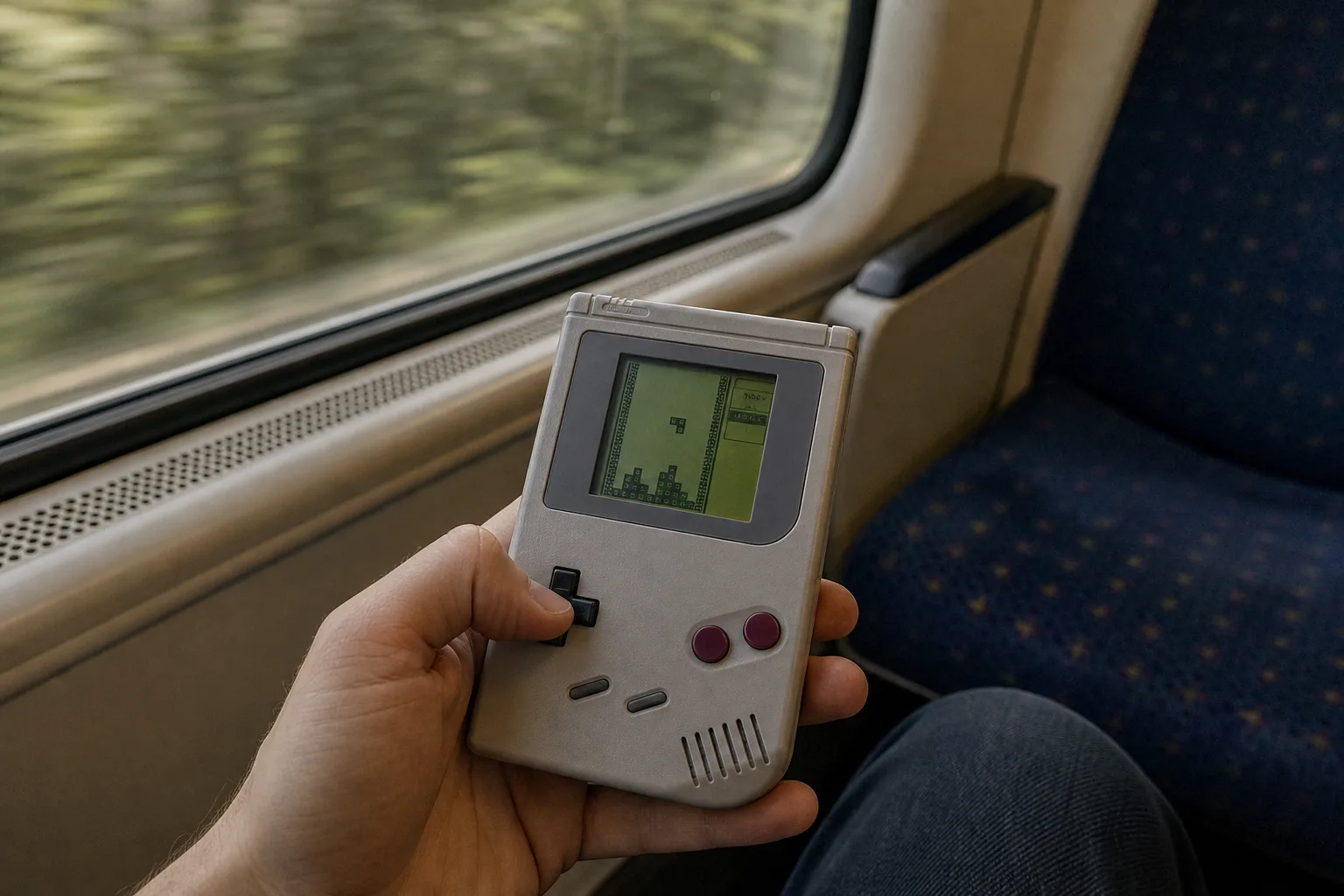
The winner was Nintendo, with the help of the game designer Henk Rogers. In 1989 it packed Tetris with every Game Boy. The pairing was perfect, and tens of millions of people who had never played anything suddenly carried a console. Pajitnov himself only began to receive royalties in 1996.
Easy to learn in thirty seconds, impossible to finish. That is the whole design.
Why it works
The rules fit in one sentence: complete horizontal lines so they disappear. There are only seven pieces. But the game never ends in victory. It only gets faster until you lose, so there is always a reason to try again.
It also leaves a mark on the mind. People who play for a long time see falling blocks when they close their eyes. Psychologists call it the Tetris effect.
Still breaking records
For decades, players believed the original Nintendo version could not be beaten: at some point the pieces fall too fast for human hands. Then players invented new ways of holding the controller. At the end of 2023, an American thirteen-year-old played until the game itself crashed, something only an artificial intelligence had done before.
The music
The famous tune is not original. It is "Korobeiniki", a nineteenth-century Russian folk song about a peddler. Millions of people around the world can hum it without knowing its name.
Where to play today
Almost anywhere. There are official versions for every console and phone, including one where ninety-nine players compete at once.