Etching, lithograph, screenprint: how to read an art print
A print is not a poster. It is an original work made to exist in several copies. What the techniques are, and what those small numbers in pencil mean.
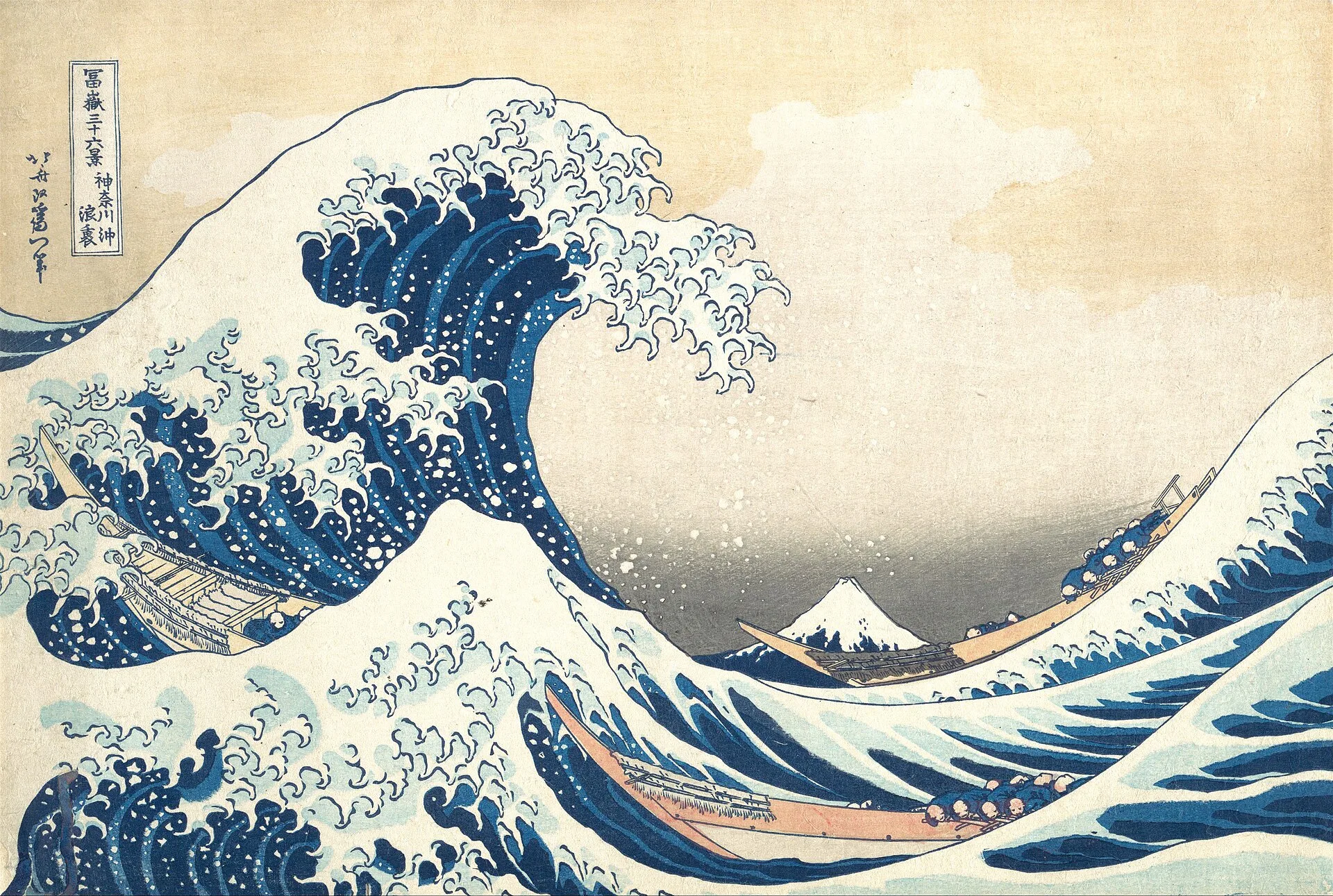
Walk into a gallery and you may see the same image hanging in several frames, each with a small pencilled number in the corner, such as 12/50. That is not a copy of a painting. It is a print, a work designed from the start to be made in several originals. Artists from Albrecht Dürer to Andy Warhol have used prints to reach more people than a single canvas ever could, and some of the most famous images in art history, from Hokusai's Great Wave to Goya's nightmares, exist only as prints.
This guide explains what makes a print an original work, the main techniques and how to recognise them, what the pencilled notes in the margin mean, and how to buy, care for and enjoy prints.
Prints and reproductions
The key difference is how the image was made. An original print is created by the artist, or under their direct supervision, using a matrix they made themselves: a block of wood, a metal plate, a stone or a screen. Ink is applied to the matrix and transferred to paper, and each sheet that results is an original, even though there are many of them.
A reproduction, by contrast, is a photographic or digital copy of an existing artwork, like a poster, a postcard or a book illustration. It can be beautiful and useful, but it is a record of a work, not the work itself. The art market treats the two very differently, and so should you when buying.
A short history of printmaking
Printing images is older than printing books in Europe. In China, woodblock printing was used for texts and images more than a thousand years ago; the Diamond Sutra, dated 868 and now in the British Library, is often cited as the oldest dated printed book, and it opens with an illustration. In Europe, woodcuts of saints and playing cards circulated in the early 15th century, shortly before Gutenberg's press.
The German artist Albrecht Dürer, around 1500, turned woodcut and engraving into high art and sold his prints across Europe, becoming famous far beyond his city of Nuremberg. In the 17th century, Rembrandt made etchings that he reworked again and again, producing different versions of the same image. At the end of the 18th century, Francisco de Goya used etching and aquatint for his series Los caprichos, published in 1799, a sharp satire of Spanish society, and later for the Disasters of War.
In Japan, colour woodblock prints known as ukiyo-e flourished from the 17th to the 19th centuries. Hokusai's Under the Wave off Kanagawa, made around 1831, was printed in thousands of copies and sold cheaply; today, surviving impressions are among the most treasured prints in museums. When Japanese prints reached Europe in the second half of the 19th century, they deeply influenced Monet, Van Gogh and many others.
In the 20th century, prints became a political and popular medium. The German Expressionists of the group Die Brücke, founded in Dresden in 1905, revived the woodcut with raw, angular forms, and Käthe Kollwitz made powerful prints about poverty and war. In Mexico, José Guadalupe Posada printed satirical skeleton images for cheap broadsheets, including the figure later known as La Catrina, and in 1937 artists founded the Taller de Gráfica Popular, a collective that produced prints for social causes. In the 1960s, pop artists embraced commercial techniques, and screenprinting became the signature of an era.
The four families
Printmaking techniques are usually grouped into four families, depending on where the ink sits on the matrix.
1. **Relief**: the artist cuts away the parts of a block that should stay white, inks the raised surface and presses paper onto it, like a rubber stamp. **Woodcut** is the oldest form. **Linocut**, cut into linoleum, is softer and easier to carve, and was used by Picasso and Matisse. **Wood engraving**, cut into the hard end grain of the wood, allows very fine lines.
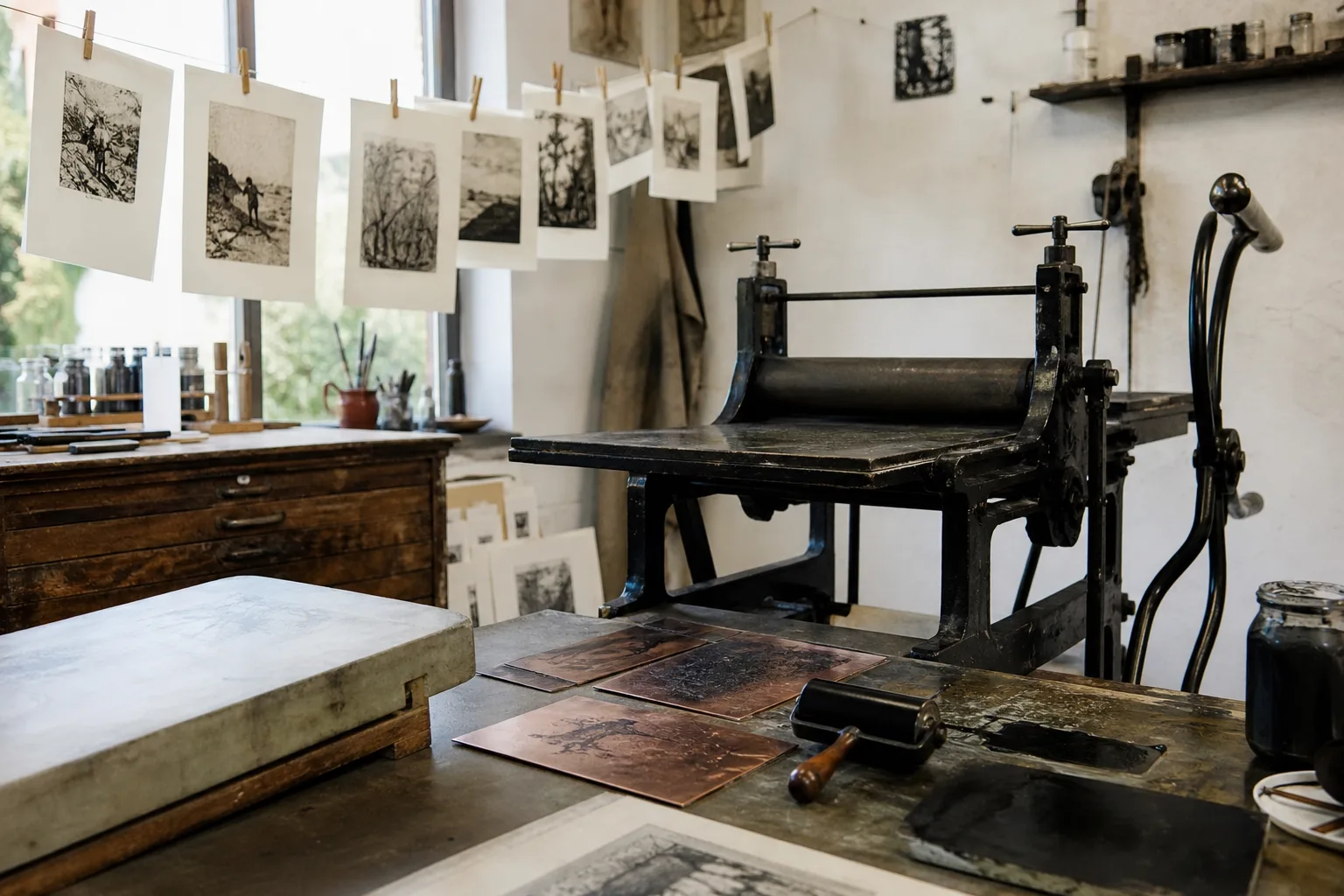
2. **Intaglio**: the opposite principle. Lines are cut or bitten into a metal plate, ink is pushed into the grooves, the surface is wiped clean, and a heavy press forces damp paper into the grooves to pick up the ink. In **engraving**, the artist cuts lines with a sharp tool called a burin. In **etching**, the plate is covered with an acid-resistant ground, the artist draws through it with a needle, and acid bites the exposed lines. **Drypoint** scratches lines directly, raising a burr that gives a soft, velvety line. **Aquatint** uses resin dust and acid to create areas of tone, like a wash of ink.
3. **Planographic**: the image is on a flat surface. In **lithography**, the artist draws on a smooth stone or plate with a greasy crayon or ink. The surface is dampened, and because grease and water repel each other, the oily ink sticks only to the drawing. It was invented by **Alois Senefelder** in Munich in 1796, and allowed artists to draw freely, almost as on paper. Toulouse-Lautrec used colour lithography for his famous Paris posters in the 1890s. A **monotype**, painted on a smooth plate and printed once, is a related technique that produces a single unique impression.
4. **Stencil**: ink is pushed through a fine mesh, with parts blocked by a stencil. **Screenprinting**, also called serigraphy, gives flat, bold areas of colour. Andy Warhol made it the signature technique of pop art, repeating images of celebrities and consumer goods.
A print is not a lesser painting. It is a different way of thinking, one that works in reverse and in layers.
Thinking in reverse and in layers
Printmaking imposes particular disciplines. Because the paper is pressed against the matrix, the image comes out reversed: text and compositions must be made as mirror images. Colour prints are usually made with a separate block, plate, stone or screen for each colour, printed one on top of another, and every layer must line up exactly, a process called registration. Japanese woodblock prints could involve a dozen or more blocks for a single image.
Many artists also work through states: they print a proof, change the plate, print again, and so on. Collectors and museums study these states to see how an image developed. Rembrandt's plates sometimes went through many states, and the differences can be dramatic.
The paper matters too
A print is ink on paper, and the paper is part of the work. Printmakers choose it as carefully as painters choose canvas. Traditional European papers were made from cotton or linen rags, which last for centuries when kept well; Japanese papers, made from the long fibres of plants such as kozo, are thin, strong and absorbent, ideal for woodblock printing. Many modern printmaking papers are still made from cotton and are free of the acids that make cheap paper turn yellow and brittle.
Paper also helps experts date and authenticate prints. Many handmade papers carry a watermark, a design formed in the mould that becomes visible when the sheet is held up to the light. Because paper mills and their watermarks changed over time, a watermark can show whether an impression of an old master print was made during the artist's lifetime or much later. The texture of the paper tells a story as well: laid paper shows fine parallel lines from the wires of the mould, while wove paper, which became common from the late 18th century, has an even surface.
Large margins are valued for the same reason. Collectors prefer prints whose margins have not been trimmed, because the full sheet preserves the plate mark, any inscriptions and the integrity of the object.
Reading the margin
The information is written in pencil below the image, and learning to read it is the first step in understanding a modern print.
5. **Edition number**, such as 12/50: this is the twelfth print in an edition of fifty. The number does not usually affect value much; the order of printing often has little to do with the order of numbering.
6. **Signature**: the artist's signature, usually at the bottom right. Signing prints in pencil became common only from the late 19th century. Older prints may have a signature engraved in the plate, or none at all.
7. **Title and date**: sometimes written at the bottom left or centre.
8. **A.P. or E.A.**: artist's proof, or *épreuve d'artiste*, a small number of prints kept outside the edition for the artist, usually about a tenth of its size.
9. **H.C.**: *hors commerce*, not for sale, prints for the workshop, the publisher or exhibitions.
10. **B.A.T.**: *bon à tirer*, "good to print", the proof the artist approves as the standard that the printer must match for the whole edition.
11. **T.P.**: trial proof, an early test print, often different from the final edition.
After the edition is printed, the matrix is often cancelled, for example by scoring a line across the plate, to guarantee that no more prints will be made. Some museums and collectors also look for the blind stamp, an embossed mark without ink pressed into the paper by the printing workshop.
Workshops and master printers
Many artists do not print their own editions. They work with master printers in specialised workshops, who understand presses, inks and papers in depth and help the artist translate an idea into the technique. In the second half of the 20th century, workshops such as Tamarind in the United States and many studios in Paris, Barcelona, Berlin and Mexico City helped revive lithography and drew painters and sculptors into printmaking. The printer's name or stamp often appears on the sheet or in the documentation.
Restrikes, posthumous prints and digital prints
Not every print is what it seems.
12. **Restrikes**: prints made from an original plate long after the artist's death. Goya's copper plates, preserved at the Calcografía Nacional in Madrid, have been printed in several later editions. Restrikes can be interesting but are worth much less than lifetime impressions.
13. **Posthumous editions**: prints made after the artist's death by estates or publishers, sometimes with stamped signatures.
14. **Digital prints**: high-quality inkjet prints, often called **giclée**. When an artist creates an image digitally and supervises the printing, the result can be a legitimate original edition. When a painting is simply photographed and printed, it is a reproduction, even if it is signed and numbered.
How to tell what you are looking at
Look closely, ideally with a magnifying glass, and in raking light.
15. **Etching and engraving**: a **plate mark**, a slight dent in the paper around the image, and lines of ink that stand slightly raised from the surface.
16. **Woodcut and linocut**: bold shapes, sometimes visible wood grain, and ink pressed into the paper with a slight embossing on the back.
17. **Lithograph**: soft, crayon-like textures with no plate mark and no raised ink.
18. **Screenprint**: flat, thick layers of colour with sharp edges.
19. **Reproduction**: a regular pattern of tiny dots, the rosettes of commercial offset printing, or a uniform inkjet texture.
If you are unsure, ask the gallery or a specialist. A reputable dealer will explain the technique, the edition and the provenance.
Buying prints
Many collectors start with prints, because they are one of the most affordable ways to own an original work. Some tips:
20. **Ask for documentation**: technique, edition size, printer or workshop, date and whether the print is signed by hand.
21. **Check the condition**: look for fading, stains, foxing, small brown spots caused by damp, and whether the margins have been trimmed, which reduces value.
22. **Start local**: print fairs, art school sales and artist-run workshops offer original prints by living artists at modest prices.
23. **Buy what you love**: the market can be unpredictable, but a print you enjoy every day is always worth having.
Caring for prints
Paper is fragile. Frame prints with acid-free mounts and backing, use glass or acrylic that filters ultraviolet light, and hang them away from direct sunlight, radiators and damp walls. Do not use adhesive tape on the print itself. Unframed prints should be stored flat, between sheets of acid-free paper.
Where to see prints
Most great museums have a print room where works on paper are stored away from light and can often be viewed by appointment. The British Museum in London, the Albertina in Vienna, the Kupferstichkabinett in Berlin and the National Library of Spain in Madrid hold vast collections. In Mexico City, the Museo Nacional de la Estampa is devoted entirely to printmaking.
Prints have always been the democratic side of art: cheaper than paintings, easier to move, made to circulate. They carried news, satire, religion and beauty into ordinary homes for centuries. Learning to read them, from the ink on the paper to the numbers in the margin, opens a whole world of art that is often hiding in plain sight.