What art restorers do, and what happens when it goes wrong
Cleaning a masterpiece can reveal colours nobody has seen for centuries, or start a scandal. How conservation works, and the rules restorers follow.
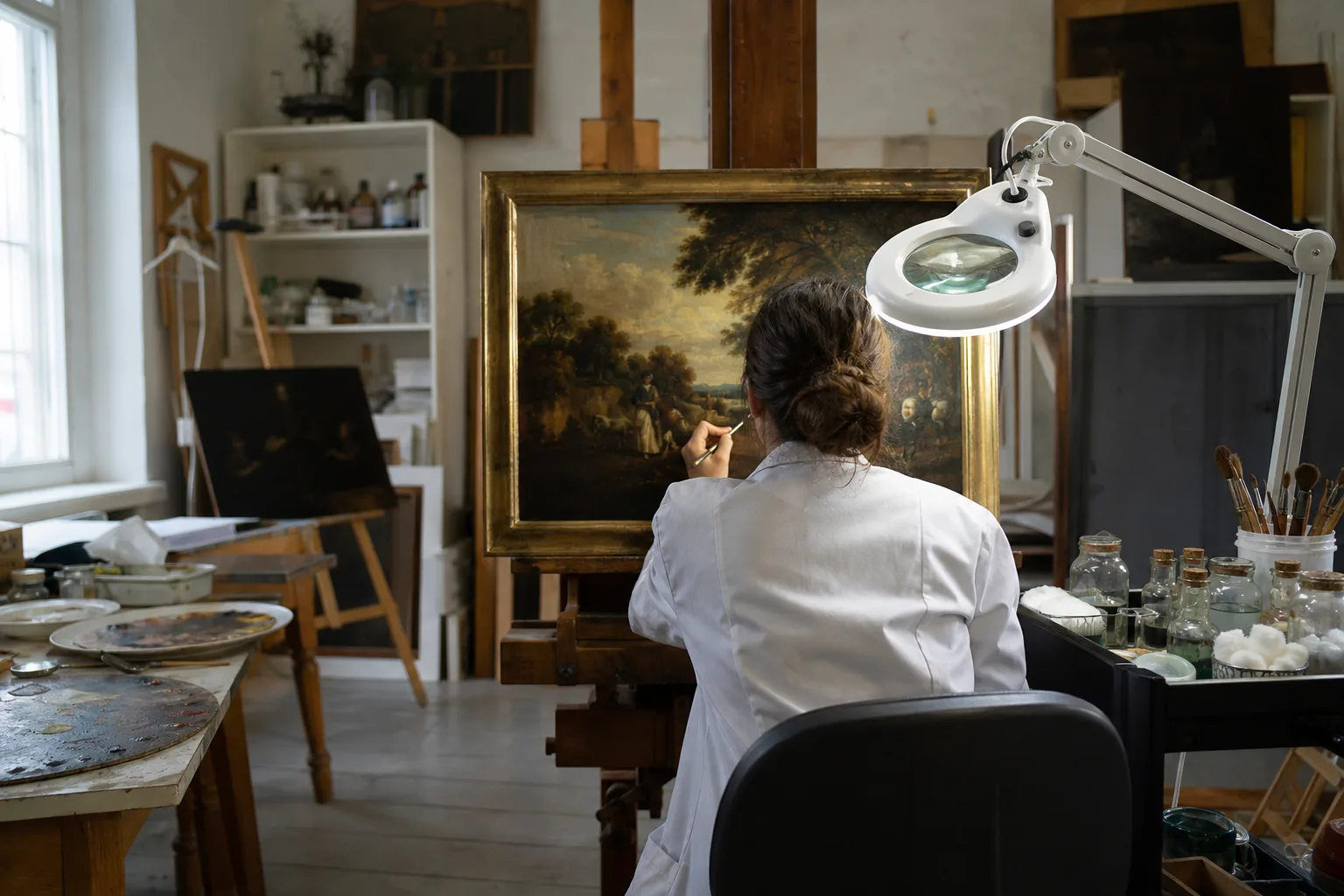
Every famous painting you see in a museum has been looked after, cleaned or repaired at some point, often several times. The people who do it are conservators, or restorers, and their work sits somewhere between science, craft and ethics. When it goes well, nobody notices; when it goes badly, the whole world laughs.
This guide explains why artworks need care, what a restoration actually involves, the rules modern conservators follow, the great controversies and disasters, and what you can do to look after art at home.
Conservation and restoration
The two words are often used interchangeably, but professionals distinguish them. Conservation is everything done to slow down decay and keep an object stable: controlling light and humidity, fixing flaking paint, strengthening a weak support. Restoration goes a step further and tries to recover the appearance of a work, for example by removing yellowed varnish or filling losses. Many professionals now call themselves conservator-restorers to cover both.
The profession has become highly specialised. Conservators train for years, usually at university, and specialise in particular materials: paintings, paper, textiles, sculpture, archaeological objects, furniture, photographs or even modern plastics and video art. They work in museums, libraries, archives, private studios and on historic buildings.
Why artworks need care
Paintings age. The varnish that once protected the surface turns yellow and brown, so a blue sky can look green and a pale face can look tanned. Canvas slackens and tears, wooden panels warp and crack, paint shrinks, cracks and flakes, and earlier repairs change colour over time. Smoke from candles and fires, light, damp, insects and accidents all leave marks.
Previous treatments can be as damaging as time. For centuries, owners and artists repainted works to suit new tastes, enlarged or cut them down to fit a frame, covered nudity or added details. Some 19th-century "restorers" cleaned paintings with harsh chemicals or scrubbed away delicate glazes. Much of today's conservation consists of undoing the work of earlier, well-meaning hands.
Looking before touching
Before touching anything, conservators study the work, often for weeks.
1. **X-rays** reveal what lies beneath the visible surface: earlier compositions, changes of mind, hidden repairs and the structure of the support.
2. **Infrared reflectography** can show the artist's underdrawing, the sketch made on the prepared surface before painting.
3. **Ultraviolet light** makes old varnish glow and shows later retouching as dark patches.
4. **Paint samples**, tiny cross-sections studied under the microscope, show the layers of a painting and identify pigments. Because some pigments were only invented at known dates, analysis can also reveal forgeries: a supposedly 17th-century painting containing titanium white, a pigment not used in art until the 20th century, cannot be what it claims.
Everything is photographed and documented, so that the condition before treatment is recorded forever.
What a restoration involves
After the study come the usual steps, adapted to each object.
5. **Cleaning**: removing surface dirt, and then old discoloured varnish and later overpaint, with carefully tested solvents or gels. Conservators often work a few square centimetres at a time with cotton swabs, watching closely under magnification.
6. **Consolidation**: fixing loose or lifting paint so it does not fall off, often with adhesives applied under gentle heat and pressure.
7. **Structural repair**: mending tears, flattening distortions or adding a new canvas behind a weak one, a process called **lining**, which today is done far less often than in the past.
8. **Filling and retouching**: filling small losses so the eye is not distracted, then painting only within those losses.
9. **Varnishing**: applying a fresh, stable varnish that protects the surface and can be removed safely in the future.
A major restoration can take months or years. Leonardo da Vinci's Last Supper in Milan, painted on a wall and deteriorating almost from the start, underwent a restoration that lasted from 1978 to 1999.
The rules of modern conservation
Modern conservation follows a few principles, developed in the second half of the 20th century and written into the codes of ethics of professional bodies.
10. **Minimal intervention**: do only what is necessary.
11. **Reversibility**: use materials that a future conservator can remove without harming the original.
12. **Distinguishability**: additions should be recognisable on close inspection, so that no one mistakes them for the artist's work.
13. **Documentation**: record every step, with photographs and reports.
The Italian theorist Cesare Brandi, director of the Istituto Centrale del Restauro in Rome, set out many of these ideas in his Theory of Restoration, published in 1963. His institute developed tratteggio, a retouching technique made of fine vertical hatched lines that blend into the image from a normal viewing distance but can be seen clearly up close. Many museums today use similar methods, or simply make retouching slightly different in tone, so that a viewer can tell what is original.
A restorer's job is not to make a painting look new. It is to let it look like itself.
Beyond paintings
Paintings get the headlines, but conservators care for every kind of object, and each material has its own problems.
14. **Paper**: drawings, prints, books and documents suffer from acidity, light, damp and mould. Paper conservators wash sheets in carefully controlled baths, repair tears with thin Japanese tissue and wheat starch paste, and rebind fragile books.
15. **Textiles**: tapestries, costumes and flags are weakened by light, dust and their own weight. Conservators support them with stitching onto fine fabrics, often taking months for a single large tapestry.
16. **Sculpture and stone**: outdoor monuments face pollution, rain, frost and graffiti. Conservators clean them, consolidate crumbling surfaces and sometimes replace originals with copies, moving the original indoors. Michelangelo's *David* in Florence has stood inside the Accademia since 1873, while a copy occupies its original place in the square.
17. **Archaeological objects**: metal, ceramics and organic remains begin to deteriorate quickly once excavated, so conservators often work on site alongside archaeologists.
18. **Wall paintings and murals**: they cannot be moved easily, so conservators work on scaffolding, in churches, palaces and public buildings, sometimes for years.
Modern and contemporary art
Recent art poses some of the hardest questions. Many artists of the 20th and 21st centuries used materials never meant to last: household paints, plastics, foam, food, fat, electronics and video. Plastics yellow and crack, foam crumbles, and the equipment needed to play an artwork made with a cathode-ray television or a slide projector may no longer be manufactured.
Conservators of contemporary art often interview living artists to understand what matters most in a work: its exact material, its appearance, or the idea behind it. Sometimes the answer is that a damaged element can simply be replaced; sometimes the decay is part of the work. Misunderstandings can be costly. In 1986, a cleaner at the Düsseldorf art academy wiped away a corner of fat that the German artist Joseph Beuys had installed, believing it to be dirt.
When restoration causes debate
Even careful restorations can provoke fierce arguments, because they change how a famous work looks.
The restoration of Michelangelo's frescoes in the Sistine Chapel, carried out between 1980 and 1994, revealed bright pinks, greens and oranges under centuries of soot and old glue. Some critics and artists accused the restorers of removing the master's own final touches, which they believed had been painted on top of the dry plaster to deepen the shadows. Today most experts accept the result, but the argument showed how much our idea of a painting depends on the dirt we are used to.
In the middle of the 20th century, the National Gallery in London faced a long cleaning controversy after removing old varnish from several masterpieces; critics argued that the cleaning had been too aggressive. In 1984, the Prado's restoration of Velázquez's Las Meninas was also debated before being widely accepted. More recently, the restoration of the Ghent Altarpiece by the van Eyck brothers caused a stir in 2020 when the removal of 16th-century overpaint revealed the original face of the Lamb of God, startlingly human-like, and the image spread worldwide on social media.
When it goes wrong
Then there are the true disasters. In 2012, a fresco of Christ in a church in Borja, in Spain, was repainted by an elderly parishioner without training who had wanted to repair the flaking image. The result became a worldwide joke, nicknamed "Ecce Mono", "Behold the Monkey". The town then saw an unexpected wave of tourism, and the church began charging visitors to see the painting.
Other cases have followed. In 2020, a copy of a Murillo painting owned by a private collector in Valencia was reportedly disfigured after being entrusted to a furniture restorer, and in the same year a sculpted figure on a building facade in Palencia was repaired with a face that many compared to a cartoon. Professional associations point to such cases to argue for regulation of the profession, which is not protected by law in many countries, so that anyone can call themselves a restorer.
Emergencies
Some of the most important conservation work happens after disasters. When the river Arno flooded Florence in November 1966, mud and oil damaged thousands of paintings, books and manuscripts. Volunteers from around the world, nicknamed the "mud angels", rushed to help, and the rescue effort drove major advances in conservation techniques, especially for paper and panel paintings.
When fire tore through the roof of Notre-Dame de Paris in 2019, conservators worked for years to clean and stabilise the cathedral's stone, paintings and decoration before it reopened at the end of 2024. Conservators are also part of international efforts to protect heritage during wars and natural disasters, often evacuating or securing objects under difficult conditions.
Prevention: the quiet side of the job
Most conservation is invisible and preventive. Museums carefully control light, because ultraviolet and even visible light fade pigments and weaken paper and textiles; works on paper are often displayed in very dim rooms and only for limited periods. They keep temperature and humidity stable, because wood and canvas swell and shrink with moisture, cracking the paint. They monitor pests, use special materials for storage and plan how objects travel to exhibitions. A painting that is protected from damage never needs dramatic restoration.
Restoration you can watch
Some museums now restore their masterpieces in public. In Amsterdam, the Rijksmuseum has worked on Rembrandt's Night Watch inside a glass room since 2019, with live updates online, in a project that also used advanced scanning to map the painting in extraordinary detail. Other museums open their conservation studios on special days or publish videos showing how cleaning reveals hidden colours.
Watching a conservator work, one swab at a time, changes how you look at every painting on the walls. You begin to wonder how the colours looked when they were fresh, what lies beneath, and how many hands have cared for the picture before yours.
A profession of patience
Conservators often describe their work as a conversation with the past. They need steady hands and sharp eyes, but also knowledge of chemistry, art history and materials science, and the humility to accept that their own work will one day be judged, and perhaps undone, by a future colleague. Many spend long hours on tasks invisible to the public, such as removing one layer of varnish from a corner the size of a coin. Training usually takes several years, often including internships in museum studios, and jobs are competitive. Yet few professions offer the same privilege: to spend months face to face with a work that has survived for centuries, and to help it survive a little longer.
Looking after art at home
You do not need to be a professional to protect the art you own. A few basics:
19. **Avoid direct sunlight**, which fades colours and weakens paper and textiles.
20. **Keep away from heat and damp**: radiators, fireplaces, bathrooms and outside walls are risky places to hang art.
21. **Do not clean paintings yourself**: water, household cleaners and even bread, a traditional remedy, can damage paint and varnish. Dust gently with a soft, dry brush at most.
22. **Frame works on paper properly**, with acid-free materials and UV-filtering glass.
23. **Ask a professional**: if a work is flaking, torn or valuable, consult a qualified conservator. Professional associations in many countries keep directories of members.
Art lasts as long as people care for it. Behind every masterpiece that has survived centuries there are generations of conservators, most of them anonymous, who made sure it would still be there for us to see.