Mexican muralism: the art painted on walls so everyone could see it
Rivera, Orozco and Siqueiros turned public buildings into history books. Where to see them today.
When the Mexican Revolution ended, most of the country's population could not read. In 1921, the education minister, José Vasconcelos, offered painters the walls of schools and public buildings to tell the national story. Muralism was born.
The first walls were those of the National Preparatory School, in the old Colegio de San Ildefonso, in the historic center of Mexico City. Then came the new Ministry of Public Education building, where Rivera covered the courtyards with more than two hundred panels over five years. The state paid painters a modest wage, like any other public worker, and in return gave them something no gallery could offer: an audience of millions.
The big three
Diego Rivera painted Indigenous life, the conquest and the workers' struggle in bright colors and crowded compositions. José Clemente Orozco, darker, showed suffering and distrusted every side. David Alfaro Siqueiros, a militant and experimenter, used spray guns and industrial paints.
Their differences were as much political as artistic. Rivera built a heroic, almost didactic history of Mexico, with good and bad characters easy to recognize. Orozco, who had lost his left hand in an accident as a young man, painted revolution as tragedy, with no winners. Siqueiros, the most radical, fought in the Revolution and in the Spanish Civil War, spent years in prison for his political activity and wanted painting to be as modern as a factory. In 1936 he ran an experimental workshop in New York where a young Jackson Pollock learned to pour and drip paint.
The technique
Many murals are frescoes: painted on wet plaster, a day's section at a time, with no chance to correct. It is the technique of Giotto and Michelangelo, revived for a political art.
Painters had to plan each section carefully, since the plaster dries within hours and the pigment becomes part of the wall. Later, Siqueiros in particular tried synthetic paints, airbrushes and curved surfaces that changed as the viewer moved. The aim was always the same: a picture that would last as long as the building and could be read from a distance.
The idea was simple and radical: art should not hang in drawing rooms but be where people pass by.
Where to see them
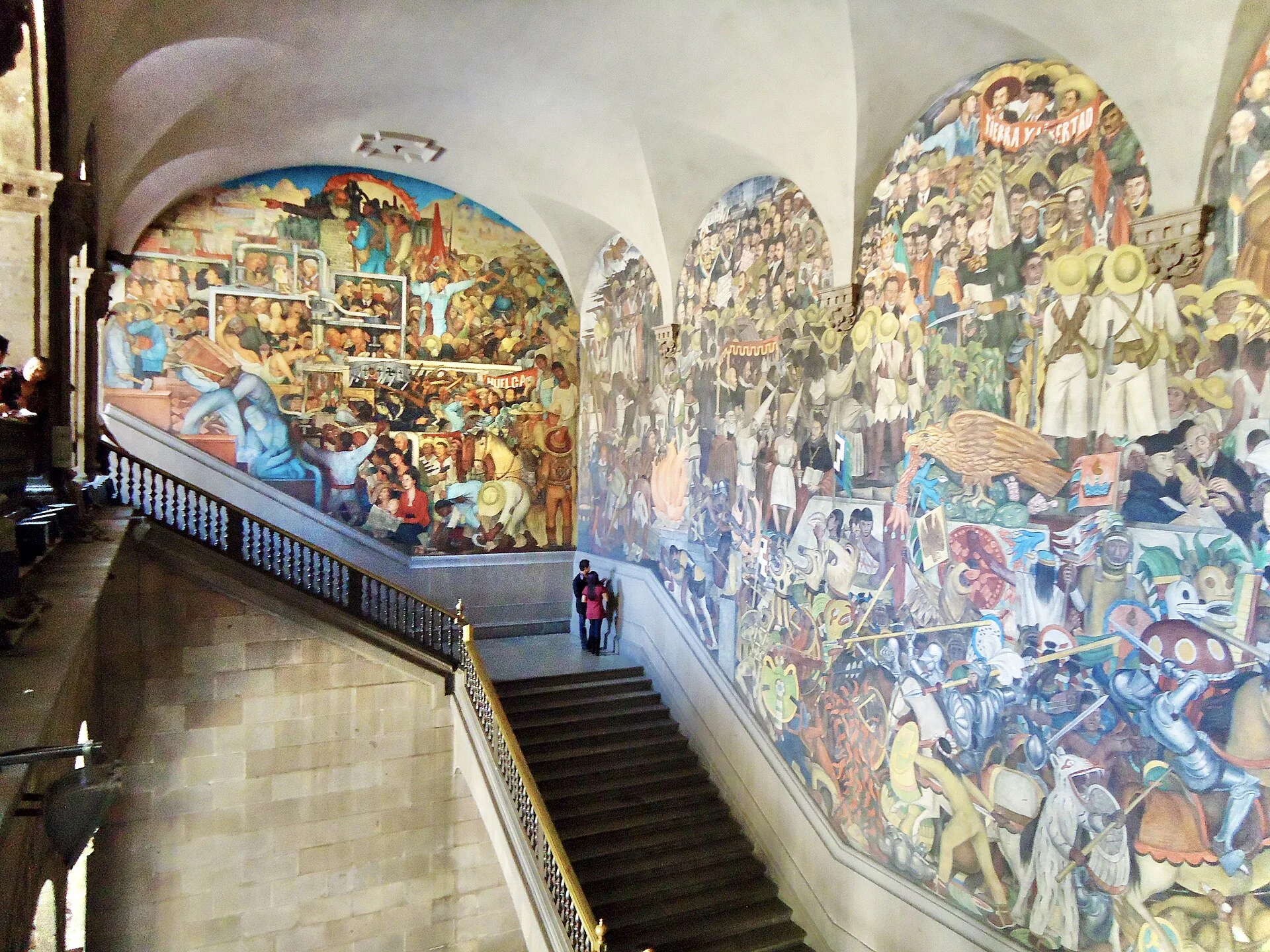
In Mexico City's National Palace, Rivera narrated the country's history on the main staircase. The Palacio de Bellas Artes brings together works by all three. In Guadalajara, Orozco's Man of Fire covers the dome of the Hospicio Cabañas, now a World Heritage site.
A good route through Mexico City's historic center can start at San Ildefonso, continue at the Ministry of Public Education, a few blocks away, and end at the National Palace and Bellas Artes, all within walking distance. Farther south, the campus of the National Autonomous University of Mexico, also a World Heritage site, has the next generation's murals, such as Juan O'Gorman's stone mosaic on the Central Library. On the way there, on Avenida Insurgentes, stands the Polyforum Cultural Siqueiros, the painter's last great project. Many of these buildings are free or cheap to enter; check the opening hours before you go, since some government buildings close for official events.
The influence
In the 1930s, all three painted in the United States. Their example inspired the public murals of the New Deal and, later, Chicano art.
Rivera's Detroit Industry, at the Detroit Institute of Arts, celebrates the car factories and their workers. Orozco painted The Epic of American Civilization in the library of Dartmouth College, in New Hampshire. Siqueiros left América Tropical in Los Angeles in 1932; it was whitewashed for its political content and only recovered decades later. In the 1970s, Chicano artists in California took up the idea of painting the neighborhood's walls to tell its own history, and murals from Los Angeles to Chicago still follow that path.
A destroyed mural
In 1933, Diego Rivera was painting a mural for Rockefeller Center in New York when he decided to include a portrait of Lenin. The Rockefellers asked him to remove it; he refused, and the work was covered and then destroyed. Rivera repainted it the following year at the Palacio de Bellas Artes in Mexico City, where it remains: Man, Controller of the Universe. The episode sums up what the muralists understood by public art.