'The Birth of Venus': a pagan goddess in Medici Florence
Botticelli painted the first great mythological nude since antiquity. How to read the Uffizi's most famous picture.
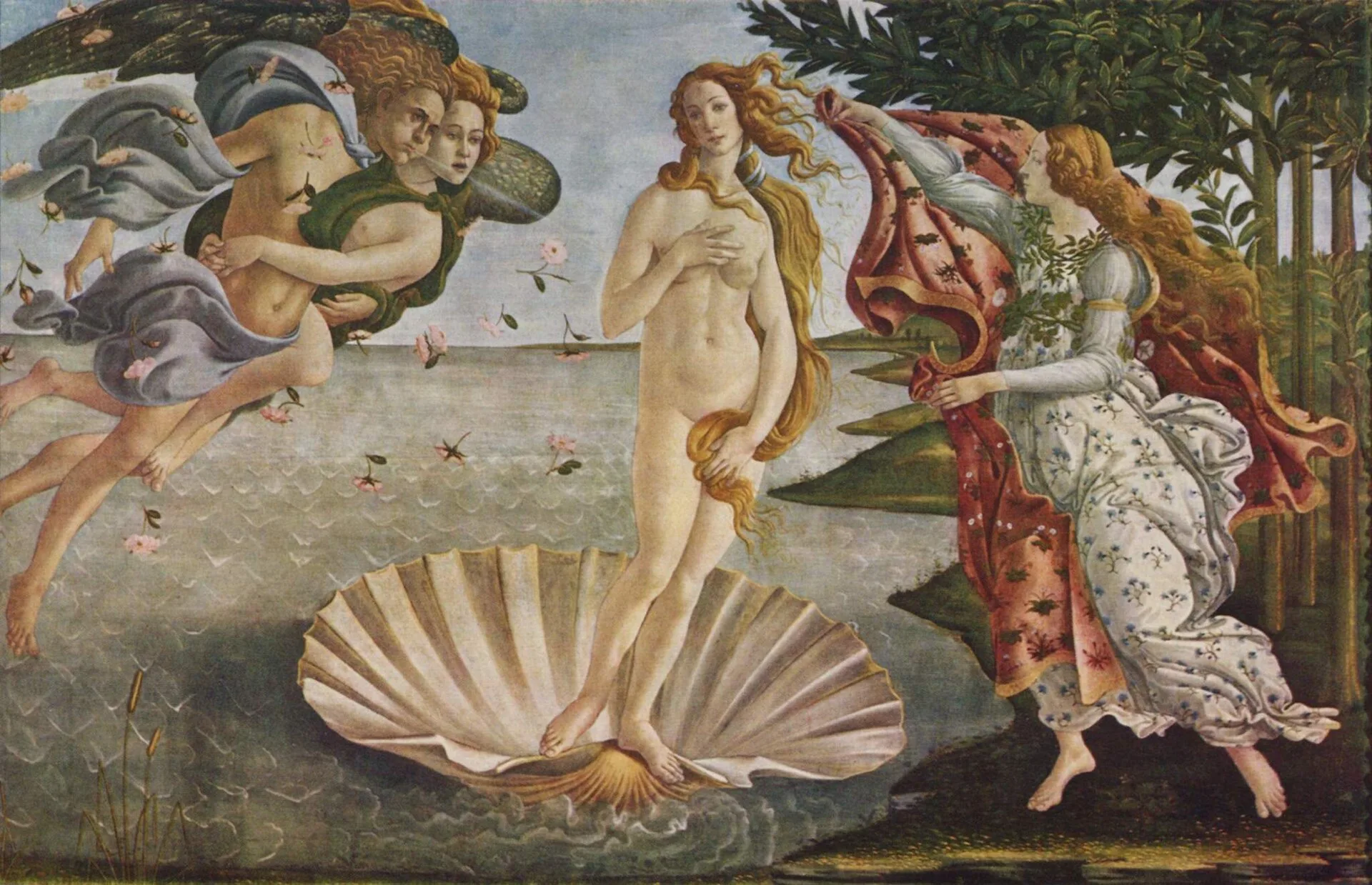
Around 1485, Sandro Botticelli painted on canvas — unusual then, when wood panel was preferred — a scene that did not come from the Bible: the goddess of love arriving on shore.
What we see
Venus, born of sea foam, advances standing on a shell. On the left, Zephyr, the west wind, blows while embracing a female figure and makes roses rain down. On the right, one of the Horae, goddesses of the seasons, hurries to cover her with a flowered cloak.
The context
Florence lived under the Medici, patrons of philosophers who wanted to reconcile Plato with Christianity. For them, earthly beauty was a path to the divine. A nearly life-size nude, unthinkable a century earlier, became possible.
Venus has no weight: she floats. Botticelli gave up anatomy to gain grace.
The "mistakes"
The neck is too long, the left shoulder drops impossibly and the pose could not be held. None of it matters. The posture comes from ancient sculptures of the Venus Pudica.
Oblivion
Botticelli died in 1510, out of fashion. The English Pre-Raphaelites rediscovered him in the 19th century.
Where to see it
At the Uffizi Gallery in Florence, next to Primavera. Book ahead and go in first thing.
The model
Tradition holds that the face of Venus is that of Simonetta Vespucci, a young noblewoman considered the most beautiful woman in Florence, who died at twenty-two. There is no proof: the picture was painted almost a decade after her death. But the legend persists, fed by one true fact: Botticelli asked to be buried in the church of Ognissanti, the same one where she lies.