The guayabera: elegance for impossible climates
Four pockets, pintucks and worn untucked. The Caribbean shirt that works for a wedding as well as an office.
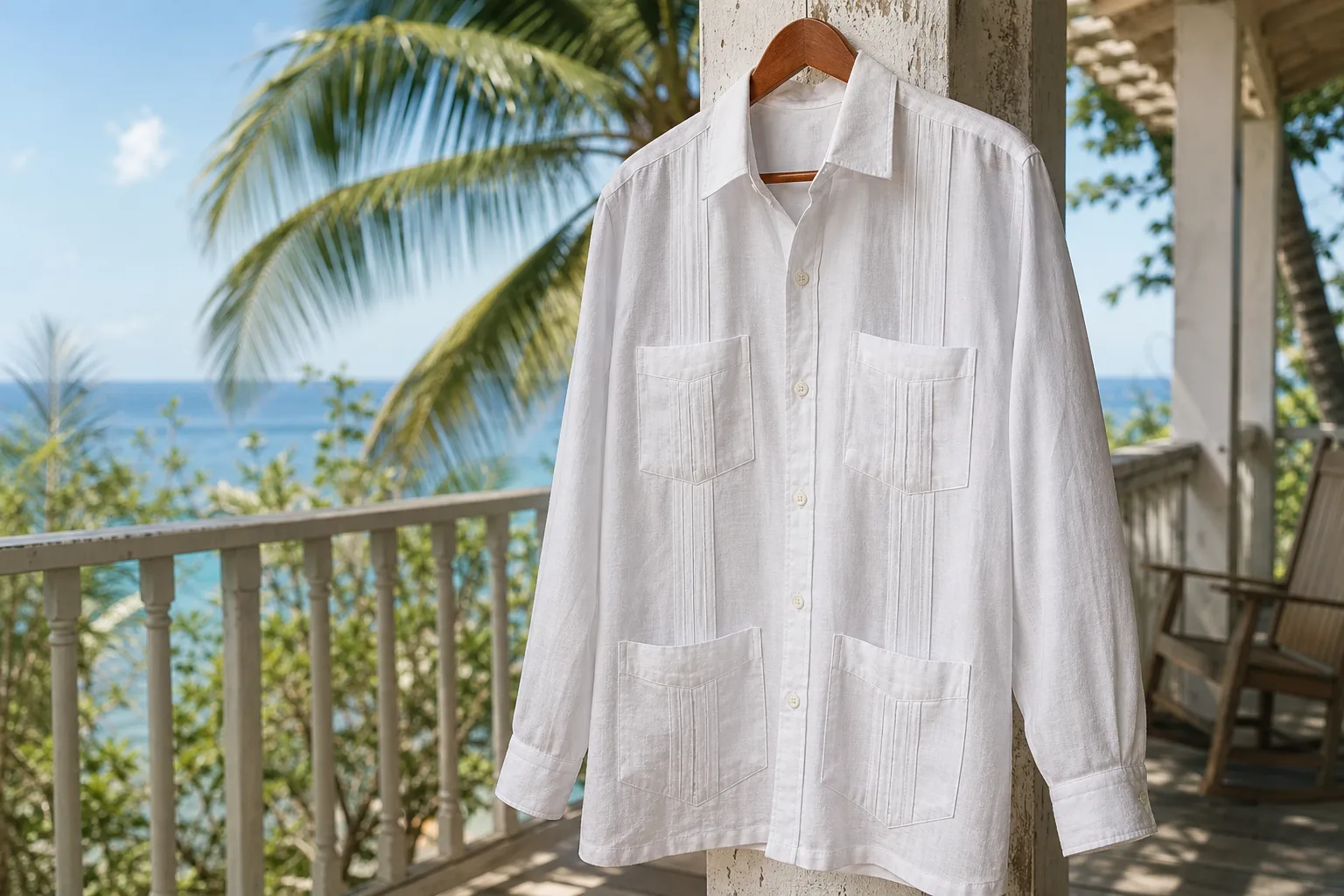
Across much of the Caribbean, Mexico and Central America, a man in a guayabera is properly dressed for any occasion, even the most formal. It is fashion's smartest answer to heat.
How to recognize it
A classic guayabera has four patch pockets, two on the chest and two at the hem. It has two vertical rows of pintucks — fine sewn pleats — on the front and three on the back. The hem is straight, with side vents, because it is worn untucked. The most formal ones are long-sleeved, white, in linen or cotton.
A disputed origin
Cuba claims it: legend places it in Sancti Spíritus, on the banks of the Yayabo River, where a seamstress is said to have sewn large pockets onto her husband's shirt to carry guavas. In Cuba it has been official dress for state events since 2010. Mexico, where Mérida is the great capital of its manufacture, and the Philippines, with its barong, claim part of the story.
The guayabera solves an old problem: how to look smart without a jacket when it is 35°C.
Who has worn it
From Ernest Hemingway in Havana to Gabriel García Márquez, who received the Nobel in 1982 wearing a liquiliqui, its Colombian-Venezuelan cousin.
How to wear it today
Well pressed, in your size, with linen trousers or chinos. No tie, of course.
Care
Linen creases: it is part of the charm. Wash it cold and iron it damp.
Close relatives
The guayabera has cousins in other warm climates. In the Philippines, the barong tagalog is an embroidered, translucent shirt of pineapple fiber that is also worn untucked and serves as formal dress. Yucatán keeps a tradition of its own, with workshops in Mérida that make them to measure. All respond to the same idea: you can be elegant without a jacket when the thermometer passes thirty degrees Celsius.