Cartagena de Indias, the city behind the wall
Wooden balconies, coral stone, and sunsets over the Caribbean: how to explore Colombia's most famous old town, with a three-day plan, the fortress, Getsemaní, the islands and the practical details.
Culturera may earn a commission if you buy through the links on this page. As an Amazon Associate I earn from qualifying purchases. The selection is ours alone.
Cartagena needs three days: one to walk the walled city without a plan, one for the fortress of San Felipe and the neighborhood of Getsemaní, and one on the water, in the Rosario Islands. Walk early and late, sleep or swim through the hours in between, and end every day in the same place, on top of the wall, facing west. Come between December and April if you can, when the sea breeze takes the edge off the heat.
Cartagena de Indias was founded in 1533 by Pedro de Heredia and soon became one of the most important ports of the Spanish Caribbean. That wealth drew pirates and privateers, and the answer was to build, over almost two centuries, kilometers of wall. Today the port, fortresses, and monuments are a World Heritage site.
It is the best-preserved colonial city in the Caribbean and the most visited place in Colombia, and both things are evident the moment you arrive: the beauty is real, and so is the crowd of people trying to sell you something. This guide tries to help with both. Where a guide or a boat is the sensible way to do something, we link tours on GetYourGuide. We have not taken these tours: they are chosen for what they cover.
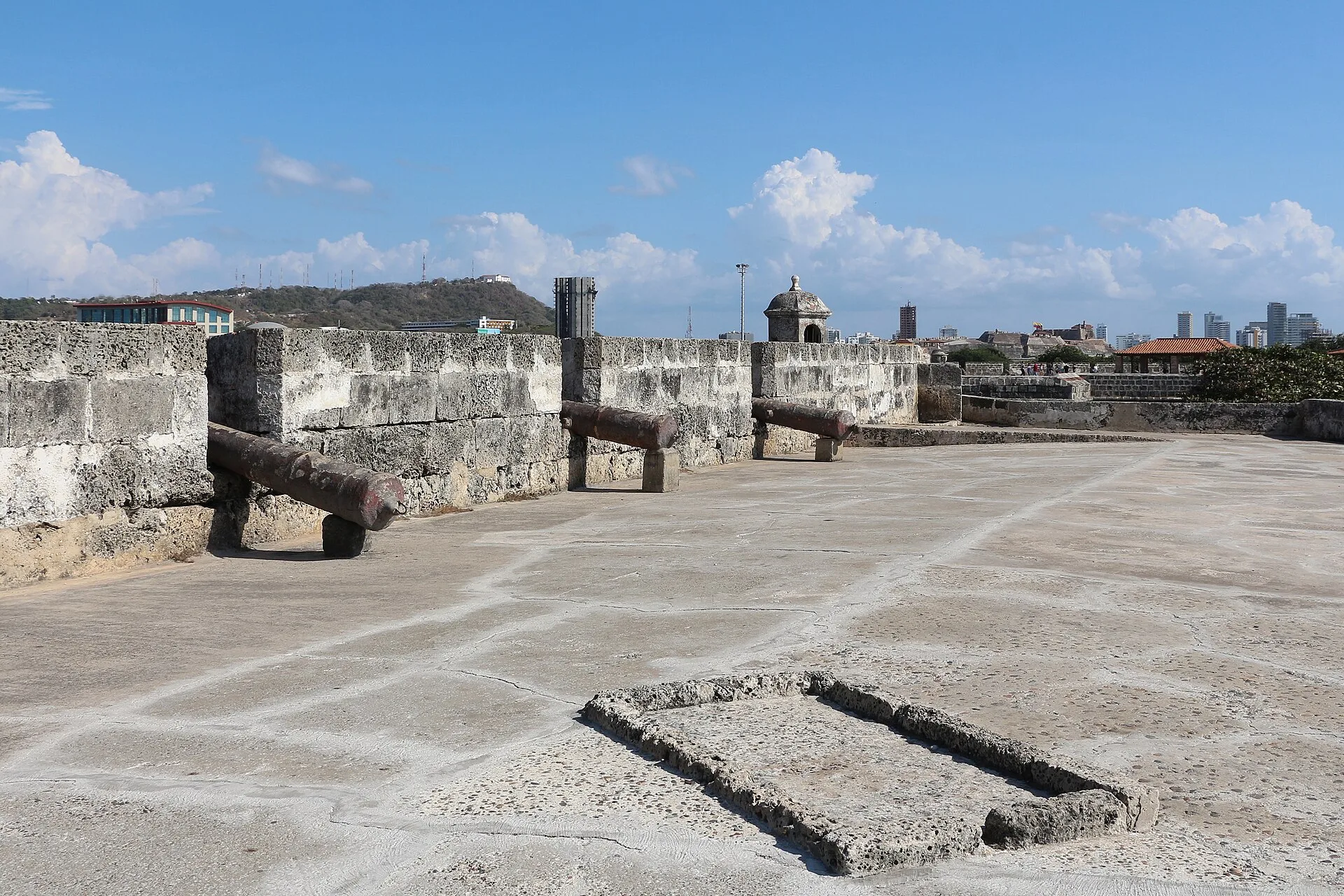
Why was so much wall built?
Because everything Spain took out of South America passed through here. The silver of Potosí and the gold and emeralds of New Granada were gathered in Cartagena's warehouses to wait for the fleet that sailed once a year for Havana and Seville. A city full of treasure, on a bay with two entrances, was an invitation.
The French sacked it first. In 1586 Francis Drake arrived with twenty-three ships, held the city for two months and left only after a ransom was paid; he had begun demolishing the cathedral with his cannons to speed up the negotiation. After Drake, the crown sent its best military engineers, and work on the walls went on, with interruptions, until 1796. Eleven kilometers of them were built. The irony is that they were finished barely fifteen years before the city declared itself independent of the country that had paid for them.
The great test came in 1741, when the British admiral Edward Vernon appeared off the coast with some 180 ships and more than 25,000 men, one of the largest fleets assembled up to that time. The defense, with a fraction of that force, was led by Blas de Lezo, a Basque sailor who had already lost a leg, an eye and the use of an arm in earlier battles. After two months of siege, fever and failed assaults on the castle of San Felipe, Vernon withdrew. Medals celebrating his victory had already been struck in London.
There is another history inside the same walls, and the city has only recently begun to tell it. Cartagena was the main slave port of Spanish America: hundreds of thousands of Africans were landed and sold here. The square just inside the main gate was the market. And from 1610 the Inquisition had one of its three American tribunals in the city. Both stories have their place on the walk that follows.
How do you plan three days?
Day 1: the walled city. In by the Clock Tower at 8:00, the squares and churches of the center before noon, a long lunch and a rest, the quiet streets of San Diego in the late afternoon, and sunset on the wall.
Day 2: the castle and Getsemaní. San Felipe at 7:00, when it opens and the stone is still cool; the museums on Plaza de Bolívar in the heat of the day; Getsemaní from five o'clock on, for the murals, the square and the music.
Day 3: the islands. A full day by boat in the Rosario archipelago, or one night there if you can spare it.
With a fourth day, choose between the hilltop convent of La Popa with the mangroves of La Boquilla, a cooking or street-food morning, or doing nothing at all, which the climate recommends.
In through the Clock Tower
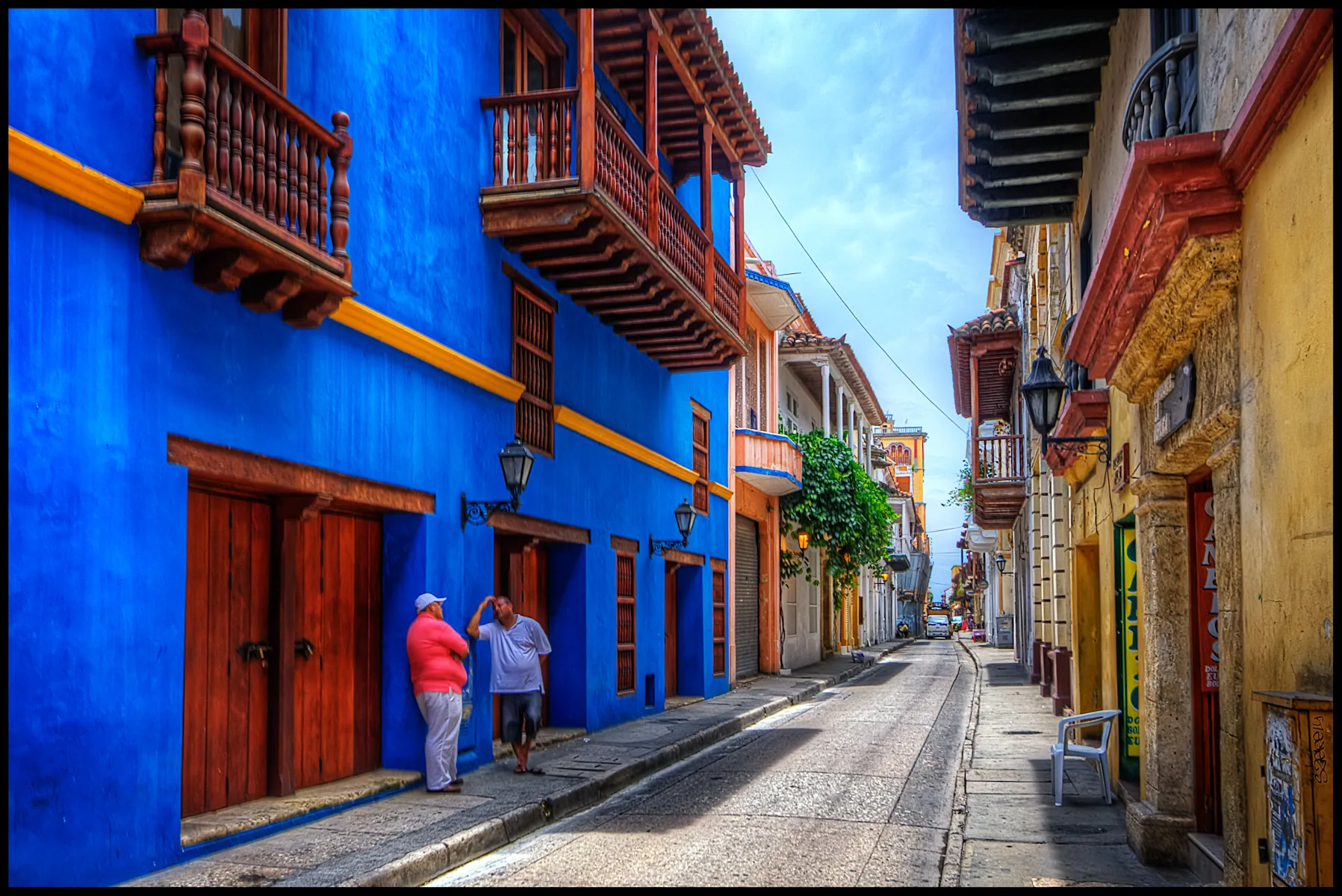
The main gate to the walled city is the Clock Tower. Beyond it are shaded squares, churches, and colonial houses with wooden balconies heavy with bougainvillea. You don't need an itinerary: the center is small and best walked aimlessly, early or toward evening, when the heat lets up.
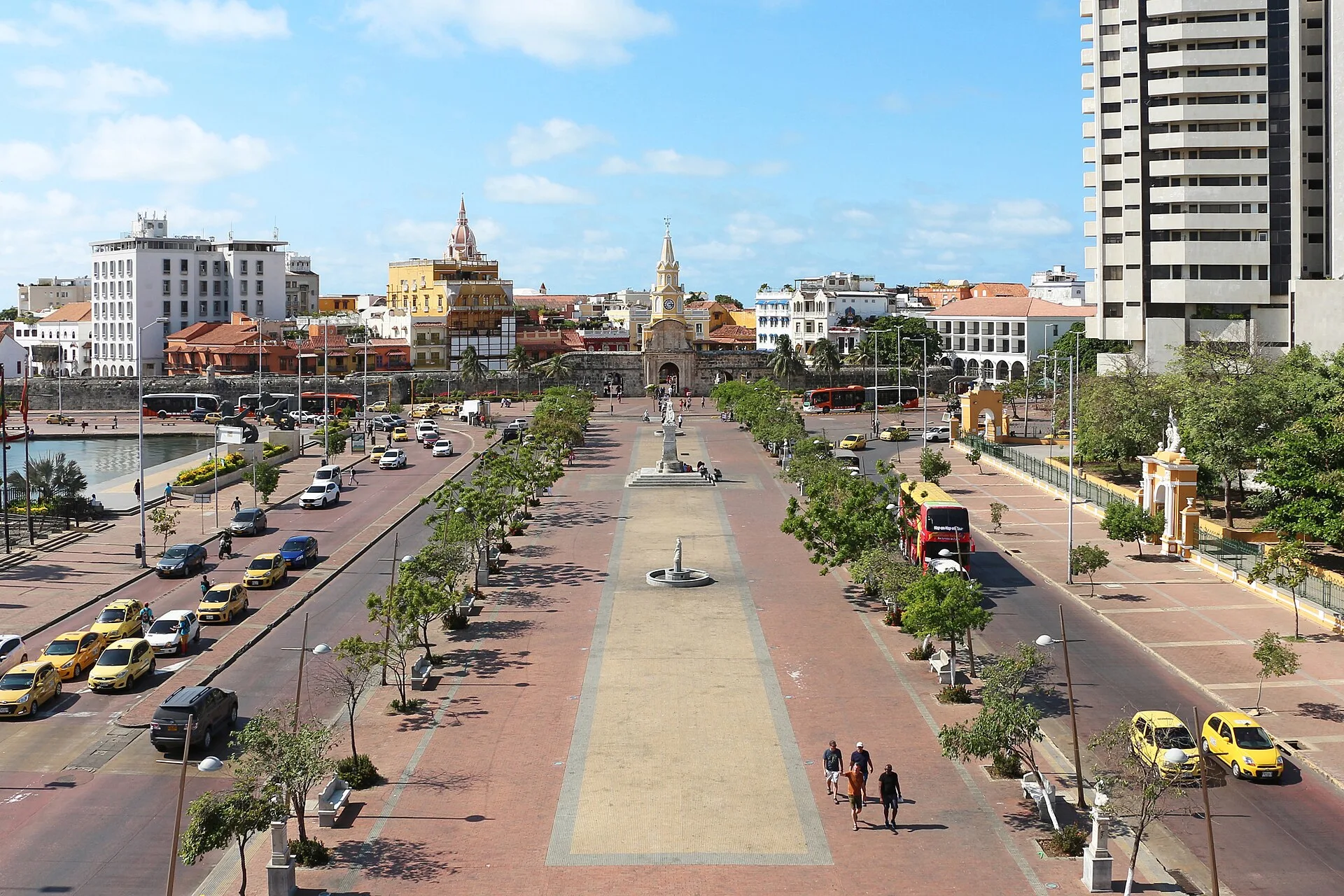
Aimless does not mean blind. These are the places you will pass, in roughly the order the streets lead you.
Plaza de los Coches. The triangular square behind the gate, where enslaved Africans were sold. Under the arcade on one side, the Portal de los Dulces, women sell coconut and tamarind sweets from glass jars, as they have for generations.
Plaza de la Aduana. The largest square, once the parade ground, with the old customs house, now the city hall.
San Pedro Claver. The church and cloister of the Jesuit who, in the 17th century, met the slave ships as they docked, went down into the holds with food and medicine, and called himself "the slave of the slaves forever". His remains lie under the altar, and the cloister, with its garden of old trees, is one of the calmest places in the city. Outside, small iron sculptures of everyday characters, a barber, a sewing woman, chess players, share the square with the café tables.
Plaza de Bolívar. The shadiest square, with an equestrian statue of the Liberator and dancers who perform for tips in the evening. Two museums face it. The Zenú Gold Museum, recently renovated from top to bottom, is free: a small, excellent collection about the people who engineered the wetlands of the Caribbean plain and made some of the finest goldwork in the Americas. The Palace of the Inquisition, behind a splendid Baroque doorway, is now the city's history museum; the little window with a cross on the side street is where accusations were handed in.
Plaza de Santo Domingo. The liveliest at night. In front of the oldest church in the city lies Gertrudis, a reclining bronze nude by Fernando Botero; rubbing her is supposed to bring luck in love, which explains the polish.
San Diego. The northern half of the walled city is quieter and more residential. Look for the Plaza de San Diego, with restaurants around a school of fine arts in a former convent, and for Las Bóvedas, twenty-three vaults built into the wall as storerooms at the very end of the colonial period, later used as dungeons and now as craft shops.
Look at the doors as you go. The bronze knockers announced the trade of the family: a lizard for nobility, a lion for the military, fish and sea creatures for merchants. And the height of the door was a declaration of wealth.
If you prefer the stories told in order, a guided walk of two or three hours on the first morning pays for itself. You can check dates for one here.
The best thing to do in Cartagena is free: climb the wall and watch the sun drop into the sea.
Where do you watch the sunset?
On the wall, on the side that faces the open sea. You can climb it at many points by ramps and stairs, and walk along the top for a couple of kilometers between bastions, cannons and sentry boxes; there is no fee and no closing time. The stretch between the bastion of Santo Domingo and Las Bóvedas is the classic one. A bar on the Santo Domingo bastion has tables among the cannons and prices to match the view; the same sunset is free twenty meters to either side, and street sellers pass with cold beer.
The other way to see it is from the bay, with the skyline of domes on one side and the towers of Bocagrande on the other. Boats leave from the pier beside the old town in the late afternoon, on outings such as this sunset cruise around the bay.
One change worth knowing: the horse-drawn carriages that used to circle the old town at dusk were retired in 2026, after years of complaints about the animals, and replaced by electric carriages.
Getsemaní and the literary city
Across the promenade, Getsemaní was for a long time the city's working-class quarter. Today it mixes lifelong residents, murals, music in Plaza de la Trinidad, and small restaurants.
This was the neighborhood of freed slaves, artisans and sailors, and it was from here that a militia of craftsmen marched on November 11, 1811, to force the city council to declare independence from Spain. For most of the 20th century it was poor and avoided. Now it is the most fashionable address in town, with all that follows: boutique hotels in old houses, rising rents, and neighbors who put chairs out on the pavement in the evening as their grandparents did, while visitors photograph their street.
Come at five. Walk the Calle de la Sierpe for the murals and the alleys strung with flags and umbrellas, and arrive at the Plaza de la Trinidad as the heat goes. In front of the yellow church, children play football, vendors set up grills and carts, someone brings a speaker, and by eight the whole square is eating, drinking and dancing in the open air. Nothing is organized, and that is the charm. The music you hear from the speakers is probably champeta, born in the poor neighborhoods of Cartagena from African records that sailors brought home.
Cartagena is also Gabriel García Márquez territory: he worked here as a journalist and made it the setting of his novels. Reading Love in the Time of Cholera before the trip is a good way to begin.
He arrived in 1948, at twenty-one, fleeing the riots in Bogotá, slept his first night on a bench, and was hired by the newspaper El Universal. Although he never names it, this is the city of Love in the Time of Cholera: the Portal de los Dulces is the arcade of scribes where Florentino Ariza writes love letters for others, and the park where he waits for Fermina Daza is the little Plaza Fernández de Madrid, in San Diego. The former convent of Santa Clara, now a hotel, is the setting of Of Love and Other Demons; the crypt that inspired the novel can be seen from the bar. The house he built later, a plain red wall facing the sea near that convent, is not open. His ashes rest since 2016 in the cloister of La Merced, part of the university, under a bronze bust in a courtyard you can enter freely.
Outside the walls
Twenty minutes on foot from the center rises the Castillo de San Felipe de Barajas, the largest fortress Spain built in the Americas. Its tunnels, designed so that sound would give the enemy away, can be explored. And to escape the heat, the Rosario Islands, an hour away by boat, offer clear water and coral reefs. Choose operators that respect the natural park and avoid public holidays.
The castle is not a castle in the fairy-tale sense but a hill turned into a machine: a mountain of sloping walls, with batteries placed so that each could fire on the next if it was captured. It was begun in 1657 and enlarged after every attack. Inside runs a network of galleries, low and dim, that connect the batteries and were mined so they could be blown up under an invader; their walls carry sound so well that the defenders could hear boots approaching. Children love them. Those who do not like confined spaces can stay on the ramparts, which have the best view of the old town.
In 2026 the entry costs 38,000 pesos, a little under ten US dollars, and the fortress opens every day from 7:00 to 18:00. Be there at opening or after 16:00: there is no shade on the upper levels, and at midday the stone burns. A statue of Blas de Lezo, sword raised, stands at the foot of the hill.
Higher still, on the only real hill in the city, the white convent of La Popa dates from 1607 and has a flowered cloister and a view over the whole bay, the islands and the airport runway. Go by taxi and ask the driver to wait; the road up crosses neighborhoods where walking is not advised.
The Rosario Islands: how do you choose a boat?
The archipelago is a group of some 27 small coral islands, about 35 kilometers southwest of the city, inside a national marine park. Boats leave in the morning from the La Bodeguita pier, opposite the Clock Tower, and take between 45 minutes and an hour and a half.
There are three ways to go, and they are very different days.
A day at one island. You are taken to a small hotel or beach club on one island, with lunch, loungers and a patch of calm sea, and brought back in mid-afternoon. It is the most restful option.
An island-hopping tour. A fast boat makes four or five stops: a swim, a snorkel over the reef, a sandbank where boats gather and music plays, lunch on the mainland beach of Playa Blanca, in Barú. You see more and rest less. This Rosario Islands excursion with snorkeling and Playa Blanca is of this kind.
A night on the islands. The best choice if you have time. When the day boats leave at three, the islands go quiet, and after dark some of the lagoons glow with bioluminescent plankton.
Some advice that applies to all three. The crossing can be rough in the afternoon, especially from December to March, when the wind blows; sit at the back if you are prone to seasickness. A port tax and the park fee are sometimes included in the price and sometimes charged in cash at the pier, so ask. Playa Blanca is beautiful and badly overcrowded on weekends and holidays. And the reef is fragile: use mineral sunscreen, do not stand on the coral, and do not buy shells, coral or anything made of turtle.
Is there a beach in the city?
Yes, and it is not the reason to come. Bocagrande, the peninsula of high-rise hotels south of the old town, has a long strip of gray sand and warm, cloudy water, with rented tents, and vendors every thirty seconds. It is fine for a swim. For the Caribbean of the photographs you need a boat.
Two alternatives closer than the Rosario Islands. Tierra Bomba, the island that closes the bay, is fifteen minutes away and has quiet beach clubs. And at La Boquilla, a fishing village north of the airport, local guides pole wooden canoes through tunnels of mangrove at dawn or dusk, among herons and crabs; the cooperative of fishermen that runs the trips keeps the income in the village.
A stranger excursion is the Totumo mud volcano, an hour to the northeast: a mound fifteen meters high whose crater is a pool of warm, dense gray mud in which it is impossible to sink. It is silly, crowded and great fun; trips such as this Totumo mud volcano experience include the transport and a wash in the lagoon afterwards. Carry small notes, because every service at the volcano expects a tip.
What should you eat?
The coast cooks with coconut, plantain and fish, and fries almost everything else.
Arepa de huevo. The street snack of the city: a corn cake fried, opened, filled with a raw egg and sometimes minced meat, and fried again. Eat it hot, standing, with a spoonful of spicy suero, a sour cream.
Fried fish with coconut rice. The beach lunch: a whole snapper or mojarra, crisp outside, with rice cooked in coconut milk until it turns brown and slightly sweet, patacones of fried green plantain and a wedge of lime.
Ceviche and seafood cocktail. Shrimp, octopus or sea snail in a sauce of tomato, lime and onion, served in a cup with crackers.
Posta cartagenera. Beef cooked slowly in a dark, sweet-and-sour sauce of raw sugar and cola. It is the Sunday dish of old Cartagena families.
Cazuela de mariscos. A thick seafood stew with coconut milk.
Fruit. The women who carry bowls of it on their heads, in bright dresses, are palenqueras: they come from San Basilio de Palenque, a town founded by escaped slaves in the hills to the south and recognized by the Spanish crown as free in 1713, long before any independence. They sell mango, papaya and watermelon, and they pose for photographs for a tip; ask first and pay.
To drink. Limonada de coco, a frozen blend of lime and coconut cream, is the taste of the city. Juices of corozo, a small red palm fruit, and of lulo are worth trying. Coffee here is tinto, small and black, sold from thermos flasks in the street.
A walk with tastings, such as this street food tour of the walled city, is a quick way to try most of the list on the first day, and to learn which stalls the locals use.
When should you go?
It is hot all year: about 31 degrees by day, 25 at night, with high humidity. What changes is the wind and the rain.
December to April is the dry season, with steady breezes, blue skies and the best sea color at the islands. From mid-December to mid-January, and again in Holy Week, the whole country is on vacation: prices double and the old town is packed.
May to November is wetter, with heavy, short downpours in the afternoon, most of all in October and November, when some streets flood for an hour or two. It is also cheaper and emptier, and mornings are usually clear.
Three dates for the diary. The Hay Festival, at the end of January, brings writers from all over the world to talk in the theaters and squares. The International Film Festival, in the spring, is the oldest in Latin America. And on November 11, the city celebrates its independence with parades, music and a great deal of foam and flour thrown in the streets.
How do you get there and get around?
The Rafael Núñez airport is ten to fifteen minutes from the old town, closer than in almost any other city of its size. There are flights from Bogotá, an hour and a half away, from Medellín and from several cities in the Americas and Europe. Official taxis charge a fixed fare, about 24,000 pesos to the historic center in 2026; you get a slip with the price at a booth before leaving the terminal.
Inside the walls and in Getsemaní you walk. For anything else, taxis are cheap and have no meter: fares are set by zone, so agree on the price before you get in, or use one of the ride apps. The public bus system, Transcaribe, costs 3,900 pesos a ride and is useful mainly for reaching the bus terminal, which is far out of town. Buses from there go to Barranquilla in two hours and to Santa Marta in four or five.
Where should you stay?
Inside the walls, in the Centro or San Diego, you sleep in restored colonial houses with patios and small pools, at the highest prices in Colombia. It is worth it for a night or two: the old town before eight in the morning belongs to those who slept there.
Getsemaní has hostels and smaller hotels, more noise and more life, five minutes from the Clock Tower.
Bocagrande has the big hotels with sea views, the beach at the door and a ten-minute taxi ride to everything else.
Whatever you choose, make sure the room has air conditioning that works. This is not a detail.
What should you know about money, vendors and safety?
The currency is the Colombian peso, and the numbers are large: in late 2026, a US dollar is worth around 4,000 pesos. Cards are accepted in hotels, restaurants and most shops; carry cash for street food, taxis and tips. In restaurants a ten percent service charge is added to the bill as a "voluntary tip"; you may decline it, and almost nobody does.
The vendors are the thing visitors complain about most. On the squares and above all on the beaches, people will offer hats, cigars, bracelets, massages, oysters and tours, one after another. A calm "no, gracias" without stopping usually works. Never accept anything described as a free sample, a free massage of thirty seconds or a gift: it will be charged, sometimes aggressively. On the beach, agree on the price of everything, in writing if necessary, before you sit down or eat.
The old town, Getsemaní and Bocagrande are safe to walk by day and in the evening, with the precautions of any tourist city: no jewelry, the phone out of sight, official taxis at night. Do not leave a drink unattended or accept one from strangers. And the city asks visitors for one more thing, on signs at the airport and in hotels: the sexual exploitation of minors is a crime that is prosecuted, and reporting it is everyone's business.
What should you pack, and does it work with children?
Pack for heat and nothing else: loose cotton or linen, a hat, sandals that can get wet and one pair of closed shoes for the castle tunnels and the cobbles. Add sunscreen, insect repellent for the evenings and for the mangroves, a light rain jacket between May and November, and a dry bag for the boat. You will not need a sweater unless your hotel's air conditioning is ambitious.
With children the city works well in short stretches. The wall has cannons to climb on, the castle has tunnels, the squares fill with other children at dusk, and the islands are a day in shallow, warm water. Plan around the heat even more strictly than for adults, choose a hotel with a pool, and on the boats insist on life jackets in the right size, which good operators provide without being asked.
What mistakes should you avoid?
Walking at noon. From eleven to three the city is an oven. Use those hours for a museum, lunch, a pool or a siesta.
Paying for the sunset. The wall is free.
Taking a taxi without asking the fare. There are no meters. Ask first.
Going to Playa Blanca on a Sunday. Or on any public holiday.
Accepting a "free" oyster or massage. Nothing on the beach is free.
Skipping Getsemaní at night. The square of La Trinidad after dark is the best show in town.
Coming only for the beach. Cartagena is a city with a sea, not a beach resort. For beaches, add the islands or continue along the coast to Santa Marta and Tayrona.
Quick answers
How many days do you need in Cartagena? Three: the walled city, the castle and Getsemaní, and a day in the Rosario Islands.
How much is the castle of San Felipe in 2026? 38,000 pesos, a little under ten US dollars. It opens daily from 7:00 to 18:00.
Is the wall free? Yes. You can walk on top of it at any hour.
What is the best month? From December to April, avoiding the weeks around Christmas and Holy Week if you want lower prices.
How do you get to the Rosario Islands? By boat from the La Bodeguita pier, opposite the Clock Tower, in 45 to 90 minutes.
Is Cartagena safe? The areas visitors use are, with ordinary care. The main annoyance is persistent street selling.
Which García Márquez novel is set here? Love in the Time of Cholera and Of Love and Other Demons. His ashes are in the cloister of La Merced.
Are there still horse carriages? No. Since 2026 the carriages in the old town are electric.
Prices and opening hours in this guide were checked in November 2026 in official and local sources. Confirm them before you go.