Rome without queues: six places that need no ticket
The Pantheon, the fountains, Caravaggio in the churches and a keyhole: a full guide to the Rome that is free or nearly free, and to the few tickets worth paying for.
Culturera may earn a commission if you buy through the links on this page. As an Amazon Associate I earn from qualifying purchases. The selection is ours alone.
The best of Rome costs little or nothing: the Pantheon (€7 since July 2026), Caravaggio in three churches (free), the fountains, a keyhole on the Aventine, Trastevere and the Appian Way. You can link the first five on foot in one day, without a reservation. Keep your bookings and your budget for three places where a ticket really is unavoidable: the Colosseum, the Vatican Museums and the Borghese Gallery.
Rome receives tens of millions of visitors a year, and its two great ticketed sights demand planning and patience. But much of the city is in the street or behind an open church door, and that part has not changed in centuries. This guide goes through the six classics in detail, adds a dozen more places that ask for no ticket, and then tells you plainly when paying for an entry or a guide makes sense.
Where a guided visit helps, we link tours on GetYourGuide. We have not taken these tours: they are chosen for what they cover, and you can do everything on this list on your own.
What changed in Rome in 2026?
Three things, and all three affect this list. The Pantheon costs €7 since July 1, 2026, up from the €5 fee introduced in 2023. The Trevi Fountain charges €2 since February 2, 2026, to step down into the area beside the basin; looking from the square is still free. And Metro line C reached the Colosseum on December 16, 2025, with two new stations, Colosseo-Fori Imperiali and Porta Metronia, that display the archaeology found while digging them.
The Jubilee year of 2025 ended in January 2026, so the extra pilgrim crowds are gone, and the building sites that covered half the center before it are gone too. Piazza Pia, beside Castel Sant'Angelo, is now a pedestrian square that leads straight to St. Peter's.
1. The Pantheon: is it still worth it now that it charges?
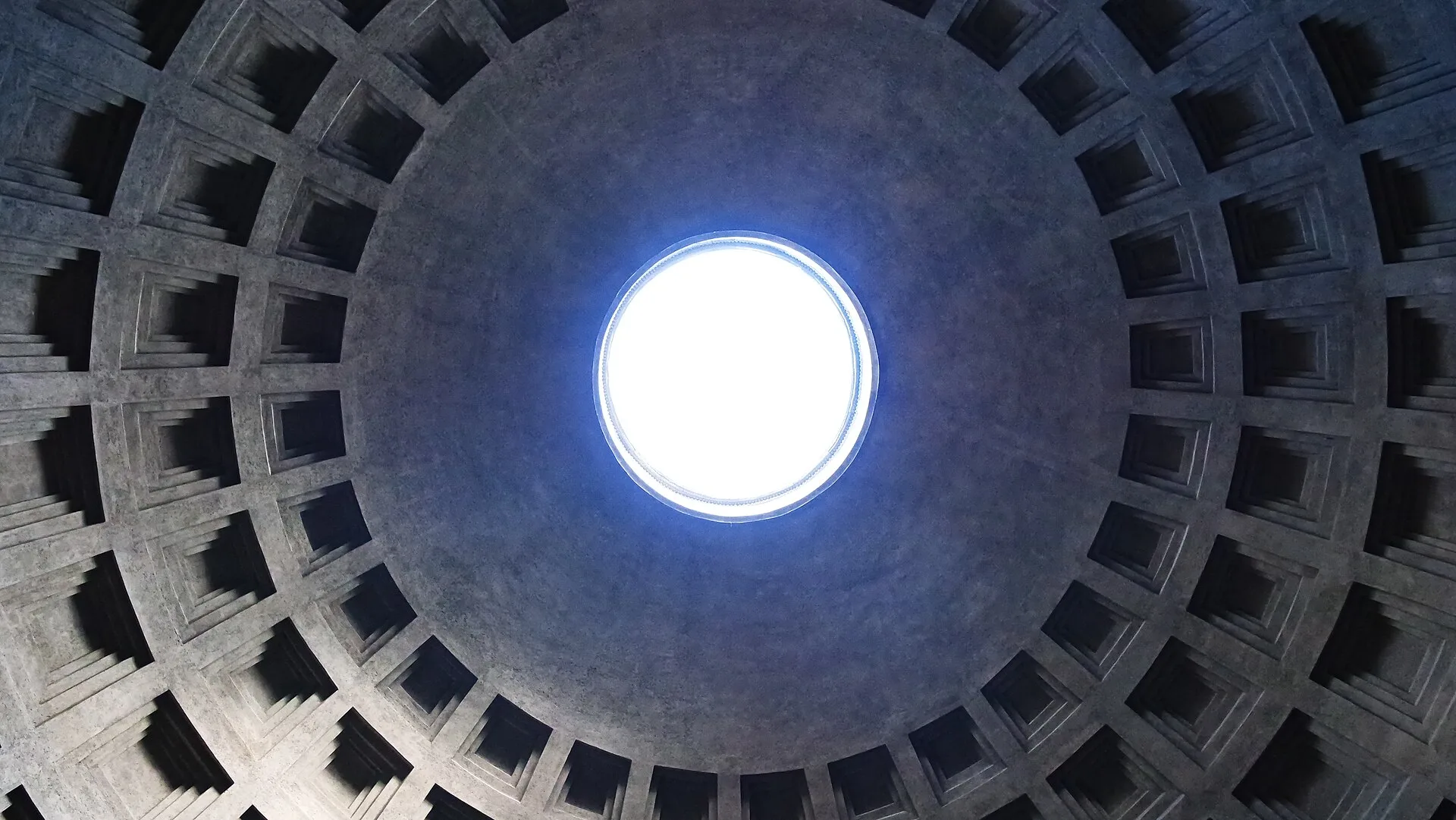
Yes. For €7 you walk into the best-preserved building of ancient Rome, and you rarely wait more than a few minutes outside the summer peak. It was built under Emperor Hadrian around the year 125, and it still has the largest unreinforced concrete dome in the world. Its oculus, about eight meters across, is open to the sky: when it rains, it rains inside.
The dome is as wide as it is high, a little over 43 meters, so a perfect sphere would fit inside. The building survived because it became a church in the year 609, and it holds the tombs of the painter Raphael and of two kings of Italy. Look at the floor: it slopes gently and has small drain holes for the rain that falls through the oculus. Look at the front, too: the inscription names Marcus Agrippa, who built the first temple here, more than a century before Hadrian rebuilt it and kept the old dedication.
The practical part. The Pantheon opens every day from 9:00 to 19:00, with last entry at 18:30. A full ticket is €7; EU citizens aged 18 to 25 pay €2, and under-18s enter free. It is also free for everyone on the first Sunday of the month, when the line is long, and for those attending Mass. You can buy the ticket on the Italian culture ministry's museum site or at the door. Because it is a working church, visits stop during services, and shoulders and knees should be covered.
Two moments are worth planning around. Near midday on a sunny day, the beam from the oculus falls like a spotlight on the walls. And at Pentecost, seven weeks after Easter, firefighters climb the dome and drop thousands of rose petals through the opening at the end of the Mass.
2. Where can you see Caravaggio for free?
In three churches within a fifteen-minute walk of each other, which between them hold six of his paintings. Five minutes from the Pantheon, the church of San Luigi dei Francesi holds three Caravaggio canvases on Saint Matthew. Free. Santa Maria del Popolo has two more, and Sant'Agostino one.
In San Luigi the paintings are in the Contarelli Chapel, at the far left; a coin-operated light illuminates them for a few minutes, so bring a euro coin or wait for someone else to pay. The Calling of Saint Matthew, with its beam of light crossing the tavern, is one of the most copied images in Western painting. Caravaggio painted the three canvases around 1600, and they made him famous within months.
In Santa Maria del Popolo, at the northern gate of the old city, the Conversion of Saint Paul and the Crucifixion of Saint Peter face each other in the Cerasi Chapel. The same church has a chapel designed by Raphael and sculptures by Bernini, so it is a small museum in itself. On the way between the two, the church of Sant'Agostino has another Caravaggio, the Madonna of Loreto, with the dirty feet of its pilgrims that scandalized his contemporaries, and a fresco of the prophet Isaiah by Raphael on a pillar.
One warning that applies to every church in this guide: most close for a few hours in the middle of the day, often from about 12:30 to 15:00 or later, and they do not admit visitors during Mass. Go in the morning or the late afternoon.
3. The fountains: what does the new Trevi fee cover?
Only the last few steps. Since February 2, 2026, visitors who are not residents of Rome pay €2 to enter the inner area next to the Trevi basin, the place where people throw the coin. It applies from 9:00 to 22:00 (from 11:30 on Mondays and Fridays, when the fountain is cleaned first), with last entry at 21:00. You pay by card at the entrance or online. The fountain can still be seen for free from the square, a few meters back, at any hour, and the fee applies only during those times. Residents of Rome and children under five do not pay.
Is it worth €2? If you want the photo at the water's edge without a hundred elbows, yes: the fee came with a cap on how many people can be down there at once. If you only want to see it, the view from the square is the same view.
The Trevi Fountain was built between 1732 and 1762 to a design by Nicola Salvi, and it marks the end of an aqueduct that has brought water to Rome since the year 19 BC. Tradition says that throwing a coin over your shoulder ensures your return to the city; the coins, well over a million euros a year, are collected and given to charity. Go at dawn, when the square is nearly empty, or late at night.
The other fountains ask for nothing. In Piazza Navona, which keeps the long oval shape of the Roman stadium buried beneath it, Bernini's Fountain of the Four Rivers holds up an Egyptian obelisk over four giants that stand for the Danube, the Ganges, the Nile and the Río de la Plata. At the foot of the Spanish Steps, the Barcaccia is a sinking stone boat by Bernini's father, Pietro. In the old Jewish quarter, the small Turtle Fountain in Piazza Mattei is the most charming in the city. And on the Janiculum Hill, the monumental Acqua Paola looks out over all of Rome.
If you would rather have someone tell the stories while you walk, a guided walk through the center, such as this walking tour of the Pantheon, Trevi and Navona, covers the squares of this section in a couple of hours. A note on the Spanish Steps: sitting on them has been banned since 2019, and the fines are real.
Rome looks best before eight in the morning and after eight in the evening.
4. The keyhole on the Aventine: where is it and what else is up there?
On the Aventine Hill, a quiet residential hill above the Circus Maximus, the door of the Priory of the Knights of Malta has a keyhole through which you see, perfectly framed by a tunnel of hedges, the dome of St. Peter's. The address is Piazza dei Cavalieri di Malta, about fifteen minutes on foot uphill from the Circo Massimo metro station.
The square in front of it was designed in 1765 by Giovanni Battista Piranesi, better known for his engravings of ruins and imaginary prisons. There is often a short line, but it moves fast: everyone looks for a few seconds. Phone cameras struggle to focus through the hole, so look first with your own eye.
A few steps away, the Garden of Oranges offers one of the best free views of the city, especially at sunset, with the river below and the dome in the distance. Next to it, the basilica of Santa Sabina is a nearly intact church of the fifth century; its carved wooden doors are as old as the building and include one of the earliest known images of the Crucifixion. In late spring, usually from late April to mid-June, the city's rose garden on the slope of the hill is open and free.
5. Trastevere: when should you go?
In the late afternoon, when the light turns golden and the neighborhood fills with people having an aperitivo. Trastevere, on the far bank of the Tiber, is alleys, hanging laundry and ivy, and the basilica of Santa Maria in Trastevere, with its mosaics.
The basilica is one of the oldest churches in Rome dedicated to the Virgin. The gold mosaics of the apse date from the 12th century, and below them runs a cycle on the life of Mary made by Pietro Cavallini a century later; they shine even in low light. Ten minutes away, in the quieter half of the neighborhood, the basilica of Santa Cecilia keeps a marble statue of the saint lying as her body was said to have been found, and, for a small fee paid to the nuns, a Last Judgment frescoed by the same Cavallini.
From Trastevere you can climb to the Janiculum Hill for a view over the domes of the center. A cannon is fired from the hill every day at noon, a custom that dates from the 19th century, when it was used to set the city's church bells. On Sunday mornings, the Porta Portese flea market fills the southern edge of the neighborhood.
Trastevere is also where many visitors come to eat, which means the main streets have their share of tourist menus. The good places are a few streets away from Piazza di Santa Maria, and they fill up by nine. One shortcut is a food walk with a local guide, such as this Trastevere food tour with tastings, which strings together several stops in one evening; another is simply to follow the rules in the eating section below.
6. The Appian Way: how do you walk the oldest road?
On Sundays, closed to traffic, it is a walk among pines and Roman tombs. The Appian Way was begun in 312 BC to carry the legions south, and in July 2024 it was added to UNESCO's World Heritage list.
Strictly speaking, on Sundays and holidays motor traffic is restricted, from morning to evening, along the first stretch of the ancient road, so there are far fewer cars but some buses and authorized vehicles still pass. The Regional Park of the Appian Way is free and always open. Walking the original Roman paving stones, with tombs and aqueducts on both sides, is one of the most memorable experiences in the city.
How to do it. Bus 118 runs from the center to the first part of the road. The best walking begins after the round Tomb of Cecilia Metella, where the traffic thins out and the big basalt stones appear; from there you can go on for kilometers. The Circus of Maxentius, a chariot track better preserved than the Circus Maximus, is free. The catacombs of San Callisto and San Sebastiano are not: they charge a ticket and are visited only with their own guides, and each closes one day a week, so check before you go.
The road is long, and the most beautiful stretches are far from the start, so a bicycle is the usual answer. Bikes can be rented at the park's information point near the beginning. If you prefer a guide, transport and an electric bike, there are tours such as this e-bike ride along the Appian Way, the catacombs and the aqueducts. The aqueducts are in a separate park, the Park of the Aqueducts, which is free and reachable on Metro line A: a long line of arches crossing a meadow, the Rome of old paintings.
What else in Rome needs no ticket?
A great deal. These are the ones we would not skip, grouped so that you can add them to the six above.
St. Peter's Basilica. Entry to the largest church in the world is free. What you queue for is the security check, which is shortest before 8:00 and in the late afternoon. Inside are Michelangelo's Pietà, which he carved at 24, and Bernini's bronze canopy over the altar. On Wednesday mornings, when the pope holds his general audience in the square, the basilica usually opens late. The climb to the dome is paid; you can buy it on the spot or book ahead a dome ticket with an audio guide. The dress code is enforced here: no bare shoulders, no shorts above the knee.
Michelangelo's Moses. In the church of San Pietro in Vincoli, a short climb from the Colosseum, sits the horned, furious Moses that Michelangelo carved for the tomb of Pope Julius II. Free, and often quiet.
Bernini's Saint Teresa. The Ecstasy of Saint Teresa, perhaps the most theatrical sculpture of the Baroque, is in the small church of Santa Maria della Vittoria, near Termini station. Free.
A ceiling that is not there. In Sant'Ignazio, the painter Andrea Pozzo turned a flat vault into an open sky, and painted a dome on a flat canvas because the money for a real one ran out. A mirror in the nave lets you see it without hurting your neck.
Santa Maria sopra Minerva. Behind the Pantheon, a Gothic church, rare in Rome, with a Risen Christ by Michelangelo. In the square outside, a small marble elephant designed by Bernini carries an obelisk on its back.
Santa Maria Maggiore. One of the four great papal basilicas, with mosaics from the fifth century and a ceiling said to be gilded with the first gold brought from the Americas. Pope Francis was buried here in April 2025, and his plain tomb has become a place of pilgrimage.
The Capitoline Hill. The square designed by Michelangelo is free; the museums around it are not. Walk around the back of the central palace for the best free view of the Roman Forum, particularly at dusk.
Largo di Torre Argentina. Four Republican temples in a sunken square, the place near which Julius Caesar was killed in 44 BC, and home to a colony of cats looked after by volunteers. You see nearly all of it from the street.
The old Jewish quarter. Around the Portico of Octavia and the Theater of Marcellus, which looks like a small Colosseum with apartments on top. This is also the place to eat fried artichokes.
The Pincio terrace and Villa Borghese. Above Piazza del Popolo, the sunset view that rivals the Garden of Oranges, at the edge of the city's great public park.
The Non-Catholic Cemetery. Keats and Shelley are buried under the cypresses, beside a Roman pyramid older than the city walls built around it. Entry is by donation.
Which tickets in Rome are worth paying for?
Three, and all three should be booked before you travel. Everything above works without planning. These do not.
The Colosseum. The standard ticket costs €18 and includes the Colosseum, the Roman Forum and the Palatine Hill. You choose an entry time for the Colosseum, and tickets go on sale on the archaeological park's official site 30 days before the date. They carry the visitor's name, and staff may check it against an ID. A more complete ticket, the Full Experience at €24, adds the arena floor and the underground level, where the animals and gladiators waited. In winter the site closes at 16:30. Official tickets for popular hours sell out quickly; if yours are gone, or if you want someone to explain what the ruins were, a guided visit is the sensible alternative. Below you can check dates for a guided tour of the three sites.
A tip that needs no ticket at all: the Forum is laid out before you, for free, from Via dei Fori Imperiali and from the terrace behind the Capitoline Hill. The new Colosseo-Fori Imperiali metro station leaves you beside both.
The Vatican Museums and the Sistine Chapel. A ticket costs €20 at the door, where the line along the walls can take two hours in high season, or €25 with the official online booking fee, which lets you skip that line. The museums open Monday to Saturday from 8:00 to 20:00, with last entry at 18:00. There are about seven kilometers of galleries, and the Sistine Chapel is at the very end: allow three hours, go straight to what interests you, and remember that photos and talking are not allowed in the chapel. If the official site is sold out for your dates, resellers such as GetYourGuide offer timed entry to the Vatican Museums and the Sistine Chapel, at a higher price than the official one.
The Borghese Gallery. The finest small museum in Rome, in a villa in the middle of a park: Bernini's Apollo and Daphne, in which marble turns to leaves, and six paintings by Caravaggio. A reservation is compulsory, visits run in two-hour slots, and the gallery is closed on Mondays. Slots go weeks ahead in spring and fall. You can book on the gallery's own site or take a ticket with an audio guide or a guided visit.
What about a city pass? Do the sum first. The passes sold in Rome bundle public transport with one or two free entries, and most of the places in this guide are free anyway. A pass pays off only if you plan several paid museums in two or three days.
When is Rome free?
On the first Sunday of the month, Italy's state museums and archaeological sites are free, including the Colosseum, the Roman Forum, the Palatine, the Pantheon, Castel Sant'Angelo and the Borghese Gallery, where you still need to reserve. The Colosseum is also free on April 25, June 2 and November 4. Expect crowds, arrive early and book your time slot where one is required. The Trevi fee still applies on those Sundays.
On the last Sunday of the month, the Vatican Museums are free from 9:00 to 14:00, with last entry at 12:30. The line starts forming before dawn. It is a real saving for a family, and a poor way to see the Sistine Chapel.
How do you link the six in one day?
Start early and walk downhill where you can. This route is about eight kilometers.
7:30. Trevi Fountain. Before the barriers and before the crowd. Coffee at a bar, standing.
8:30. Sant'Ignazio and the Pantheon. The church is on the way and opens early. Be at the Pantheon door at 9:00.
10:00. San Luigi dei Francesi and Sant'Agostino. The Caravaggios, before the churches close at midday. Then Piazza Navona, two minutes away.
12:00. Campo de' Fiori and the Jewish quarter. The market, the Turtle Fountain and lunch.
15:00. The Aventine. Cross behind the Circus Maximus and climb to Santa Sabina, the Garden of Oranges and the keyhole.
17:30. Trastevere. Walk down to the river and cross it. Santa Maria in Trastevere is open until evening. Stay for the aperitivo and dinner.
Leave the Appian Way for another day, ideally a Sunday morning, and Santa Maria del Popolo for the day you visit the Borghese Gallery, which is a short walk away through the park.
What if you have three days?
Day 1: the walking route above. Day 2: the Vatican. Be at St. Peter's when it opens, climb the dome, and enter the museums in the early afternoon, when the morning groups are leaving; end the day at Castel Sant'Angelo and the bridge of angels. Day 3: the Colosseum, the Forum and the Palatine in the morning, with the Moses on the way, and the Borghese Gallery and the Pincio terrace in the late afternoon. With a fourth day, or a Sunday, add the Appian Way.
When is the best time to go to Rome?
April to mid-June and mid-September to October have the best weather, and the highest prices. July and August are hot, with afternoons well above 30 degrees; do your walking early and late, and spend the middle of the day inside a church or a museum. Around the August 15 holiday many family restaurants close for a week or two. November to February is the quiet season: short days, some rain, mild temperatures by northern European standards, and the shortest lines of the year, except around Christmas and Easter. Easter week is the busiest of all.
How do you get around?
On foot, mostly. The historic center is small, and the six places in this guide, apart from the Appian Way, lie within three kilometers of each other.
For longer hops, a single ticket costs €1.50 and is valid for 100 minutes on buses and trams, including one metro ride. You can skip the ticket altogether and tap a contactless bank card or phone at the metro gates and on the readers in buses. There are also passes for 24, 48 and 72 hours. If you use a paper ticket, validate it in the machine on board: inspectors fine tourists and locals alike.
The metro has three lines. Line A serves the Spanish Steps, the Vatican and the Park of the Aqueducts; line B, the Colosseum and Circo Massimo, for the Aventine; line C now connects with B at the Colosseum. Trastevere has no metro: take tram 8 from the center or walk across the river.
From Fiumicino airport, the Leonardo Express train reaches Termini station in about half an hour, and cheaper regional trains stop at Trastevere and Ostiense. Official taxis are white and charge a fixed fare between the airports and the area inside the ancient walls; it is printed on the door, so check it before you get in. From Ciampino, buses run to Termini.
Where should you stay?
For this list, anywhere inside or just outside the historic center saves you transport. Around the Pantheon and Piazza Navona you can walk to nearly everything, at the highest prices. Monti, between the Colosseum and Termini, is central, lively and a little cheaper. Trastevere is the prettiest at night, and the noisiest. Prati, next to the Vatican, is residential and well connected by metro, and so is Testaccio, the old market district at the foot of the Aventine, where Romans go to eat.
Budget for the city's tourist tax, charged per person and per night for up to ten nights and paid at the accommodation: from €4 to €10 in hotels, depending on the stars, with €6 for a three-star and €7.50 for a four-star.
Eating without traps
The rules are simple. Walk a couple of streets away from the monuments and be wary of menus with photos and of waiters calling you in from the door. Order the house dishes: cacio e pepe, carbonara, amatriciana or gricia, the four Roman pastas. Coffee is drunk standing at the bar, where it costs less than at a table. And remember that Romans dine late: a restaurant that is full at seven is full of tourists.
Rome is also a city of cheap, excellent street food. A supplì is a fried ball of rice with tomato and a heart of melted mozzarella. Pizza al taglio is baked in trays, cut with scissors and sold by weight. A maritozzo is a soft bun split and filled with whipped cream, for breakfast. In late winter and spring, order artichokes: alla romana, braised with herbs, or alla giudia, fried whole until the leaves crackle.
On the bill, bread and service are sometimes listed as separate charges; they must appear on the menu. Tipping is not expected, and rounding up is enough. For ice cream, skip the shops with tall, brightly colored mounds on display: good gelato is kept flat in the tray, or out of sight in metal tubs with lids.
One tip
Carry a bottle: the nasoni, the public fountains named after their nose-shaped spouts, give cool drinking water all over the city. There are about 2,500 of them. Block the spout with a finger and the water arcs out of a small hole on top, at drinking height.
And if you do want the big monuments without paying, choose the first Sunday of the month, as explained above. Expect crowds and book your time slot where it is required.
What mistakes should you avoid?
Buying tickets in the street. The people offering "skip the line" entries outside the Colosseum and the Vatican are not staff. Buy on the official sites or from a known reseller, before you arrive.
Dressing for the beach. Churches, including the Pantheon and St. Peter's, ask for covered shoulders and knees. A light scarf in the bag solves it in summer.
Trusting the lunch hour. Churches close at midday, and many restaurant kitchens close between about 15:00 and 19:00.
Carrying everything in a back pocket. Rome is a safe city, but pickpockets work the crowded buses to the Vatican, metro line A and the area around Trevi. Wear your bag in front in crowds.
Paying for a photo you did not ask for. Decline the men dressed as gladiators, the "free" bracelets and the roses pressed into your hand. A firm no and keep walking.
Driving. The historic center is a limited traffic zone watched by cameras, and rental cars receive their fines by mail months later.
Trying to see everything. The Romans have a saying: a lifetime is not enough. Choose a few places, sit down in a square and let the city come to you.
Quick answers
Is the Pantheon free? No. It costs €7 since July 2026, €2 for EU citizens aged 18 to 25, and it is free for under-18s and for everyone on the first Sunday of the month.
Is the Trevi Fountain free? Seeing it from the square is free. Entering the area beside the basin costs €2 between 9:00 and 22:00, from 11:30 on Mondays and Fridays.
Is St. Peter's Basilica free? Yes. Only the dome, the treasury and guided visits are paid.
How many days do you need in Rome? Three full days cover this list and the three big ticketed sights. Four let you slow down.
Do you need to book the Colosseum? Yes, with a timed, named ticket. Official sales open 30 days ahead.
Can you drink the water from the fountains? Yes, from the nasoni and any fountain not marked as non-potable.
What is free on the first Sunday of the month? State museums and archaeological sites, including the Colosseum, the Forum, the Palatine and the Pantheon.
Prices and opening hours in this guide were checked in November 2026. They change often in Rome, so confirm them on each monument's official site before you go.