Mexico City in a long weekend
The historic center, Chapultepec, Coyoacán and tacos at any hour: a realistic four-day plan for a city too big to cover, with Teotihuacán, what to eat, how to move around and 2026 prices.
Culturera may earn a commission if you buy through the links on this page. As an Amazon Associate I earn from qualifying purchases. The selection is ours alone.
The short version: four days are enough for a first meeting. Give one to the historic center, one to Chapultepec and its Anthropology Museum, one to the south, Coyoacán and Xochimilco, and one to the pyramids of Teotihuacán. Book Frida Kahlo's house weeks ahead, remember that almost every museum closes on Monday, and eat in the street at least once a day. In 2026 the big state museums and Teotihuacán cost 210 pesos, the metro costs 5, and the best taco of your life costs about as much as the metro ride home.
Mexico City has more than nine million inhabitants, about 150 museums and sits 2,240 meters above sea level. You cannot see it all; you can make a good start.
This guide follows the plan day by day and then adds what makes the days work: the neighborhoods, the food, the transport, the altitude and common sense about safety. Where a guide earns the fee, among the murals, at the pyramids at dawn, in front of a taco stand, we link tours on GetYourGuide. We have not taken these tours: they are chosen for what they cover.
What kind of city is this?
A city built on a lake. In 1325, according to their own chronicles, the Mexica, whom we usually call Aztecs, founded Tenochtitlan on an island in the shallow waters of Lake Texcoco, at the spot where they saw an eagle on a cactus, the image now on the Mexican flag. Two centuries later it was one of the largest cities on Earth, with causeways, aqueducts, floating gardens and perhaps two hundred thousand people. Hernán Cortés and his allies took it in 1521 after a siege that destroyed it, and the Spanish built their capital from its stones, on the same grid, filling the canals and, over centuries, draining the lake.
The consequences are still under your feet. The soft lakebed swallows what stands on it: the center is sinking, in places by tens of centimeters a year, and its churches lean like ships. The same soil amplifies earthquakes, which is why the city has a public alarm that sounds a minute before the shaking arrives. And the metropolitan area that grew over the dry lake now holds more than twenty million people.
What a visitor meets, though, is not chaos but a series of villages: the colonial center, the tree-lined streets of Roma and Condesa, the cobbled squares of Coyoacán, each with its market, its church and its taco stands. Mexico City is greener, friendlier and more cultured than its reputation, with a museum for everything and a cuisine with few rivals. The surprise of nearly everyone who comes is that they want to come back.
Day 1: the Centro
The Zócalo is one of the largest squares in the world. On one side, the cathedral; on another, the National Palace, with Diego Rivera's murals. Behind them rise the ruins of the Templo Mayor, the heart of Aztec Tenochtitlan. The historic center is a World Heritage site. Walk down Calle Madero to the Palacio de Bellas Artes and go up to the Torre Latinoamericana viewpoint at sunset.
The Zócalo. Officially the Plaza de la Constitución, it has been the ceremonial center of the city for seven hundred years: the Mexica's sacred precinct lay under its northeast corner. An enormous flag is raised at 8:00 and lowered at 18:00 by soldiers, to a drum. Concerts, protests, book fairs and an ice rink take turns on it.
The Metropolitan Cathedral. Begun in 1573 and finished 240 years later, which is why it is a catalog of styles. Look at the floor: a plumb line hanging from the dome traces how far the building has tilted as it sinks. The gilded Altar of the Kings, at the far end, is the peak of Mexican Baroque.
The Templo Mayor. In 1978, electricity workers digging beside the cathedral struck a carved stone disc eight tons in weight, showing the dismembered moon goddess Coyolxauhqui. The find led to the excavation of the Great Temple of Tenochtitlan, which everyone had believed lay under the cathedral. You walk on catwalks over its seven superimposed building phases, each pyramid encasing the last, past serpent heads still colored, and then through a museum of what the priests buried: knives with faces, jaguar skeletons, coral, and the offerings to the rain god. It is the most moving archaeological site in the city, and the top-category state fee applies.
The National Palace. Along the whole east side. Diego Rivera spent years painting its staircase and corridors with the history of Mexico, from the market of Tenochtitlan to the class struggle. Access rules change often, with free guided visits by limited ticket and an identity document required: ask at the entrance on the day.
Calle Madero. The pedestrian street west from the Zócalo, a kilometer of churches, palaces and shops. Halfway along, the House of Tiles, an 18th-century mansion faced in blue and white ceramic from Puebla, has a famous café in its covered courtyard. At the end, the gilded Postal Palace, still a working post office.
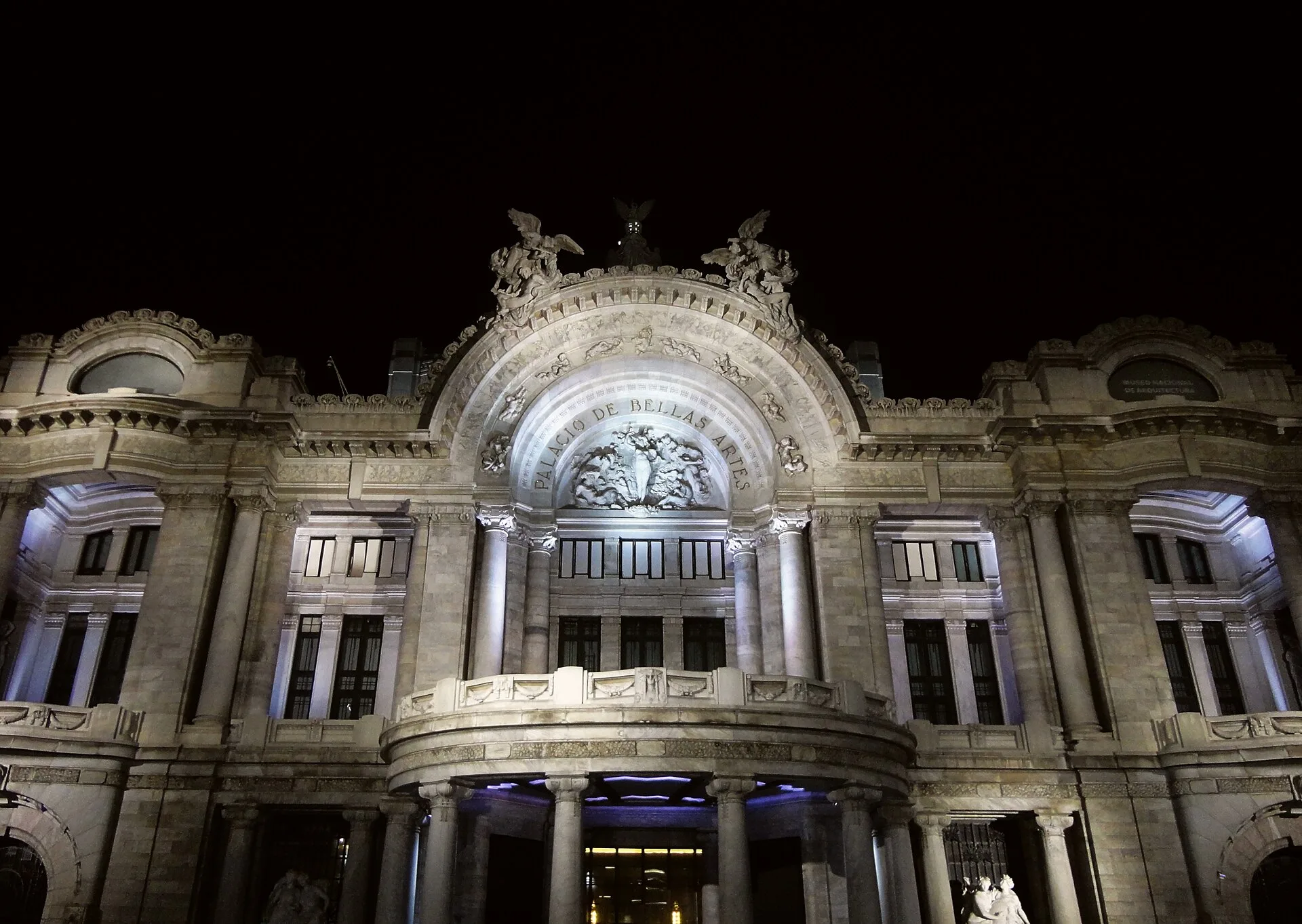
Palacio de Bellas Artes. A white marble opera house begun in 1904 in Art Nouveau and finished thirty years later in Art Deco, so heavy that it has sunk four meters. Inside are murals by the three great names, Rivera, Orozco and Siqueiros, and by Rufino Tamayo: Rivera's Man, Controller of the Universe is his second version of the mural destroyed at Rockefeller Center in New York for including Lenin. The museum opens Tuesday to Sunday from 10:00 to 18:00 and costs 95 pesos in 2026; on Sundays it is free. In the theater, the Ballet Folklórico performs in front of a stage curtain of a million pieces of Tiffany glass.
Torre Latinoamericana. A skyscraper of 1956 that has survived every earthquake since. From its observation deck on the 44th floor you understand the size of the valley; go an hour before sunset. The café across the street on the top floor of a department store gives the classic view down onto Bellas Artes.
The Alameda. The oldest public park in the Americas, beside Bellas Artes. At its western end, a small museum built for a single work: Rivera's Dream of a Sunday Afternoon in the Alameda, with the skeleton lady Catrina in the middle, holding the hand of the painter as a boy.
The center is dense, and half of what matters is not marked. A walk with a guide on the first morning repays itself, for example this essentials walking tour of the historic center.
Day 2: Chapultepec
The National Museum of Anthropology deserves a whole morning: the Sun Stone, the Olmec heads, the Maya hall. Afterwards, the park and the castle.
The museum is one of the great ones of the world, and the building, of 1964, is part of the reason: halls around a courtyard shaded by a concrete umbrella the size of a football pitch, held up by a single pillar down which water falls. It opens Tuesday to Sunday from 9:00 to 18:00, and admission is 210 pesos in 2026.
Do not try to see it all. The ground floor is archaeology, region by region; the upper floor shows the living Indigenous peoples of Mexico. A sensible route: the Teotihuacán hall, to prepare for the pyramids; the Mexica hall, straight ahead from the entrance, with the Sun Stone, twenty-four tons of carved basalt that is not a calendar but an image of the cosmos, and the terrifying statue of the earth goddess Coatlicue; Oaxaca, for the gold of Monte Albán; the Gulf Coast, for the colossal Olmec heads; and the Maya hall, with the reconstruction of the tomb of King Pakal of Palenque and his jade mask. Two and a half hours go by quickly. Someone who can read the stones adds a great deal, as on this tour of the museum with an archaeologist.
Outside the door, the Voladores of Papantla perform several times a day: four men descend, spinning head-down on ropes from the top of a thirty-meter pole, while a fifth plays the flute on its tip.
Chapultepec is twice the size of Central Park and has been a place of rest since the Mexica emperors kept gardens here. On its hill, the castle was a military college, the palace of the ill-fated Emperor Maximilian and the residence of presidents; it is now the National History Museum, with rooms furnished as the Habsburgs left them, more murals, and terraces with the best view down the Paseo de la Reforma. In the park below are the Museum of Modern Art, with Frida Kahlo's The Two Fridas, the Tamayo Museum, a lake with rowing boats, and on Sundays half the families of the city.
In the afternoon, walk or ride into Polanco, the wealthy quarter north of the park, for the silver cloud of the Soumaya Museum, which is free, and the Jumex collection of contemporary art, or go south to Condesa and Roma for the evening.
Golden rule: go to the taco stands where locals are queuing.
Day 3: the south
In Coyoacán, Frida Kahlo's Casa Azul requires booking weeks ahead. The market and its tostadas are nearby. If there is time, the trajineras of Xochimilco glide along the last canals of the ancient lake.
The Casa Azul. The cobalt-blue house where Frida Kahlo was born, lived with Diego Rivera and died, left as it was: her studio with the wheelchair at the easel, the kitchen with their names in tiny jugs on the wall, the bed with the mirror in its canopy, the corsets she painted, and her dresses. It is small, and entry is by timed ticket sold only online; in high season slots sell out weeks in advance. It is closed on Mondays and opens from 10:00 to 18:00 on most other days, later on Wednesdays, when it opens at 11:00, and until 21:00 on Thursdays. A second museum devoted to her family life, the Museo Casa Kahlo, opened nearby in 2025.
Coyoacán itself. A village swallowed by the city, with two connected squares, a 16th-century church, a fountain of coyotes, bookshops, and a market famous for its seafood tostadas. On weekends it is a fairground. A few streets away, the house where Leon Trotsky lived in exile and was murdered in 1940 keeps his study as he left it, bullet holes from an earlier attempt included.
Xochimilco. Half an hour farther south, the last remnant of the lake system: some 180 kilometers of canals between chinampas, the artificial islands on which the Mexica grew their food and where flowers and vegetables are still grown. You hire a trajinera, a flat-bottomed boat painted like a carnival float and poled like a gondola, by the hour and by the boat, not per person; the official hourly rate is posted at the docks, and you should point to it before boarding. On weekends the main canals are a floating party, with mariachi boats, food boats and beer boats alongside. For the quiet, ecological side, with herons and market gardens, leave from the Cuemanco dock early on a weekday.
The south is far, and its sights are scattered. Combining them by public transport takes patience; an organized day links them, like this small-group day at the Frida Kahlo Museum, Xochimilco and Coyoacán. Check, when you book any tour, that the museum ticket is included and for which house.
If you have an hour to spare on the way back, the central campus of the national university, the UNAM, is a World Heritage site: its library is wrapped in a mosaic of colored stones by Juan O'Gorman that tells the history of Mexico on four sides.
Day 4: Teotihuacán
An hour to the northeast stand the pyramids of Teotihuacán, one of the largest cities of the ancient world. You walk the Avenue of the Dead between the Pyramid of the Moon and the Pyramid of the Sun, more than sixty meters high. Go early, before the heat and the tour groups, and bring a hat and water: there is almost no shade. Buses leave from the Terminal del Norte all morning.
Nobody knows who built it, or what they called it. The city rose around the beginning of our era, reached more than a hundred thousand inhabitants about the year 400, traded with the Maya a thousand kilometers away, and was burned and abandoned around 550. When the Mexica found the ruins, eight centuries later, they could only suppose that gods had made them, and gave them the name we use: the place where the gods were born.
What you see is the ceremonial core, laid out along an axis more than two kilometers long. At the south end, the Temple of the Feathered Serpent, its façade bristling with stone heads; in the middle, the Pyramid of the Sun, one of the largest pyramids ever built; at the north end, the Pyramid of the Moon, framed by the mountain behind it, and beside it the Palace of Quetzalpapálotl, with carved pillars and painted walls. Climbing the Pyramid of the Sun has not been permitted since 2020, and rules for the Moon have changed more than once; do not count on going up either.
In 2026 the site opens every day from 8:00 to 17:00, with last entry at 16:30, and costs 210 pesos. Be at the gate at eight. By eleven the sun is fierce and the avenue is full of vendors blowing jaguar whistles. Allow three hours and about five kilometers of walking.
By bus: from the Terminal del Norte, services marked "Pirámides" leave every twenty minutes or so and take about an hour. Tours leave earlier still, arrive at opening time and bring an archaeologist's explanation, which here, where almost nothing is labeled, matters more than usual.
Which neighborhoods are worth your evenings?
Roma and Condesa. Two adjoining quarters west of the center, laid out a century ago, with Art Nouveau and Art Deco houses, plane trees, and more good restaurants, cafés, mezcal bars and bookshops than you can use. The oval Avenida Ámsterdam, in Condesa, follows the track of a vanished racecourse, and Parque México in its middle is the city's living room. Both were badly hit by the earthquakes of 1985 and 2017, and both are at the center of an angry debate about rents and foreign remote workers. Be a guest who notices.
Juárez and Reforma. The grand avenue with the golden Angel of Independence, closed to cars on Sunday mornings for cyclists and skaters.
San Ángel. A colonial village in the south with a Saturday art market and the twin studio-houses, linked by a bridge, that Juan O'Gorman built for Diego and Frida.
Garibaldi. The square where mariachis in silver-buttoned suits wait to be hired by the song. Lively and a little rough: go with company and leave by taxi.
Arena México. The cathedral of lucha libre, Mexican wrestling, on Tuesday, Friday and Sunday nights: masked heroes and villains, acrobatics off the ropes, and a crowd of grandmothers and children shouting advice. It is theater and sport at once, and tremendous fun, alone or on an evening such as this lucha libre night with tacos and seats near the ring.
Eating
Tacos al pastor at night, chilaquiles in the morning, a market at midday.
That sentence is a complete plan. Here is the vocabulary to carry it out.
Tacos al pastor. The city's own invention, adapted from the shawarma of Lebanese immigrants: pork marinated in dried chilies and achiote, stacked on a vertical spit, shaved onto a small tortilla with a flick of pineapple. Add onion, coriander, salsa and lime. Order three to start.
Other tacos. Suadero, a soft cut of beef confited in its fat; carnitas, pork cooked for hours in a copper pot; barbacoa, lamb steamed overnight in a pit, eaten on Sunday mornings with its broth; de canasta, steamed in a basket and sold from the back of a bicycle.
Corn in every shape. Tlacoyos, blue-corn ovals stuffed with beans; quesadillas, which in this city do not contain cheese unless you ask for it; sopes, huaraches, gorditas. Tamales and hot atole from street corners in the morning. Esquites, corn kernels in a cup with mayonnaise, cheese, chili and lime, at night.
Breakfast. Chilaquiles, fried tortilla pieces bathed in red or green salsa, with cream, cheese and an egg or shredded chicken. Sweet bread, pan dulce, and coffee with cinnamon.
Soups and stews. Pozole, hominy and pork in broth, with radish, lettuce and oregano; mole, the dark sauce of chilies, seeds and chocolate.
Markets. The Mercado de San Juan for cooks and the curious; Coyoacán for tostadas; Jamaica for flowers by the truckload; La Merced, immense and overwhelming, for everything.
Sweet. Churros and chocolate at a café that has been frying them since 1935.
To drink. Aguas frescas of hibiscus, tamarind or rice; craft beer; mezcal, sipped, with orange and chili salt; and pulque, the fermented sap of the agave, milky and ancient, in a traditional pulquería.
At the other end of the scale, Mexico City has several of the most admired restaurants in Latin America, which need reservations a month or two ahead. When the Michelin guide arrived in 2024, it gave a star to them and to a taco stand with four items on the menu.
How to eat in the street without regret: choose stalls with a queue and a fast turnover; eat what is cooked to order and served hot; go easy on raw garnishes the first day; taste the salsa before you pour it, and remember that the innocent green one is often the fiercest. Do not drink tap water; ice in established places is made from purified water. To get your bearings, and to try things you would not know how to order, there are guided walks such as this food tour with more than eight dishes.
How do you get around?
From the airport. The main airport, Benito Juárez, is inside the city, twenty to forty minutes from the center depending on traffic. Use the authorized taxis, paying a fixed fare at a booth inside the terminal, or a ride app from the marked pick-up points. The Metrobús line 4 runs to the historic center for 30 pesos. Check which airport you are flying into: the newer Felipe Ángeles airport is some 45 kilometers north, more than an hour away.
Metro. Twelve lines, 5 pesos a ride in 2026, fast and extremely crowded at rush hours, from seven to ten in the morning and six to nine in the evening. The front cars are reserved for women and children. Watch your pockets. Stations have pictograms as well as names, a legacy of 1969.
Metrobús. Buses in their own lanes along the main avenues, 6 pesos. Line 1 on Insurgentes and line 7 on Reforma are the useful ones.
Both systems use the same rechargeable card, sold at stations.
Ride apps. Cheap by international standards and the simplest choice at night. Avoid hailing taxis in the street.
On foot and by bicycle. The center, Roma, Condesa and Coyoacán are walking neighborhoods. The public bicycle scheme works well in the central districts, and on Sundays Reforma belongs to bicycles.
Traffic. Legendary. Plan each day in one part of the city, and never cross it between five and eight in the evening.
Where should you stay?
Roma or Condesa. The favorite of most visitors: leafy, walkable, full of places to eat, with small hotels and guesthouses. Twenty minutes from the center.
The historic center. Next to the monuments, in grand old buildings, lively by day and quiet, in parts deserted, late at night. Stay near Madero or the Alameda.
Reforma and Juárez. The large international hotels, between the center and Chapultepec.
Polanco. Luxury hotels, the best-known restaurants, close to the museums of Chapultepec.
Coyoacán. A village atmosphere, far from everything else.
Tips: what should you know before you go?
The altitude is tiring on day one: drink water and walk slowly. Use the metro or ride apps. And bring a jacket: nights are cool all year.
Altitude. At 2,240 meters you may sleep badly and get out of breath on stairs for a day or two. Alcohol hits harder. The sun burns more than the temperature suggests.
Air. Pollution is at its worst in the dry months, from February to May. Sensitive travelers should check the daily index.
Mondays. Nearly all museums and archaeological sites in the city are closed. Use Monday for markets, neighborhoods, Xochimilco or Teotihuacán, which opens daily.
Sundays. Many museums are free for Mexican residents, and therefore crowded.
Safety. The areas in this guide are busy and well policed, and visitors rarely have problems beyond pickpocketing on the metro and in crowds. Use ride apps at night rather than street taxis, carry only what you need, keep your phone in your hand rather than your back pocket, and do not wander beyond the tourist streets of the center after dark. Ask your hotel about any neighborhood you do not know.
Earthquakes. If the public alarm sounds, a wailing siren and a recorded voice from loudspeakers in the street, you have up to a minute. Follow the people around you out to the open, away from façades. Drills are frequent.
Money. Cards are widely accepted, but markets, street stalls and small entry fees need pesos in cash. Withdraw from machines inside banks. Tip ten to fifteen percent in restaurants.
Language. Outside hotels and upscale restaurants, English is limited. A few words of Spanish and a smile go a long way: Mexicans are formal and warm, and every exchange begins with a greeting.
When should you go?
The climate is spring-like all year, with warm days and cool nights. November to April is the dry season, with blue skies; in March and April the jacaranda trees turn the avenues violet. May is the hottest month. June to September is the rainy season: bright mornings and a violent downpour in the late afternoon, which you wait out in a museum or a café.
Dates to know. Day of the Dead, on November 1 and 2, with altars of marigolds across the city and a large parade on a nearby weekend. Independence, on the night of September 15, when the president rings the bell from the balcony of the National Palace over a packed Zócalo. December 12, when millions of pilgrims converge on the Basilica of Guadalupe, the most visited Catholic shrine in the world. And Easter week, when the residents leave and the city is pleasantly empty.
What if you have more time?
More museums. The house and studio of the architect Luis Barragán, a World Heritage site of color and light, by reservation well in advance. Anahuacalli, the dark volcanic-stone temple Rivera built for his collection of pre-Hispanic art. The Museo de Arte Popular, for the folk art of every state. Tlatelolco, where an Aztec market site, a colonial church and modern housing blocks share the Plaza of the Three Cultures, with a memorial to the students killed there in 1968.
Day trips. Puebla, two hours east, a colonial city of tiled churches and the home of mole, with the great pyramid of Cholula next door. Taxco, the white silver town on a hillside. Tepoztlán, a village under cliffs with a small pyramid at the top of a steep climb.
Is it a good city for children, or for limited mobility?
For children, yes: the flying men at the museum, the boats of Xochimilco, the castle, the zoo and the lake in Chapultepec, the wrestling, and a culture that welcomes them everywhere and at any hour. Take the altitude slowly and carry water.
For travelers with limited mobility, the picture is mixed. The big museums are accessible and lend wheelchairs. Pavements are broken and uneven, kerbs are high, and the metro has lifts at only some stations. Ride apps and the Metrobús, which boards level, are the practical way to move. At Teotihuacán, the ground along the avenue is rough but mostly level.
What mistakes should you avoid?
Trying to see Frida's house without a ticket. It sells out weeks ahead.
Planning museums for Monday. They are closed.
Crossing the city at six in the evening. Stay where you are and have a drink.
Arriving at Teotihuacán at noon. Be there at eight.
Hailing a taxi in the street at night. Use an app.
Pouring the green salsa without tasting it. Taste first.
Scheduling a full first day. The altitude will slow you.
Eating only in restaurants. The street is where the city cooks.
Quick answers
How many days do you need in Mexico City? Four for a first visit: the center, Chapultepec, the south and Teotihuacán.
How much is the Anthropology Museum in 2026? 210 pesos. It opens Tuesday to Sunday from 9:00 to 18:00.
How much is Teotihuacán, and can you climb the pyramids? 210 pesos; open daily from 8:00 to 17:00, last entry 16:30. Climbing the Pyramid of the Sun is not permitted.
Do you need to book the Frida Kahlo Museum? Yes, online and weeks ahead. It is closed on Mondays.
Is the metro safe? By day, yes, with attention to pickpockets. It costs 5 pesos. Avoid rush hours.
Is street food safe? Generally, if you choose busy stalls and food cooked to order. Do not drink tap water.
Is the altitude a problem? Most people feel only tired on the first day. Drink water, walk slowly and go easy on alcohol.
When is the best time to go? November to April for dry weather; early November for the Day of the Dead.
Prices and opening hours in this guide were checked in November 2026 in official sources. Confirm them before you go.