Guanajuato: the city you explore through tunnels and alleys
Silver mines, colorful houses and musicians who guide you at night. A getaway to the heart of Mexico, with a three-day plan, the museums, the callejoneadas and the practical details.
Culturera may earn a commission if you buy through the links on this page. As an Amazon Associate I earn from qualifying purchases. The selection is ours alone.
Guanajuato needs two full days, and three if you can: one to get lost in the center on foot, one for the mines, the mummies and the viewpoint, and a third for a day trip to the towns where Mexican independence began. It is a city without a beach, without pyramids and almost without straight lines, and it is one of the most beautiful in the country. Come on a weekday outside October if you want it quiet, or in October, with a room booked months ahead, if you want the biggest arts festival in Latin America.
Guanajuato has no straight streets. The city grew in the 16th century at the bottom of a ravine, around some of the richest silver mines in the world, and adapted to the terrain as best it could. The historic town and its mines have been a World Heritage site since 1988.
This guide explains how the city is laid out, what to see and in what order, what the museums cost in 2026 and how to get here. Where a guide adds something, in the alleys, down the mines or on the road to the neighboring towns, we link tours on GetYourGuide. We have not taken these tours: they are chosen for what they cover.
Why does the city look like this?
Because of silver. Spanish prospectors found the first veins here in the middle of the 16th century, and in the 18th the mine of La Valenciana, on the hill north of the city, hit one of the richest lodes ever worked. For decades it produced a large share of all the silver that New Spain shipped to the world. The owners became counts, built churches covered in gold leaf and mansions around tiny squares, and the workers built their houses wherever the slope allowed, one on top of another, painted in whatever color was at hand.
The ravine left no room for a grid. Streets follow the old paths of mules and water, climb in steps, end in a wall or open without warning onto a square the size of a living room. The river ran through the middle and flooded the city again and again, sometimes catastrophically, until it was put into a channel and, in the 20th century, diverted altogether. The dry riverbed, vaulted over long before, became a street. That is the origin of the tunnels.
Then the silver declined, and the lack of money did what it does to old cities: it preserved them. Nobody widened the streets or knocked down the mansions. What you walk through today is, in its outline, the city of 1800.
Above and below: how do you find your way?
Traffic runs through a network of tunnels, many of them former channels of the river that used to flood the city. Above are small squares and more than three thousand alleys. The most famous is the Callejón del Beso, the Alley of the Kiss, so narrow that two balconies almost touch; legend tells of a tragic love.
The center is a narrow strip, less than two kilometers long, that follows the bottom of the ravine. Two roughly parallel streets run along it and change name every few blocks; the Jardín de la Unión, a triangular garden of clipped laurel trees with cafés on its sides, is the middle of everything. If you get lost, and you will, walk downhill: every alley ends up in the strip.
Underneath, the Calle Miguel Hidalgo, also called the Subterránea, runs for about three kilometers along the old bed of the river, under stone arches and the foundations of houses, with stairs that come up into the squares. Other tunnels were bored through the rock from the 1960s on to take cars out of the center. Buses, taxis and pedestrians share them; there are bus stops down there, and sidewalks. Walking a stretch of the Subterránea is one of the stranger pleasures of the city, and it is safe by day, though the fumes do not invite you to stay.
Two consequences. A car is useless: if you arrive in one, leave it at the hotel or in a car park and forget it. And maps on a phone are unreliable, because the signal does not know whether you are on the street or under it.
What should you see in the center?
The Teatro Juárez, with its columned portico and Moorish interior. The yellow basilica. The Alhóndiga de Granaditas, scene of one of the first battles of independence in 1810. The university and its great staircase. And the house where Diego Rivera was born, now a museum.
In walking order, from the Jardín de la Unión toward the west:
Teatro Juárez. Opened in 1903 by the dictator Porfirio Díaz, it is the perfect portrait of his era: a Roman portico crowned by bronze muses outside, and inside an auditorium decorated like a hall of the Alhambra, in red, blue and gold. When there is no rehearsal, you can visit it by day for a small fee. Its steps are the city's grandstand: people sit there in the evening to watch the mimes, the musicians and one another.
Templo de San Diego. The church beside the theater, with a pink Churrigueresque doorway. The callejoneadas start from its steps.
Plaza de la Paz and the basilica. The most elegant square, sloping and triangular, lined with the mansions of the mining aristocracy. The yellow and red Basílica de Nuestra Señora de Guanajuato keeps a wooden image of the Virgin that, according to tradition, was sent from Spain as a gift from King Philip II in 1557.
The University. A white building of the 1950s in a neo-Moorish style, which only works because of its staircase: more than a hundred steps rising straight from the street. Climb them for the view over the roofs, and to see what the city is made of. Guanajuato is a university town, with tens of thousands of students, and it shows in the prices, the bars and the mood.
Museo Casa Diego Rivera. The painter was born in 1886 in this house on Calle Positos and lived here until he was six. The ground floor recreates the family home; upstairs there are early works, sketches and studies for murals. In 2026 it opens Tuesday to Saturday from 10:00 to 19:00 and Sunday from 10:00 to 15:00, and the ticket costs about 30 pesos.
Museo Iconográfico del Quijote. Hundreds of paintings, sculptures, prints and objects on a single subject: Don Quixote, as seen by artists from Dalí to anonymous potters. It explains the city's obsession with Cervantes, of which more below.
Alhóndiga de Granaditas. A massive stone granary on the western edge of the center, more fortress than warehouse. On September 28, 1810, twelve days after the uprising against Spain began, the Spanish garrison and the wealthy families of the city barricaded themselves inside with their silver. The insurgent army of the priest Miguel Hidalgo could not break in until, according to the story every Mexican child learns, a miner nicknamed El Pípila tied a slab of stone to his back as a shield against the bullets, crawled to the wooden door and set it on fire. What followed was a massacre. A year later, when the leaders of the revolt had been captured and shot, the heads of Hidalgo, Allende, Aldama and Jiménez were hung in iron cages from the four corners of the building, where they stayed for ten years. The hooks are still there. Inside, the regional museum has pre-Hispanic collections and murals by José Chávez Morado on the staircases. It opens Tuesday to Saturday from 10:00 to 18:00 and Sunday from 10:00 to 15:00.
Mercado Hidalgo. Two blocks from the Alhóndiga, an iron hall inaugurated in 1910 for the centenary of independence. More on it under food.
A guide is worth having on the first morning: the city does not explain itself, and the stories are half the visit. You can check dates for a walk of the center here.
To understand the city, take the funicular up to the Pípila monument: from above it looks like a painted model.
Where is the best view?
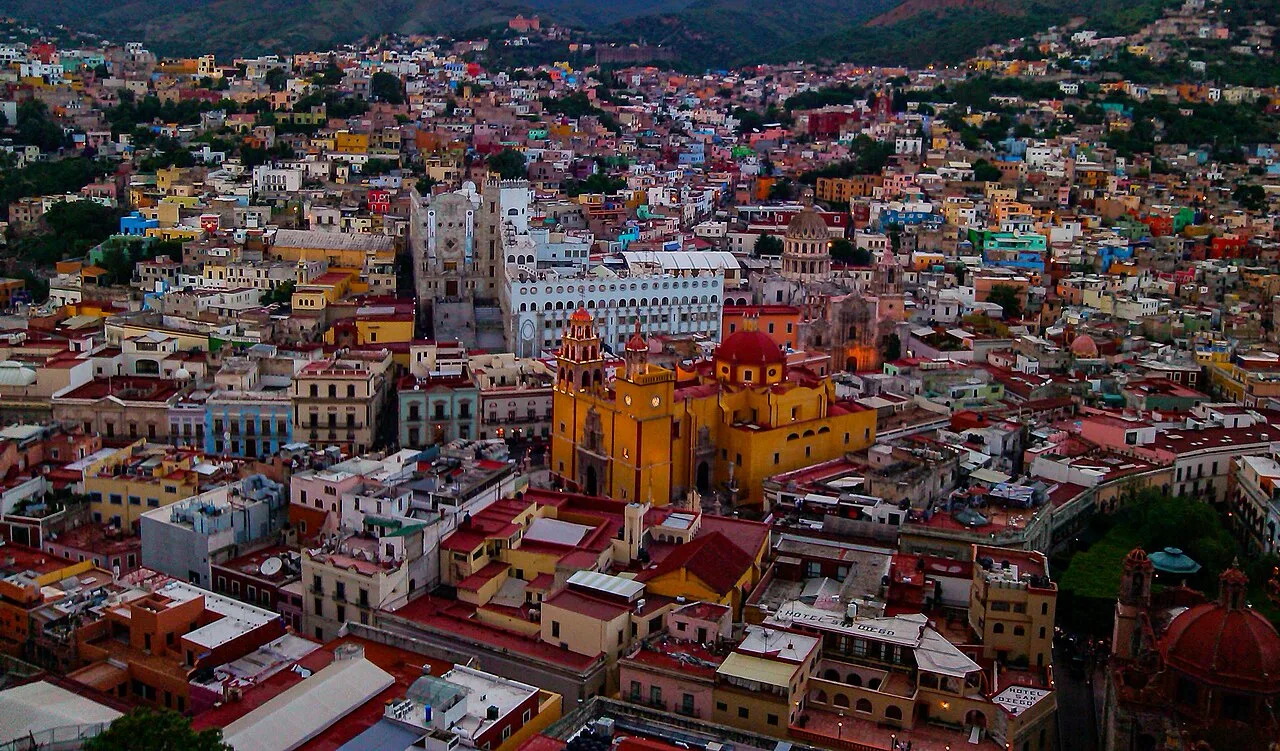
At the Pípila monument, the giant of pink stone holding a torch on the hill south of the center. A funicular climbs to it in a couple of minutes from behind the Teatro Juárez, for a few dozen pesos; you can also walk up through the alleys in fifteen or twenty steep minutes, by day and preferably not alone. From the terrace the whole city is at your feet: the basilica, the university, the theater, the domes, and the houses going up the hills in every color.
Go twice if you can. In the morning the light is behind you and the colors are at their best. At dusk the lights come on in the ravine while the sky is still blue, and the terrace fills with families, couples and vendors of corn and micheladas.
What is the story of the Alley of the Kiss?
The Callejón del Beso is a five-minute walk from the Jardín de la Unión, up a narrow street behind the Plaza de los Ángeles. At its narrowest it measures less than 70 centimeters between walls, and two balconies on opposite houses are close enough for two people to kiss across the gap.
The legend says they did. Doña Carmen, the daughter of a rich and violent father, loved Don Luis, a poor miner. He rented the room opposite hers so they could meet from balcony to balcony. Her father caught them and stabbed his daughter with a dagger; Don Luis kissed her hand as she died.
The ritual: couples must kiss on the third step, painted red, or suffer seven years of bad luck. There is a queue at weekends, local photographers, and a house whose owners charge a few pesos to let you out on the balcony. It is small, crowded and slightly absurd, and almost everyone ends up going.
What are the callejoneadas?
At nightfall, groups of students in period dress, the estudiantinas, walk the alleys singing and telling legends, followed by anyone who wants to join.
The tradition comes from the Spanish university tunas, and arrived here in the 1960s. The musicians wear the black velvet doublets, capes and ribbons of the 17th century, and play guitars, mandolins, a double bass and tambourines. Every evening, from around eight o'clock, several groups set out from the steps of San Diego, beside the Teatro Juárez. For about an hour and a half they lead a crowd through the alleys, stopping in small squares to sing serenades, tell the story of each corner and make jokes at the expense of the audience, and they end at the Callejón del Beso.
The members sell tickets themselves, in costume, around the Jardín de la Unión during the afternoon, and you can also reserve a place in advance, as with this night walk with the estudiantina. Two warnings. Everything is in Spanish, fast and full of wordplay; if you do not speak it you will still enjoy the music and the walk, but you will miss the jokes. And on Friday and Saturday the groups are very large; on a weekday it feels more like what it is supposed to be.
Mummies and mines: what is beyond the center?
Museo de las Momias. Guanajuato's most famous attraction is also its most disturbing. From 1865, the bodies of people whose families could not pay the burial tax were removed from the crypts of the municipal cemetery, and the gravediggers found that many had not decomposed: the dry air and the mineral soil had preserved them, with skin, hair and sometimes clothes. The workers began to show them to the curious for a few coins. Today more than a hundred are displayed in glass cases, men, women and children, some with expressions that have fed a century of horror stories and films.
It is not for everyone, and not for small children. Mexicans, who have a familiar relationship with death, visit it in family groups; many foreign visitors come out uneasy, and in recent years there has been a public debate about the dignity of the bodies and how they are shown. In 2026 the museum opens every day from 9:00 to 18:00 and the ticket costs 111 pesos, on sale online on the city council's site or at the door. It is at the cemetery, on a hill west of the center: take a taxi or a bus marked "Momias", and go early, because the queue at weekends is long.
La Valenciana. Five kilometers up the road to Dolores Hidalgo, the mine that paid for all of this. The Templo de San Cayetano, built by its owner in the 1780s, has a façade of carved pink stone and three altarpieces covered in gold from floor to vault, among the finest of the Mexican Baroque. Beside it, you can go down a stretch of an old shaft, the Bocamina San Ramón, with a helmet and a guide who is usually a retired miner, to see the veins, the tools and the chapel where the men prayed before each shift. It is a short, steep descent by stairs.
Ex-Hacienda San Gabriel de Barrera. One of the old estates where the ore was ground and refined, on the western road. The house is furnished as it was, and the grounds have been turned into a series of gardens in different styles. It is the quietest place in the city.
Presa de la Olla. A small 18th-century reservoir at the eastern end of the ravine, with rowing boats, a park and the fine houses of the Porfirian era along the avenue that leads to it. A walk of half an hour from the center, slightly uphill, or a short bus ride.
These places are spread around the hills, and local buses or taxis reach them all cheaply. If you prefer one outing that strings them together with transport and explanations, there are group tours such as this guided tour of the mummies, the mines and the tunnels.
How do you plan three days?
Day 1: the center. Jardín de la Unión, Teatro Juárez, Plaza de la Paz, the basilica, the university stairs, the Diego Rivera house and the Alhóndiga, with lunch at the Mercado Hidalgo. At dusk, the funicular to the Pípila. At night, a callejoneada.
Day 2: the hills. The Mummy Museum first thing, La Valenciana and its church before lunch, the gardens of San Gabriel de Barrera or the Presa de la Olla in the afternoon. Back in the center, the Quixote museum, the Callejón del Beso and a walk through the Subterránea.
Day 3: the cradle of independence. A day trip to Dolores Hidalgo and San Miguel de Allende.
With only two days, keep the first two. With four, give San Miguel de Allende a night of its own.
Why is everything named after Cervantes?
Cervantes never set foot in the Americas, and Guanajuato has a Quixote museum, statues of the knight and his squire on several squares, a Cervantes theater and a festival named after him. It began as a student project. In 1953 a university teacher, Enrique Ruelas, staged the Entremeses, Cervantes's short comic plays, in the open air in the Plaza de San Roque, using the square itself, its church, its lanterns and its balconies, as the set. It became a tradition, and in 1972 the government turned it into an international festival.
Every October, the Festival Internacional Cervantino, one of the most important in Latin America, fills the city with theater, music and dance. Book months ahead.
For two to three weeks, orchestras, theater and dance companies and musicians from dozens of countries perform in the theaters, the churches, the Alhóndiga's esplanade and the squares. A country and a Mexican state are guests of honor each year. The 2026 edition ran from October 3 to 18. The 55th edition will be held in October 2027; the exact dates had not been announced when this guide was checked.
What it means for a visitor: hotel prices multiply, rooms in the center sell out months in advance, and at weekends the alleys are packed with young people who come to drink in the street as much as for the program. If you want the performances, buy tickets as soon as the program is published, usually in the summer, and come during the week. If you want the city, come in any other month.
What should you eat?
The local specialty is enchiladas mineras: tortillas dipped in guajillo chili sauce, filled with cheese and onion, and topped with fried potatoes and carrots. They began as food for the mine workers. A good place to try them is the Mercado Hidalgo, an iron building from the early 20th century that looks like a train station. For dessert, charamuscas, twisted candies shaped like mummies.
The market deserves an hour. The ground floor has fruit, cheese, sweets and food stalls; the iron gallery above sells crafts and souvenirs. Besides the enchiladas, look for:
Gorditas. Thick corn cakes split and filled with stews: pork in red sauce, beans, rajas of chili with cream, nopales.
Guacamayas. A bread roll filled with crisp pork crackling, pico de gallo, lime and a fierce salsa. It comes from León, the neighboring city, and is not for the cautious.
Tortas and tacos at the stalls around the market and the Alhóndiga, where the students eat.
Cajeta. Caramel made from goat's milk, from the nearby town of Celaya, sold in wooden boxes or as a filling for wafers.
Strawberries with cream. The state's other emblem; the fields are around Irapuato.
Nieves. Ices in flavors that range from mango to avocado, tequila or shrimp. The famous ones are in Dolores Hidalgo, but you find them here too.
In the evening the city eats and drinks around the Jardín de la Unión, where the mariachis work the terraces, and in the bars of the alleys behind it. Restaurants on the garden charge for the setting; two streets away, the same dishes cost half. For an introduction with a guide who knows the stalls, there is this food tour of Guanajuato.
Where can you go for a day?
Dolores Hidalgo. An hour north. On the night of September 15 to 16, 1810, the parish priest Miguel Hidalgo rang the bell of this church and called on his parishioners to rise against the colonial government; Mexico celebrates that call, the Grito, as the birth of the nation. The church and the priest's house, now a museum, are on the main square, where the ice-cream sellers offer the strangest flavors in the country. The town also makes painted ceramics and is the burial place of the singer José Alfredo Jiménez, under a tomb shaped like a huge sombrero and a sarape.
San Miguel de Allende. An hour and a half from Guanajuato, and its opposite: an orderly town of ocher and red façades, galleries, design shops and a large community of foreign residents, crowned by a neo-Gothic parish church of pink stone that looks like a sugar cathedral. It is prettier and more polished than Guanajuato, and more expensive. On the way, the Sanctuary of Atotonilco, covered inside with 18th-century murals, is part of the same World Heritage listing as San Miguel.
Buses link all three towns frequently. A tour does both in one day without changing buses, such as this group tour to Dolores Hidalgo and San Miguel de Allende.
Cristo Rey. On the summit of the Cerro del Cubilete, at about 2,600 meters, half an hour's drive from the city, a bronze statue of Christ twenty meters tall marks what is said to be the geographic center of Mexico. It is a place of pilgrimage, above all in January, with a view over the whole plain of the Bajío.
León. The big, modern city of the state, 45 minutes away, is the capital of Mexican leather: shoes, boots, belts and jackets at factory prices in the area around the bus station.
When should you go?
The city is at about two thousand meters, which gives it one of the mildest climates in Mexico: warm days and cool nights almost all year.
October to April is dry and sunny. December and January nights can drop to near freezing; hotels in old houses are rarely heated, so ask for extra blankets.
April and May are the hottest months, before the rains.
June to September is the rainy season: clear mornings and a heavy shower in the late afternoon, which turns the alleys into streams for half an hour and leaves the hills green.
Dates to know. The Cervantino, in October. Day of the Dead, on November 1 and 2, when the university staircase and the streets are covered with carpets of flowers and colored sawdust. Holy Week, and the Friday before it, the Viernes de Dolores, the city's own feast, when the Jardín de la Unión fills with flowers. And every Mexican long weekend, when visitors from the capital fill the hotels. From Monday to Thursday, the city is half empty and cheaper.
How do you get there and get around?
By air. The Bajío international airport (BJX) is near León, some 30 to 35 kilometers from Guanajuato. It has flights from Mexico City, Tijuana, Monterrey and Cancún and from several cities in the United States. An authorized taxi to the center takes 40 to 50 minutes; buy the ticket at the booth inside the terminal.
By bus. From Mexico City, first-class coaches of Primera Plus and ETN leave from the Terminal del Norte and take about five hours. There are also direct buses from Guadalajara, in about four hours, from Querétaro and from San Miguel de Allende. Guanajuato's bus station is several kilometers outside the center; a taxi or the local bus marked "Centro" brings you in, through the tunnels.
In the city. On foot. Taxis are cheap and have no meter: ask the fare first. Local buses, for a few pesos, go to La Valenciana, the mummies and the Presa de la Olla. Ride apps work irregularly because of the tunnels.
Where should you stay?
Around the Jardín de la Unión and Plaza de la Paz. The most convenient area: everything is within a ten-minute walk. Rooms that face the street are noisy until late, above all at weekends, when the mariachis and the callejoneadas pass under the window. Ask for an interior room if you sleep lightly.
On the hillsides. Small hotels and guesthouses on the slopes around the Pípila or San Javier have terraces with the view of the postcards. The price is the climb: confirm how many steps there are between the street and the door, and whether a taxi can reach it.
Presa de la Olla and Paseo de la Presa. Old mansions turned into quiet hotels, twenty or thirty minutes' walk from the center.
Many hotels occupy houses that are centuries old, with stairs, no lift and thick walls that stay cool. Travelers with reduced mobility should ask precise questions before booking; the city, with its steps and cobbles, is difficult for wheelchairs outside the main strip.
What should you know before you go?
Comfortable shoes: it is all slopes and cobbles. The city sits at two thousand meters; nights are cool.
Altitude. Most people notice nothing more than shortness of breath on the stairs for the first day. Drink water and take the climbs slowly.
Money. The Mexican peso. Cards are accepted in hotels and most restaurants; markets, buses, taxis and small museums take cash only. Cash machines are around Plaza de la Paz.
Safety. The historic center is busy and well watched until late, and visitors walk it at night without trouble. Use the ordinary precautions: keep to lit, peopled streets after dark, take a taxi back to hillside lodgings at night, and watch your phone in crowds during the Cervantino. Other parts of the state of Guanajuato have serious problems with organized crime; they do not usually affect the capital or San Miguel de Allende, but check your government's current travel advice and travel between towns by day.
Language. Less English is spoken here than in San Miguel de Allende or on the coasts. A few words of Spanish go a long way.
Museums. Most close on Monday. The Mummy Museum opens every day.
What mistakes should you avoid?
Arriving by car and trying to drive in the center. The tunnels are a labyrinth with no signal. Park and walk.
Coming on a long weekend without a reservation. Or during the Cervantino.
Visiting only as a day trip from San Miguel. The city is at its best at dusk and at night, after the buses have left.
Skipping the Pípila because of the climb. The funicular takes two minutes.
Taking small children to the mummies. Read about it first, and decide.
Booking a hillside room with heavy suitcases. Count the steps.
Leaving Monday for the museums. They are closed.
Eating only on the Jardín de la Unión. The market and the alleys feed you better for less.
Quick answers
How many days do you need in Guanajuato? Two full days for the city; three with a day trip to Dolores Hidalgo and San Miguel de Allende.
How much is the Mummy Museum in 2026? 111 pesos. It opens every day from 9:00 to 18:00.
When is the Cervantino? In October. The 2026 edition ran from October 3 to 18; the dates of the 55th edition, in October 2027, had not been announced in November 2026.
How do you get to the Pípila? By funicular from behind the Teatro Juárez, or on foot through the alleys in about twenty minutes.
Is the callejoneada worth it without Spanish? For the music and the walk, yes. The stories and jokes are in Spanish.
How do you get to Guanajuato from Mexico City? By first-class bus from the Terminal del Norte in about five hours, or by air to the Bajío airport, 40 to 50 minutes from the center by taxi.
Is Guanajuato or San Miguel de Allende better? Guanajuato is larger, livelier, younger and cheaper; San Miguel is more polished and quieter. They are an hour and a half apart, and the best answer is both.
Can you walk in the tunnels? Yes. The Subterránea has sidewalks and stairs up to the squares, and it is used by pedestrians during the day.
Prices and opening hours in this guide were checked in November 2026 in official and local sources. Confirm them before you go.