Istanbul between two continents: what to see in three days
Hagia Sophia, the Bosphorus, the bazaars and tea in a tulip glass. A first visit to the city that was three capitals, day by day, with 2026 ticket prices, closing days, food, ferries and the scams to sidestep.
Culturera may earn a commission if you buy through the links on this page. As an Amazon Associate I earn from qualifying purchases. The selection is ours alone.
The short version: three days, one for each layer. Sultanahmet for Byzantium and the great mosques; Topkapi and the bazaars for the Ottoman empire; and the other shores, Galata and the Asian side, for the living city. In 2026 foreign visitors pay 25 euros for Hagia Sophia and see it only from the upper gallery, Topkapi closes on Tuesdays and the Grand Bazaar on Sundays, and the best hour of the trip still costs a transit fare, on the deck of a ferry at sunset.
Byzantium, Constantinople, Istanbul. The city has been the capital of three empires and is the only great metropolis spread across Europe and Asia. Its historic areas are a World Heritage site.
This guide follows the three days and then explains how to make them work: which tickets to buy and which passes do not help, how the ferries and trams fit together, what to eat and where, how to visit a mosque, and which street tricks to walk past. Where a guide or a timed ticket saves a queue or explains what you are looking at, we link options on GetYourGuide. We have not taken these tours: they are chosen for what they cover.
Why three names?
The Greeks founded Byzantium in the 7th century BC on a triangle of land with water on three sides: the Sea of Marmara to the south, the mouth of the Bosphorus to the east, and to the north the deep inlet called the Golden Horn, the best natural harbor of the ancient world. Whoever held the point controlled the passage between the Black Sea and the Mediterranean and the crossing between Europe and Asia.
In 330 the emperor Constantine made it the capital of the Roman Empire, and for more than a thousand years Constantinople was the largest and richest city in Christendom, behind land walls that no army breached until crusaders did, in 1204, and then the cannon of the 21-year-old Ottoman sultan Mehmed II, on May 29, 1453.
The Ottomans rebuilt it as the capital of an empire that reached from Vienna's outskirts to Yemen: mosques on every hill, markets, baths, fountains, a palace on the point. The name Istanbul, long used in speech, became official only in 1930, seven years after the republic of Atatürk had moved the capital to Ankara.
All three cities are still there, one on top of another, and around them a metropolis of some sixteen million people, loud, young, hospitable and in a hurry.
How is the city laid out?
Three pieces of land and the water between them.
The old city, the historic peninsula south of the Golden Horn, holds Sultanahmet, the bazaars and the great mosques. Beyoğlu, north of the Golden Horn and still in Europe, is the 19th-century city of the Genoese tower, the embassies and Istiklal Avenue, climbing to Taksim Square. And across the Bosphorus, in Asia, are Üsküdar and Kadıköy, where much of the city actually lives.
The Galata Bridge joins the first two; ferries, a rail tunnel and three bridges join Europe to Asia. A tram line, the T1, strings together almost everything a visitor wants on the European side. Once you see this, the city stops being intimidating.
Day 1: Sultanahmet
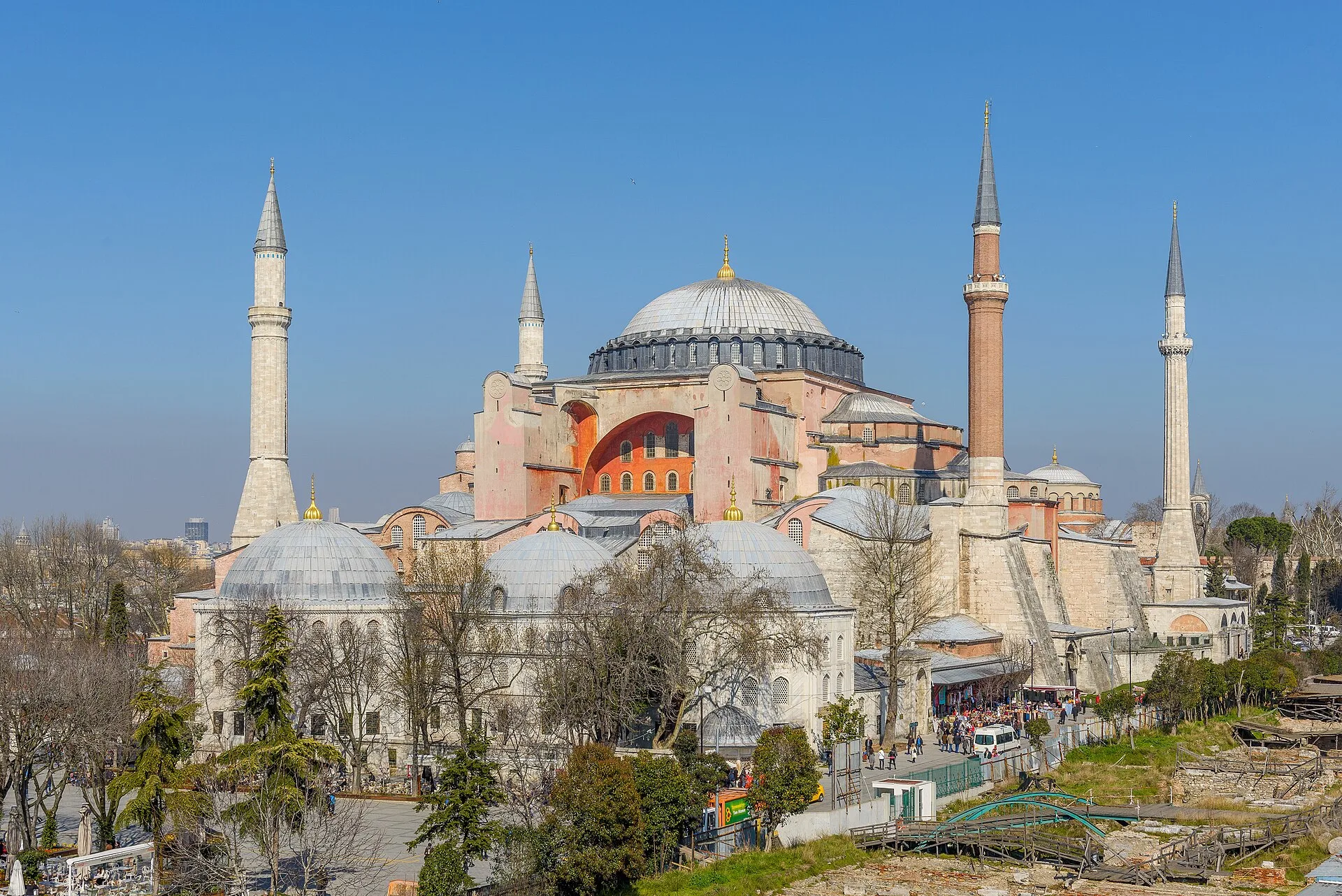
Hagia Sophia was for almost a thousand years the largest church in Christendom. Emperor Justinian inaugurated it in 537; its dome, 31 meters across, seems to float on a ring of windows. It was a mosque from 1453, a museum from 1934 and a mosque again from 2020; visitors enter the upper gallery. Opposite stands the Blue Mosque. Underground, the Basilica Cistern, a forest of 336 columns.
Hagia Sophia, in practice. It was built in less than six years, by two mathematicians, after rioters burned the previous church, and nothing so large was vaulted again for nine centuries. Since 2024 there are two entrances and two experiences. Worshippers use the ground floor, free. Foreign visitors buy a ticket, 25 euros in 2026, and follow a one-way route through the upper gallery: from there you look down into the nave and across to the dome, and you stand face to face with the finest mosaics, among them the 13th-century Deësis, Christ between the Virgin and John the Baptist, with faces of a tenderness that announces the Renaissance. Look also for the runes a Viking guardsman scratched into the marble balustrade, and for the tombstone of the Venetian doge who led the sack of 1204. The visit is open daily, from 9:00 in winter and 8:00 in summer until 19:30, and is suspended on Fridays between 12:00 and 14:00. The city's museum pass is not valid. Restoration of the dome is under way, and scaffolding hides part of the interior. Dress as for any mosque.
The Blue Mosque. Sultan Ahmed I built it between 1609 and 1617 to rival the church across the square, with six minarets, which caused a scandal, since only Mecca had as many, and an interior lined with more than twenty thousand blue tiles from Iznik. It is a working mosque, free to enter outside prayer times through the visitors' door, and at its best in the morning.
The Hippodrome. The long square beside the mosque was the racetrack of Constantinople, where chariot factions could make and unmake emperors. Three of the monuments on its central spine still stand where they were set: an Egyptian obelisk of the 15th century BC, brought from Karnak and raised here in 390 on a base that shows the emperor at the races; the bronze Serpent Column, cast by the Greek cities to celebrate their victory over the Persians at Plataea and taken from Delphi; and a second, built obelisk that has lost its bronze plates.
The Basilica Cistern. Justinian's engineers built this underground reservoir in the 530s to supply the palace, using columns salvaged from older temples, which is why no two capitals match and why two of them stand on giant heads of Medusa, one sideways and one upside down. Walkways lead over shallow water in near darkness, with music and changing light. It has its own ticket, more expensive in the evening, and its own queue: go at opening time or late.
The rest of the day. Behind Hagia Sophia, the Archaeological Museums hold the Alexander Sarcophagus, carved with battle scenes so fine that traces of paint survive. Below them, Gülhane Park, the old palace gardens, runs down to the water, full of tulips in April. End with tea on a terrace facing the two domes as the calls to prayer answer one another across the square.
A guide makes a real difference on this day, when one square holds sixteen centuries. This kind of visit covers the two great buildings together.
Day 2: palace and bazaars
Topkapi Palace, residence of the Ottoman sultans, takes half a day. Then the Grand Bazaar, some four thousand shops under one roof, and the Spice Bazaar.
Topkapi. For four centuries this was the center of the empire, and it looks nothing like a European palace: no great façade, but a series of courtyards, each more private than the last, with pavilions set among gardens like the tents of a camp. The first court was open to all. The second held the council chamber and the kitchens, which fed four thousand people a day and now display the sultans' Chinese porcelain. The third was the sultan's own, with the audience hall, the Treasury, with its 86-carat diamond and the emerald-hilted dagger of the film Topkapi, and the chamber of the sacred relics of Islam, where the Koran is recited without pause. The fourth is terraces and kiosks over the meeting of the waters.
The Harem is the part not to skip: some three hundred rooms, of which you see a few dozen, tiled from floor to ceiling, where the sultan's mother ruled over wives, concubines, children and eunuchs. In 2026 the ticket for foreign visitors that includes the Harem costs about 2,750 lira, roughly 50 euros. The palace is closed on Tuesdays. Arrive at opening time, go straight to the Harem and the Treasury, and then wander. A guided visit helps with the layout and the queue, such as this tour of Topkapi Palace and the Harem with ticket.
The Grand Bazaar. Begun by Mehmed II a few years after the conquest, it grew into a covered city of more than sixty streets, with its own mosques, fountains, police and gates that are locked at night. It opens from Monday to Saturday, 8:30 to 19:00, and is closed on Sundays. The main streets sell gold, carpets, leather, lamps and ceramics to visitors; the old caravanserais on its edges, the hans, still hold workshops where silver is beaten and thread is spun. Haggling is expected, and a glass of tea commits you to nothing.
Between the bazaars. Walk downhill through the streets of wholesalers, where the city shops for buttons, pots and wedding dresses, and look for two mosques. Süleymaniye, on the crest of the hill, is the masterpiece of the architect Sinan, built in the 1550s for Süleyman the Magnificent: a vast, calm space of white light, with the tombs of the sultan and of his wife Roxelana in the garden and a terrace over the Golden Horn. It is free, and to many eyes the most beautiful building in the city. Rüstem Pasha, hidden above the shops near the water, is a small mosque covered inside and out with the best Iznik tiles there are.
The Spice Bazaar. By the Galata Bridge: an L-shaped hall of the 1660s, scented with cumin, sumac, dried fruit and Turkish delight. The streets around it, with cheese, olives, coffee roasters and fishmongers, are better than the hall.
The best thing to do in Istanbul costs a transit fare: cross the Bosphorus by ferry at sunset.
What is worth buying, and how do you bargain?
Carpets and kilims. The great purchase and the great risk. A knotted wool or silk carpet is an investment that needs knowledge; a flat-woven kilim is cheaper, lighter and just as handsome. Visit several shops, ask to see the back, and never buy on the first visit.
Ceramics. Bowls and tiles in the Iznik tradition, hand-painted in cobalt, turquoise and tomato red. Hand-painted pieces are signed underneath; printed ones are not.
Textiles. Cotton peştemal towels, light and quick to dry; silk and wool scarves; embroidered suzani cloths from Central Asia.
Copper and brass. Coffee pots, trays and lanterns, new and old, in the lanes behind the Grand Bazaar.
Things to eat. Turkish delight and baklava packed to travel, pistachios, dried figs and apricots, sumac, pepper flakes, pomegranate molasses, tea and the small glasses to drink it from.
On bargaining: prices in food shops and in most modern stores are fixed, and marked. In the Grand Bazaar, for carpets, leather and souvenirs, they are not. Ask the price, offer about half, settle somewhere above, and keep it friendly: the conversation is part of the transaction. Do not start if you do not intend to buy, and do not feel that accepting tea obliges you. Pay by card for anything expensive, and ask for a receipt and, for carpets, a certificate. Antiques more than a century old may not legally leave the country.
Day 3: the other shore
Cross the Galata Bridge, climb the tower and walk Istiklal Avenue. Take a ferry to Kadıköy, on the Asian side, to eat in its market.
The Galata Bridge. Two levels: fishermen with rods along the top, shoulder to shoulder at all hours, and fish restaurants underneath. From the middle you have the classic skyline of the old city, domes and minarets against the light.
Galata. The steep quarter on the far side was a Genoese trading colony, with its own walls. Its tower, of 1348, gives a full circle of views; the official ticket is 30 euros in 2026, and the queue is long at sunset. The streets around it are full of music shops, cafés and design studios. The Tünel, a two-stop underground funicular opened in 1875, the second-oldest in the world, saves the climb.
Istiklal Avenue. A kilometer and a half of pedestrian street, with a red vintage tram down the middle, lined with the consulates, churches, arcades and cinemas of the cosmopolitan 19th-century city once called Pera. It is crowded at every hour. Look into the Flower Passage, the fish market behind it, and the side streets of meyhanes.
The ferry to Asia. From Karaköy or Eminönü, a public ferry reaches Kadıköy in twenty minutes: buy a glass of tea on board, stand at the rail and watch the palace, Hagia Sophia and the mosques slide by, with gulls following for scraps of simit. Kadıköy's market streets are where Istanbul shops for fish, pickles, honeycomb, cheese and coffee, and its restaurants serve the regional cooking of all Anatolia. Walk on to Moda for the seaside promenade and an ice cream, and take the ferry back at dusk.
Or along the Bosphorus. The strait is thirty kilometers long, lined with wooden summer houses, fortresses, palaces and fishing villages. The municipal ferry line runs short and long tours of it from Eminönü at ordinary prices, and many private boats run two-hour cruises at sunset, with a guide and drinks, such as this Bosphorus sunset yacht cruise.
What else is on the Asian side?
Üsküdar. One ferry stop north of Kadıköy, older and more conservative, with mosques by Sinan at the water's edge and the best sunset view in the city: the whole historic peninsula in silhouette. Offshore stands the Maiden's Tower, a small lighthouse-fortress on a rock, restored and open to visitors by boat.
Kuzguncuk. A village of wooden houses, plane trees and bakeries just up the shore, where a synagogue, two churches and a mosque stand within a few steps of one another.
Çamlıca Hill. The highest point of Istanbul, with tea gardens and a view of both continents and both bridges.
Coming back to Europe by ferry after dark, with the mosques lit, is the image most people take home.
What if you have a fourth day?
Dolmabahçe Palace. The 19th-century answer to Versailles, on the Bosphorus shore: 285 rooms, a chandelier of four and a half tons, and the bedroom where Atatürk died on November 10, 1938, with the clock stopped at 9:05. About 2,000 lira for foreign visitors in 2026; closed on Mondays.
Fener and Balat. The old Greek and Jewish quarters on the Golden Horn: steep cobbled streets of painted wooden houses, the seat of the Ecumenical Patriarch of the Orthodox Church, an iron church shipped in pieces from Vienna, antique shops and cafés.
The Chora. Near the land walls, a small Byzantine church with the most beautiful mosaics and frescoes in the city, of the early 14th century. It reopened in 2024 as a mosque, with a ticketed visit for foreigners.
The land walls. Six kilometers of triple fortification from the 5th century, from the Marmara to the Golden Horn, walkable in stretches.
The Princes' Islands. An hour and a half by ferry: pine woods, wooden villas and no cars. Büyükada, the largest, is for a slow day of walking, swimming and fish.
Eating
Turkish breakfast with cheeses, olives and simit. A fish sandwich by the bridge. Baklava and tea in a tulip glass.
Breakfast. Kahvaltı is a table, not a dish: white cheese and aged cheese, olives green and black, tomatoes and cucumber, honey with clotted cream, jams, eggs scrambled with tomato and peppers, called menemen, sausage, and bread without end, with tea. Give it a morning, at least once.
In the street. Simit, a sesame-crusted bread ring, from red carts. Balık ekmek, grilled mackerel in half a loaf, by the bridge. Roasted chestnuts and corn. Mussels stuffed with spiced rice, eaten with a squeeze of lemon, one after another. Kokoreç, grilled lamb intestines chopped with herbs, for the adventurous. Fresh pomegranate juice.
At a lokanta. The tradesmen's restaurants display the day's dishes behind glass: stews, stuffed vegetables, beans, pilaf. Point, eat well and pay little.
Kebab and its family. Döner, sliced from the spit; Adana, hand-minced and spicy; İskender, over bread with tomato sauce and yogurt. Lahmacun, a thin disc of dough with minced meat, rolled around parsley and lemon. Pide, boat-shaped and baked to order. Mantı, tiny dumplings under garlic yogurt.
The meyhane. The Istanbul evening: a table covered with meze, small cold and hot dishes, grilled fish to follow, and rakı, the aniseed spirit that turns white with water, drunk slowly, with conversation.
Sweets. Baklava, best with pistachio and eaten the day it is made. Lokum, Turkish delight. Milk puddings, among them one made, improbably and deliciously, with chicken breast.
To drink. Tea, çay, in a tulip-shaped glass, at every hour and every counter. Turkish coffee, thick, with the grounds in the cup. Ayran, salted yogurt, with kebab. In winter, hot salep, made from orchid root, with cinnamon.
To try the widest range in one go, on both sides of the water, there are walks such as this guided food tour with more than twenty tastings on two continents.
A Turkish bath
The hammam has been part of the city's life for centuries. A visit follows an order: first you sweat on a great slab of heated marble; then an attendant scrubs you with a rough mitt and covers you in foam; at the end you rest with a tea. Several historic baths, some designed by the architect Sinan in the 16th century, are still open. Men and women have separate rooms or hours.
The grand historic baths of the old city and of the port quarter are monuments in their own right, with domes pierced by glass stars, and charge accordingly; the full ritual takes an hour to an hour and a half. You are given a cotton wrap, the peştemal, and slippers; men keep the wrap on, women usually wear a bikini bottom or disposable underwear. Tip the attendant. Neighborhood baths cost a fraction and are plainer. Book the famous ones a day or two ahead, or reserve a session such as this traditional Turkish bath with scrub and foam ritual.
Tips: how do you visit a mosque?
In mosques: shoulders and knees covered, a headscarf for women and shoes off. Avoid prayer times.
The great mosques are open to everyone and free, and they are places of worship first. Tourist visits pause for about half an hour at each of the five daily prayers, whose times move with the sun and are posted at the door, and for longer at midday on Fridays. Scarves and wraps are lent at the entrance of the large mosques. Carry your shoes in the bag provided, stay behind the low barrier that marks the prayer area, keep your voice down, and do not photograph people praying. Small donations at the exit are welcome and never demanded.
A few words, and a few customs
Turkish is written in the Latin alphabet and pronounced as written, with a few surprises: c is the English j, ç is ch, ş is sh, and the undotted ı is a short neutral vowel, so Kadıköy is "kah-duh-keuy" and Topkapı ends in "puh". Merhaba is hello, teşekkürler thank you, lütfen please, and kolay gelsin, "may it come easy", said to anyone at work, will earn you a smile.
Tea is offered everywhere, in shops, in offices, on ferries, and accepting it is the simplest courtesy. Shoes come off at the door of a home as well as a mosque. Public displays of affection are modest. And Atatürk, the founder of the republic, whose portrait hangs in every shop, is not a subject for jokes.
How do you get around?
From the airports. Istanbul Airport, the main one, is about 40 kilometers northwest of the center. The M11 metro runs to Gayrettepe, where you change for the rest of the network; airport coaches go to Taksim, Sultanahmet and other points; a taxi takes 45 minutes to well over an hour. Sabiha Gökçen, on the Asian side, is linked by the M4 metro to Kadıköy.
The card. Buy an Istanbulkart from the yellow machines at any station, load it, and tap it on trams, metros, buses, funiculars and ferries; several people can share one. A ride costs about 46 lira in 2026, less than a euro, with discounts on transfers. Contactless bank cards also work at most turnstiles, at a higher fare.
The lines to know. The T1 tram: Sultanahmet, the bazaars, the Galata Bridge, Karaköy and on to Kabataş. The F1 funicular from Kabataş up to Taksim. The Marmaray train under the Bosphorus. And the ferries, from Eminönü, Karaköy and Kabataş to Üsküdar and Kadıköy, every twenty minutes or so.
Taxis. Yellow, metered and the source of most visitors' complaints: refused short rides, long detours, wrong change. Use an app that fixes the route, insist on the meter, and have small notes. For most journeys the tram and ferry are faster anyway.
On foot. The old city and Beyoğlu are hilly and cobbled. Wear proper shoes.
What does it cost, and which pass helps?
Turkey's high inflation has made prices move quickly, and the state now sets many monument fees for foreigners in euros. As a guide for late 2026: Hagia Sophia 25 euros, the Galata Tower 30 euros, Topkapi with the Harem about 2,750 lira, Dolmabahçe about 2,000 lira; the euro stood at around 55 lira in November. Check the current figures before you go.
The Museum Pass Istanbul, about 105 euros for five days, covers Topkapi, the Archaeological Museums and other state museums, but not Hagia Sophia, the Basilica Cistern, Dolmabahçe or the Galata Tower. For a three-day visit centered on those, it rarely pays. Mosques are free.
Everyday costs are gentler: transport, street food, lokantas and tea are inexpensive; restaurants with a view, alcohol and anything in Sultanahmet's main square are not. Cards are accepted almost everywhere; carry some cash for bazaars, tips and small eateries. Tip about ten percent in restaurants.
When should you go?
April and May. The best weeks: mild, bright, with millions of tulips in the parks.
September and October. Warm sea, soft light, fewer people.
June to August. Hot and humid, crowded, with long evenings on the water.
November to March. Gray, wet and sometimes snowy, with short queues, low prices, and the city's melancholy at its most beautiful.
During Ramadan, which in 2027 is expected to fall roughly from early February to early March, restaurants in visitor areas stay open by day, and the evenings are festive, with lights strung between the minarets and crowds breaking the fast on the Hippodrome.
Where should you stay?
Sultanahmet. Next to the monuments, quiet at night, with many small hotels and rooftop terraces, and restaurants aimed at visitors.
Karaköy and Galata. The best compromise: a tram ride from the old city, a walk from Istiklal, with the liveliest cafés and restaurants.
Beyoğlu, around Istiklal. Nightlife, music and noise.
Kadıköy. For a second visit, or for those who want to live as the city does and commute to the sights by ferry.
What should you watch out for?
Istanbul is safe to walk, and its people are generous to strangers. A few well-worn tricks target visitors.
The dropped brush. A shoe-shiner walking ahead of you drops his brush; you pick it up; he insists on thanking you with a shine, and then names a price. Do not pick it up.
The friendly stranger. A well-dressed man strikes up a conversation near Taksim or Sultanahmet and suggests a drink at a place he knows. The bill, presented by large waiters, runs to hundreds of euros.
The carpet invitation. "My cousin has a shop, just to look." You may enjoy the tea and the show. Buy only if you meant to.
Taxis. As above.
Restaurants without prices. Ask for a menu with prices, especially for fish, which is sold by weight.
Ordinary care with pockets and phones is enough on the trams and on Istiklal. Political demonstrations happen around Taksim; walk away from them. And the city's thousands of street cats and dogs are looked after by everyone: they are vaccinated, fed and part of the family.
Is it a city for children, or for limited mobility?
Children enjoy the ferries, the cistern, the bazaar sweets, the cats and the attention of every adult they meet. The difficulties are crowds, hills and long museum visits; plan one big sight a day and a boat.
For limited mobility, Istanbul is demanding. Trams, the Marmaray, the newer metro lines and ferries are accessible, but pavements are narrow and broken, slopes are steep, and Hagia Sophia's gallery is reached by a long stone ramp. Topkapi's courts and the Blue Mosque are largely level. A hotel in flat Karaköy or near a tram stop makes the difference.
What mistakes should you avoid?
Planning Topkapi for a Tuesday. Or the Grand Bazaar for a Sunday.
Arriving at Hagia Sophia at noon on Friday. Visits are suspended.
Buying the museum pass for Hagia Sophia. It is not valid there.
Taking a taxi across the bridge at rush hour. The tram is faster.
Following a new friend to a bar. Choose your own.
Eating only in Sultanahmet. Cross the bridge, and the water.
Skipping the Asian side. It is twenty minutes away and half the city.
Leaving without taking a ferry. It is the point.
Quick answers
How many days do you need in Istanbul? Three for the essentials; four or five with Dolmabahçe, the Golden Horn quarters and the islands.
How much is Hagia Sophia in 2026? 25 euros for foreign visitors, for the upper gallery only. It opens daily, with a pause on Fridays from 12:00 to 14:00.
Is the Blue Mosque free? Yes, outside prayer times.
When are Topkapi and the Grand Bazaar closed? Topkapi on Tuesdays, the Grand Bazaar on Sundays, Dolmabahçe on Mondays.
Is the Museum Pass worth it? Only if you will visit several state museums. It does not cover Hagia Sophia, the Basilica Cistern, Dolmabahçe or the Galata Tower.
How do you get to the Asian side? By public ferry from Eminönü or Karaköy to Kadıköy or Üsküdar, in about twenty minutes, with the transit card.
What should you wear in a mosque? Covered shoulders and knees, a headscarf for women, and no shoes.
When is the best time to go? April, May, September and October.
Prices, opening hours and closing days in this guide were checked in November 2026 in official and local sources. They change often in Turkey: confirm them before you go.