Buenos Aires for readers
A bookshop inside a theater, an avenue that never sleeps, and a neighborhood in color: Argentina's capital, read straight through, with a three-day route, the cafés, the writers and the practical details.
Culturera may earn a commission if you buy through the links on this page. As an Amazon Associate I earn from qualifying purchases. The selection is ours alone.
Buenos Aires is the best city in the Spanish-speaking world for a reader on holiday, and three days are enough for a first pass: El Ateneo Grand Splendid and Recoleta on the first day, Avenida Corrientes, the old center and San Telmo on the second, Palermo and its independent bookshops on the third. Everything on the route is cheap or free, and almost all of it can be walked.
Buenos Aires is among the cities with the most bookshops per inhabitant in the world, and you notice it on foot: there are books at newsstands, on bargain tables, and in shops that close after midnight. For anyone traveling with a reading list, it is hard to find a better destination.
The habit runs deep. Argentine publishing houses supplied much of the Spanish-speaking world for decades of the 20th century, the city's writers turned its streets into literary settings, and porteños still talk about books the way other cities talk about football. What follows is a route of about three days, walkable in stages, with a café at each stop.
Where a guide adds something, we link tours on GetYourGuide. We have not taken these tours: they are chosen for what they cover, and the whole route can be done on your own with this guide and a transit card.
How do you fit it into three days?
Day 1: Recoleta and Barrio Norte. El Ateneo Grand Splendid when it opens, the National Library at noon for the free guided visit, the Recoleta cemetery in the afternoon and a coffee at La Biela.
Day 2: the center and the south. Avenida de Mayo and its cafés, the Palacio Barolo, the oldest bookshop in the city, San Telmo for lunch and Parque Lezama, and Corrientes at night.
Day 3: Palermo. Borges's street, the independent bookshops, the used-book stalls at Plaza Italia, and a long dinner.
With a fourth day, take the train north to the house of Victoria Ocampo and the river delta at Tigre. With a fifth, repeat the café you liked most. That is not a joke: this is a city for rereading.
A bookshop with a curtain
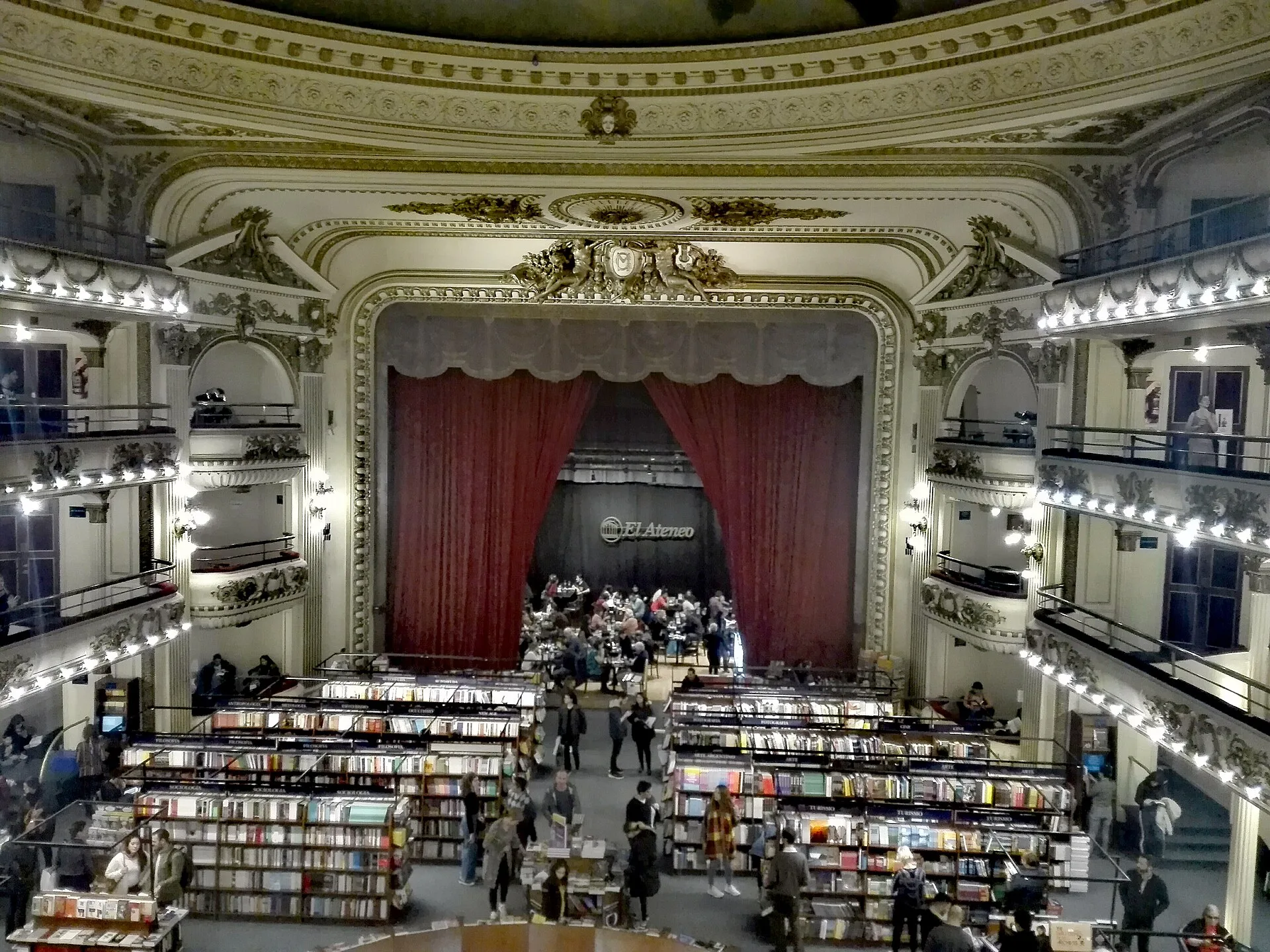
El Ateneo Grand Splendid, on Avenida Santa Fe, occupies what was the Gran Splendid theater, opened in 1919. Since 2000 the balconies have been lined with shelves, the dome still has its frescoes, and the old stage is a café. You can spend a whole morning reading in a box and nobody will ask you anything.
The building was later turned into a cinema before becoming a bookshop, and its reputation has only grown since: The Guardian placed it second on a list of the world's most beautiful bookshops in 2008, and National Geographic called it the most beautiful of all in 2019. Go early on a weekday, when the tour groups have not yet arrived, and look up before you look at the tables.
There is more history in the walls than the shelves suggest. In the 1920s the building housed a radio station and a record label, and Carlos Gardel, the great voice of tango, recorded here. The fresco in the dome, an allegory of peace painted after the First World War, is the work of the Italian Nazareno Orlandi. The stock is that of a large general bookshop, almost all of it in Spanish, with a small shelf of books in English; the basement holds the children's section and the music.
A practical note: the shop is at Avenida Santa Fe 1860 and opens every day, until late in the evening. Entry is free, of course, and photographs are allowed. If you buy only one thing, make it an Argentine edition of an Argentine author; the staff will help you choose.
Buying a book rarely feels so much like going to the theater.
Which other bookshops are worth the walk?
The Ateneo is the cathedral. The parish churches are more interesting.
Librería de Ávila, opposite the church of San Ignacio in the old center, stands on a corner where books have been sold since 1785, which makes it the oldest bookshop site in the city. It specializes in Argentine history and old editions, and the basement is a labyrinth.
Eterna Cadencia, in Palermo, is the model of the new Buenos Aires bookshop: a converted house with wooden shelves to the ceiling, a patio café at the back and its own publishing imprint. Libros del Pasaje, a few blocks away, has ladders, armchairs and a bar. Both hold readings most weeks, free and open to anyone who walks in.
For used books, there are three open-air classics. The stalls at Plaza Italia, in Palermo, sell secondhand paperbacks and magazines every day. Parque Rivadavia, in Caballito, has a permanent market of books, comics and records. And at Parque Centenario the stalls circle the park on weekends. Prices are marked in pencil on the first page, and a little bargaining is normal for several books at once.
Once a year, usually in spring or autumn, the city holds the Noche de las Librerías: Corrientes is closed to traffic, armchairs are put out in the street and the bookshops stay open into the small hours.
Corrientes at night
Avenida Corrientes gathers theaters, pizzerias, and secondhand bookshops that stay open late. The routine is simple: a show, a slice of pizza eaten standing up, and a while digging through used books before heading home.
The stretch between the Obelisk and Callao is the busiest. Many of the old bookshops there have narrow storefronts and go back much further than they seem, with piles of out-of-print editions, magazines and paperbacks at a few thousand pesos. Bring cash, ask for what you are looking for, and let the bookseller suggest something else: that is half the fun.
In the evening, part of the avenue becomes pedestrian, and the crowd coming out of the theaters walks down the middle of the road. The pizza deserves a paragraph. Buenos Aires pizza is thick, baked in a pan and heavy with cheese, and the classic order on Corrientes is a slice of muzzarella with a slice of fainá, a chickpea flatbread, laid on top, and a glass of sweet moscato wine. Güerrin, open since 1932, is the most famous counter; the line moves fast if you eat standing. The other house specialty is fugazzeta, a pizza stuffed with cheese and covered in onion.
In Borges's footsteps
Jorge Luis Borges spent his childhood in Palermo, a neighborhood he returned to again and again in his poems, and the street where his family lived now bears his name. Nearby is Plaza Cortázar, the heart of Palermo Viejo, surrounded by bars and independent bookshops. In the other direction, toward the old center, Borges ran the National Library from 1955 to 1973, when it was housed on calle México, in Monserrat, by then nearly blind and surrounded by books he could no longer read.
He wrote about that irony himself, in the "Poem of the Gifts": God, he said, had given him at the same time the books and the night. The old library building on calle México still stands, though it is not regularly open. The Palermo of his childhood was then a rough edge of the city, a district of knife-fighters and corner stores, and in a famous poem he placed the mythical founding of Buenos Aires on his own block, bounded by the streets Guatemala, Serrano, Paraguay and Gurruchaga. Today it is the most fashionable part of town, and he would not recognize a single shopfront.
Three more addresses complete the pilgrimage. Borges was born in 1899 in a house on calle Tucumán, in the center, now gone and marked by a plaque. For the last decades of his life he lived in an apartment on calle Maipú, near Plaza San Martín, with his mother and later alone; there is a plaque at the door. And the Borges International Foundation, run until her death by his widow, María Kodama, keeps manuscripts and first editions in a house in Recoleta, next to one where he lived as a young man.
One thing to know before you look for his grave in the Recoleta cemetery: it is not there. Borges died in Geneva in 1986 and is buried in that city.
What is the National Library like?
A concrete giant on legs. The current National Library, in Recoleta, was designed in the 1960s by a team led by Clorindo Testa and finally opened in 1992: the reading rooms float high above a public plaza, and the books are stored underground. People love it or hate it, and it is worth seeing either way. It stands on the site of the presidential residence where Eva Perón died in 1952, which was later demolished.
Free guided visits, in Spanish, leave from the entrance hall from Monday to Friday at 12:00 and on Saturdays at 14:00 and 16:00, with no booking; they last about an hour and a half and go up to the reading rooms, which have one of the best views in the neighborhood. Next door, the small Museum of the Book and the Language tells the story of Argentine Spanish and its literature with playful exhibits.
Where is Cortázar's Buenos Aires, and Sabato's?
Julio Cortázar left for Paris in 1951 and wrote his most famous novel, Hopscotch, there, but half of it happens in Buenos Aires, and the city has not forgotten him. On Avenida de Mayo, the café London City is where he set the opening of his first published novel, The Winners; a statue of him sits at one of the tables. On calle Florida, the Galería Güemes, an Art Nouveau shopping arcade from 1915, is the passage through which the narrator of his story "The Other Heaven" slips from Buenos Aires into 19th-century Paris. Go in and look up at the domes.
Ernesto Sabato opened his novel On Heroes and Tombs on a bench in Parque Lezama, at the southern end of San Telmo, in front of a statue. The park is still there, on a bluff above what used to be the riverbank, with its old trees and its chess players.
A few blocks north, on the corner of Chile and Defensa, a small statue of a girl on a bench always has a line of people waiting to sit beside her. She is Mafalda, the six-year-old who hated soup and worried about world peace, drawn by the cartoonist Quino, who lived in the building on that corner. For many Argentines she is as much a part of the national literature as any novelist.
Which building is a poem?
The Palacio Barolo, on Avenida de Mayo. Finished in 1923, and for some years the tallest building in South America, it was designed by the Italian architect Mario Palanti as a monument to Dante's Divine Comedy. It is 100 meters high, one for each canto. The ground floor, with its vaults and Latin inscriptions, is hell; the middle floors are purgatory; the upper floors are heaven, and at the top a lighthouse stands for God. Guided visits, for a fee, climb to the lighthouse for a 360-degree view over the center; the evening tours, when the avenue lights come on, sell out first.
Cafés for reading
Buenos Aires protects its bares notables, historic cafés declared part of the city's heritage. The most famous is the Tortoni, opened in 1858, whose tables hosted Borges and Alfonsina Storni. But there are dozens more, less crowded, with marble tables and waiters in waistcoats, where nobody frowns at someone spending two hours with a book and a cortado. It may be the city's best custom.
One worth the detour is La Biela, on the corner of Junín and Avenida Quintana, opposite the Recoleta cemetery. Borges, Adolfo Bioy Casares and Silvina Ocampo were regulars, and today two life-size statues of Borges and Bioy keep a table for themselves. Order a coffee nearby and you will be sitting, more or less, in a scene from their conversations.
Others for the list. Café La Poesía, in San Telmo, was founded by a poet in the 1980s as a meeting place for writers, and brass plaques on the tables name those who sat there. El Federal, a few blocks away, has had the same carved wooden bar since the 19th century. Las Violetas, in Almagro, is the grandest: stained glass, columns and an afternoon tea that feeds three. El Gato Negro, on Corrientes, smells of the spices it has sold since the 1920s.
How to order. A cortado is an espresso cut with a little milk; a lágrima is the opposite, hot milk with a drop of coffee; a café con leche comes with medialunas, the small, sweet local croissants. A submarino is a glass of hot milk with a bar of chocolate to sink in it. The coffee comes with a small glass of sparkling water, and the table is yours for as long as you like: nobody will bring the bill until you ask for it. The Tortoni usually has a line at the door; go when it opens, or choose another.
Recoleta: who is buried in the famous cemetery?
Presidents, generals, Nobel laureates and Eva Perón, in a walled city of marble mausoleums with streets, squares and cats. The Recoleta cemetery, opened in 1822, is the city's most visited monument. Evita lies in the vault of the Duarte family, down a narrow side alley, and it is the only tomb with fresh flowers every day.
Readers should look for three others. Adolfo Bioy Casares, author of The Invention of Morel, is here, and so are the sisters Silvina and Victoria Ocampo, one a great writer of unsettling short stories, the other the founder of the magazine Sur, which published Borges and half of Europe. Domingo Faustino Sarmiento, the president who wrote Facundo and filled the country with schools and libraries, has an obelisk crowned by a condor.
The cemetery opens every day from 9:00 to 17:00. Foreign visitors pay an entry fee, which is adjusted for inflation several times a year, by card at the gate or online; residents of Argentina enter free. The city's own free guided visits are in Spanish. If you want the stories in English, and there are many, from the girl said to have been buried alive to the feuding families who face each other for eternity, you can check dates for a guided walk here.
San Telmo: when should you go?
On Sunday, if you like crowds, and on any other day if you like San Telmo. On Sundays the antiques fair fills Plaza Dorrego, and calle Defensa becomes a kilometer-long street market with musicians and tango dancers; it is a spectacle, and you move at the pace of the crowd. On weekdays the oldest neighborhood in the city goes back to its cobblestones, its antique shops and its iron-roofed market, which dates from 1897 and is now half produce stalls and half places to eat.
This is the Buenos Aires of long patios and decayed mansions, abandoned by the rich after a yellow fever epidemic in 1871 and divided into tenements for immigrants. A guided walk, such as this walking tour of San Telmo and its market, makes sense of the layers. Parque Lezama, Mafalda's bench, Café La Poesía and El Federal, all mentioned above, are within ten minutes of each other.
A detour to La Boca
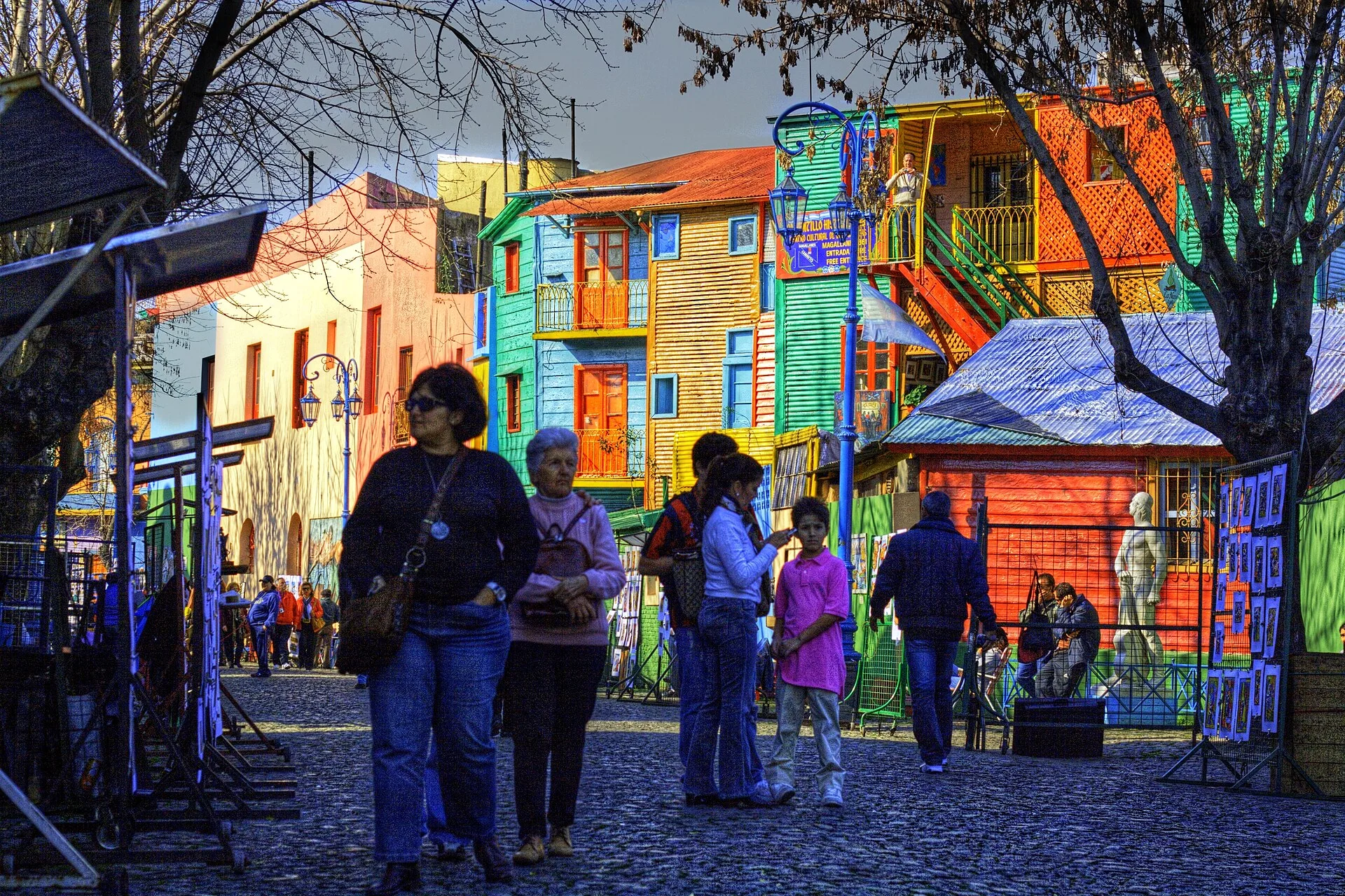
To the south, in the port neighborhood of La Boca, the street called Caminito shows the brightly painted corrugated-iron houses that made the area famous. The painter Benito Quinquela Martín led its revival, and a 1926 tango composed by Juan de Dios Filiberto bears its name.
The colors have a practical origin: dock workers and immigrant families built with sheet metal and painted with whatever was left over from the ships in the port. Caminito is crowded and touristy, but it takes only an hour, and it explains a great deal about the city that tango came from.
Two museums justify staying longer. The Quinquela Martín museum, in the building the painter gave to the neighborhood, shows his huge canvases of the port at work and has a terrace over the river. Fundación Proa, next door, is one of the best contemporary art spaces in the country, with a café on the roof. A word of caution that every porteño will repeat: go by day, arrive by taxi or bus, and stay within the few blocks around Caminito. If you would rather see the south, the center and Recoleta in one morning with transport, there are overview circuits such as this guided city highlights tour.
For the trip home, a plan: fill your suitcase with Argentine authors. Borges and Cortázar are the obvious start; any bookseller on Corrientes will know what to recommend next.
Is the Teatro Colón worth a visit if you are not going to the opera?
Yes. The Teatro Colón, opened in 1908, is one of the great opera houses of the world, famous among musicians for its acoustics, and the guided visit shows the horseshoe auditorium, the gilded foyer and the Golden Hall. Visits run every day, about every fifteen minutes from 10:00 to 16:45, last some fifty minutes and are given in English several times a day; foreign visitors pay a higher price than residents. Better still, look at the program: the upper galleries have inexpensive seats for concerts and ballets, and the cheapest standing places are sold on the day.
Where does tango fit in?
In the lyrics, first of all. Tango is a literature as much as a music: the great lyricists, Homero Manzi and Enrique Santos Discépolo among them, are read as poets, and Borges wrote a whole book of lyrics for milongas, the faster, older cousin of the tango.
To see it danced there are two options. The dinner shows are polished, expensive and made for visitors. The *milongas*, the dance halls where porteños of all ages go to dance several nights a week, are the real thing, and most welcome spectators for a small entry fee; they start late and peak after midnight. If you want to try a few steps before you go, an evening such as this milonga visit with a tango lesson combines both.
A day out: Victoria Ocampo's house and the delta
Take the train from Retiro station along the river to the north. In San Isidro, about half an hour away, stands Villa Ocampo, the 1890s mansion where Victoria Ocampo received Tagore, Camus, Graham Greene and Borges, and which she left to UNESCO. The house, its library of some 12,000 volumes and its gardens can be visited, generally from Wednesday to Sunday in the afternoon, and there is a tea room on the terrace.
The same line ends at Tigre, where the Paraná river breaks into a delta of hundreds of islands. People live there in houses on stilts, and the shop, the school bus and the ambulance are all boats. Public launches leave from the river station for trips of an hour or more; one of the island houses, preserved in a glass box, belonged to Sarmiento. If you prefer the trip organized from the city, with the boat included, there are excursions such as this Tigre delta tour with a visit to the Puerto de Frutos market.
What should you read before you go, and what should you bring back?
Before the trip, three short books are worth more than any guide. Borges's Fictions, to understand why the whole city seems to be a library. Cortázar's stories, starting with Bestiary. And The Invention of Morel, by Bioy Casares, which Borges called perfect and which takes two evenings.
For the plane home, look for the generation that is being read all over the world now, almost all of them women. Mariana Enriquez writes horror set in the Buenos Aires of today: start with Things We Lost in the Fire. Samanta Schweblin's Fever Dream is a short novel that you will read in one sitting and not forget. Claudia Piñeiro's Elena Knows is a crime novel that is not one. Selva Almada writes about the provinces in spare, hard prose. All of them are translated into English, but the Argentine editions are the souvenir.
Three classics for a second visit: On Heroes and Tombs, by Sabato, the great novel of the city; The Seven Madmen, by Roberto Arlt, the Buenos Aires of the 1920s seen from below; and Kiss of the Spider Woman, by Manuel Puig.
When to go
If you can choose, come in late April or early May for the Feria Internacional del Libro, held at La Rural, in Palermo. It is one of the biggest book fairs in the Spanish-speaking world: its 50th edition, in 2026, drew more than 1.3 million visitors. The rest of the year the city does not need an excuse. A paperback in your pocket and a free afternoon are enough.
The 51st fair runs from April 22 to May 10, 2027. Go on a weekday afternoon; weekends are packed, and the evening author talks fill early.
As for the weather, remember that the seasons are reversed. Spring, from September to November, is the most pleasant, and in November the jacaranda trees turn whole avenues violet. Autumn, from March to May, is mild and golden. Summer, from December to February, is hot and humid, and in January half the city leaves for the beach, so some theaters and small restaurants close. Winter, from June to August, is gray and cool rather than cold: ideal weather, in fact, for cafés.
How do you get around?
The center, San Telmo and Recoleta can be walked, and Palermo is a short ride away. The underground, called the Subte, has six lines, and since 2024 you can pay at the turnstiles by tapping a contactless bank card or a phone, with no local card. For buses, known as colectivos, and for suburban trains like the one to Tigre, you need a SUBE card, sold at Subte stations and at many kiosks; one card can be shared by several people.
Taxis are black and yellow and run on the meter, and ride apps work well and are inexpensive by international standards. International flights land at Ezeiza, about 45 minutes to an hour from the center depending on traffic; take an official taxi or transfer booked at the counters inside the terminal, not an offer from the hall. Domestic and regional flights use Aeroparque, on the riverfront ten minutes from Palermo.
What about money?
The advice changed in 2025, and many guides have not caught up. For years, visitors brought dollars in cash and changed them in the street at an unofficial rate far better than the bank's. Since Argentina lifted most of its currency controls in April 2025, that gap has all but closed. Today the simple choice is to pay by foreign card, which is accepted almost everywhere; if the terminal asks, choose to be charged in pesos. Carry some cash for the used-book stalls, the kiosks and tips, and change it at an exchange office, not with the men calling "cambio" on calle Florida.
Prices move quickly here. Inflation is lower than it was but still high by any other country's standards, so this guide gives no prices in pesos: what is written in a guidebook in the morning is out of date by the afternoon.
Where should you stay?
Recoleta is elegant, central and quiet at night, within walking distance of the Ateneo, the cemetery and the library. Palermo has the restaurants, the bars and the independent bookshops, and is the best choice for a week. San Telmo is the most atmospheric and the least polished, good for those who want old cafés at the door. The Microcentro, the business district around calle Florida, is convenient on paper and empty on weekends.
What should you eat?
Beef, first. A parrilla is a grill restaurant, and the order is simple: a cut such as bife de chorizo, a sirloin steak, cooked a little more than you would ask at home unless you say otherwise, with a salad, fries and a bottle of Malbec. Start with provoleta, a slab of grilled cheese, and a chorizo.
Then the rest. Empanadas, baked or fried, a dozen fillings. *Milanesa*, a breaded cutlet the size of the plate. Pasta on Sundays, a habit inherited from Italian grandmothers. *Helado*, ice cream as good as any in Italy; ask for dulce de leche. And alfajores, two biscuits joined with dulce de leche, to take home. Porteños dine late: restaurants fill after 21:00, and a table at 20:00 is easy to get. A tip of about ten percent, in cash, is customary. For an introduction with a local at the table, there are evenings such as this food tour of Palermo.
And mate, the bitter herbal infusion that Argentines drink all day from a gourd with a metal straw? You will see it everywhere and find it on almost no menu: it is something shared among friends, not sold. If someone offers you one, accept, drink it all, and hand it back without saying thank you, which means you have had enough.
What mistakes should you avoid?
Walking with your phone in your hand at the curb. Snatch thefts from passing motorbikes are the city's most common crime against visitors. Step into a doorway to check the map.
Having dinner at seven. You will eat alone, in a restaurant that is still setting the tables.
Looking for Borges in the cemetery. He is in Geneva. Bioy and the Ocampo sisters are in Recoleta.
Seeing only the Ateneo. It is magnificent, and it is a chain store. Buy at least one book in a small shop.
Changing money in the street. There is no longer a reason to, and counterfeit notes circulate.
Wandering beyond Caminito. In La Boca, stay in the visitor area and leave before dark.
Expecting everyone to speak English. In bookshops and cafés, a few words of Spanish and patience go a long way; porteños are talkers, and will meet you halfway.
Quick answers
How many days do you need in Buenos Aires? Three for this literary route; five with Tigre and time to read.
Is El Ateneo Grand Splendid free? Yes. It is a working bookshop, open every day, with a café on the old stage.
Where is Borges buried? In Geneva, Switzerland, not in the Recoleta cemetery.
Is the Recoleta cemetery free? For residents of Argentina. Foreign visitors pay an entry fee; it opens daily from 9:00 to 17:00.
When is the Buenos Aires book fair? From late April to mid-May; in 2027, from April 22 to May 10, at La Rural.
Can you pay by card? Yes, almost everywhere, and on the Subte directly at the turnstile. Carry some cash for stalls and tips.
Is Buenos Aires safe? The areas on this route are, with big-city precautions: watch your phone, take taxis at night and stay in the visitor area of La Boca.
What is the best season? Spring, from September to November, and autumn, from March to May.
Opening hours and other practical details in this guide were checked in November 2026. They change often in Buenos Aires, so confirm them on each place's official site before you go.