Hilma af Klint, the pioneer of abstraction who asked us to wait twenty years
She painted abstract pictures before Kandinsky and put them away. The world took a century to discover her.
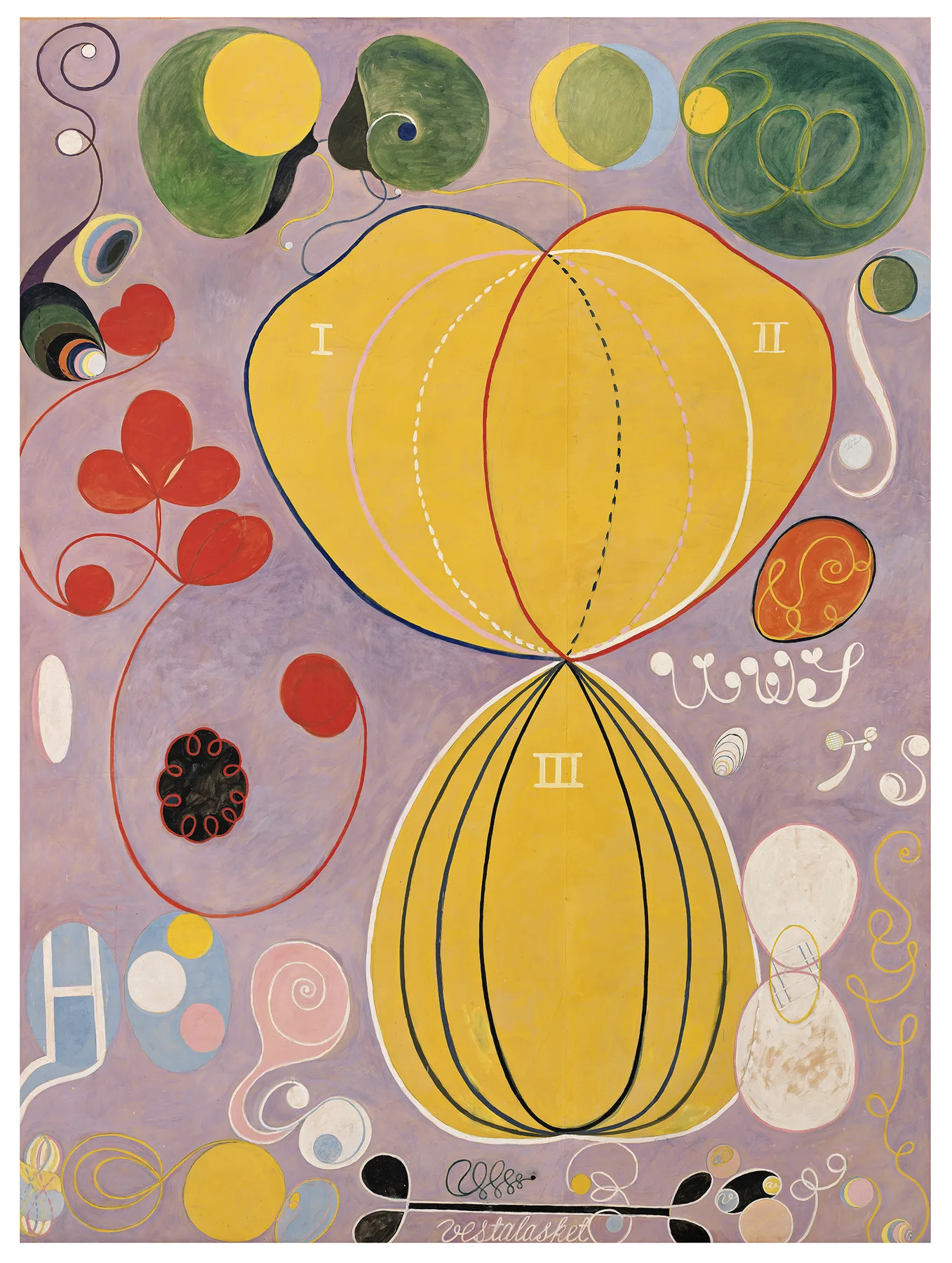
In 1906, in Stockholm, a 44-year-old painter began filling canvases with spirals, circles and shapes that depicted nothing visible. It would be several years before Kandinsky, Mondrian or Malevich did the same. Her name was Hilma af Klint.
Who she was
Born in 1862, she trained at the Royal Swedish Academy of Fine Arts and made a living from conventional landscapes and portraits. In parallel, she belonged to a group of five women who practiced spiritualism. Af Klint maintained that her abstract works were dictated to her by spirit guides.
The Ten Largest
In 1907 she painted The Ten Largest in a few weeks: ten canvases more than three meters tall that run through the ages of life, from childhood to old age, with flat colors and shapes that recall flowers, cells and snails.
She left more than 1,200 works and one instruction: not to show them until twenty years after her death.
The silence
She died in 1944. Her nephew inherited the paintings, which nobody wanted for decades. The first major exhibition came in 1986.
The discovery
In 2018, her retrospective at the Guggenheim in New York broke the museum's attendance record. Since then, art history textbooks have had to rewrite the chapter on the origin of abstraction.
How to look at her
You do not need to decode an af Klint painting to enjoy it. Notice the size first — some are more than three meters tall — and the colors: pinks, oranges, pale blues. Then the shapes that repeat: spirals, shells, flowers, letters. She gave them precise meanings, but they work just as well without knowing them, the way music works when you do not understand the words.