Lisbon, a city you read in its tiles
A walk along the ceramic facades of Portugal's capital, with tram 28 as the thread: where to see the best azulejos while the Tile Museum is closed, a three-day plan, Belém, Sintra and the practical details for 2026.
Culturera may earn a commission if you buy through the links on this page. As an Amazon Associate I earn from qualifying purchases. The selection is ours alone.
The short version: Lisbon needs three days, and the best thing in it costs nothing, because it is on the walls. One warning before anything else: the National Tile Museum, the usual first stop for anyone interested in azulejos, is closed for renovation as this guide is checked, in November 2026, with no visit possible at its convent. That changes the plan, not the pleasure: the city itself is the larger museum, and a monastery, a palace, half a dozen churches, a brewery and the metro will show you five centuries of tiles in their original places.
In Lisbon, walls have things to say. For centuries the Portuguese have covered churches, stations, kitchens, and entire facades with azulejos: glazed ceramic tiles that protect against heat and damp and, along the way, turn the street into a gallery.
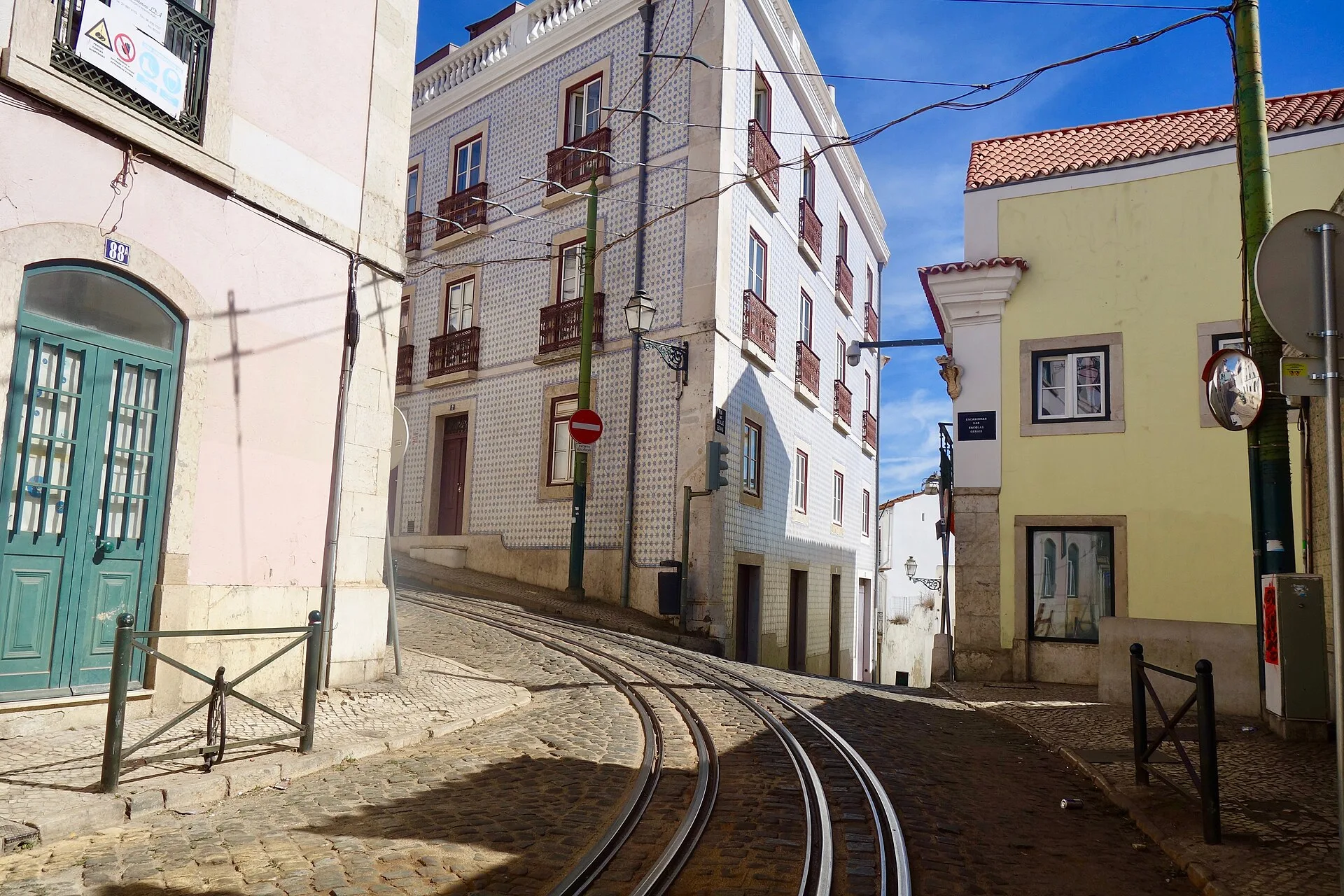
This guide follows the tiles through the city, neighborhood by neighborhood, and adds what a first visit needs: Belém, the viewpoints, a day in Sintra, what to eat, and what transport and monuments cost in 2026. Where a guide, a workshop or a ticket bought ahead is useful, we link options on GetYourGuide. We have not taken these tours: they are chosen for what they cover.
A history in ceramic: how did it start?
The blue and white panels that tell of battles, saints' lives, or hunting scenes filled palaces and convents in the 17th and 18th centuries. In the 19th, industrial production brought patterned tiles to the fronts of ordinary houses, and the city we recognize today was born.
The word comes from the Arabic al-zulayj, a small polished stone, and the first tiles in Portugal came from Seville, around 1500: geometric pieces in the Moorish manner, with raised ridges to keep the colored glazes apart. King Manuel I had seen them in Andalusia and ordered them for his palace at Sintra, where they still are.
Then the technique changed. Italian and Flemish potters brought majolica, in which the tile is covered with a white tin glaze and painted on with a brush, like a canvas. From that moment a tile could show anything. Through the 17th century Portuguese workshops produced "carpets" of repeating patterns in blue, yellow and green that covered the insides of churches from floor to ceiling, an inexpensive substitute for tapestry and marble in a country at war and short of money.
Around 1700 the palette narrowed to blue and white, under the spell of Chinese porcelain and of Dutch tiles, and the great period began. Masters who signed their work, something new, painted whole narrative cycles: the life of a saint around a cloister, a hunt up a staircase, a naval battle along a garden wall. They also invented the figura de convite, a life-size footman or halberdier in tile who stands at the foot of a stair and gestures you up.
On November 1, 1755, an earthquake, a tsunami and a fire destroyed most of the city. The rebuilding under the Marquis of Pombal was fast, standardized and frugal, and tile factories supplied simple repeating patterns by the thousand for the stairwells and kitchens of the new buildings. On the facades, small devotional panels appeared, of Saint Marçal against fire, of Saint Anthony, of the Virgin: an insurance policy in ceramic.
The last step came after 1830. Portuguese emigrants returning from Brazil, where tiles had long been used outdoors against the tropical damp, brought the custom home. Factories began printing patterns with stencils and transfers, cheaply, and within fifty years whole streets of Lisbon and Porto were clad in them. What visitors photograph today is mostly this: the 19th-century city, shimmering.
The 20th century added Art Nouveau fronts for bakeries and dairies, the public commissions of modern artists, above all in the metro, and, more recently, street artists working in tile.
How do you read a tile?
A few clues let you date a wall at a glance, and turn a walk into a game.
Ridges or grooves between the colors mean the oldest technique, from before about 1550: the glazes were kept apart by raised edges or by greasy lines, and the designs are geometric, in the Islamic tradition. You will see them at Sintra, and almost nowhere else outdoors.
Blue, yellow, green and manganese purple together, in dense repeating patterns like brocade, are 17th century. Count the tiles in one repeat: two by two, four by four, sometimes twelve by twelve. The larger the module, the grander the room it was made for.
Blue alone on white, with figures and landscapes, framed by theatrical borders of cherubs, shells and scrolls, belongs to the first half of the 18th century. Look for a signature in a corner, and for scenes copied from engravings, where European gentlemen hunt in landscapes no painter in Lisbon had ever seen.
Single motifs, one to a tile, a flower, a ship, a bird, a rabbit, painted in a few quick strokes, are figuras avulsas, the inexpensive tiles of kitchens and stairs, endearing in their clumsiness.
Garlands in soft colors, yellow, green, violet, and small medallions mark the neoclassical taste of the years after the earthquake.
A perfectly even pattern, slightly flat, on a street front is 19th century, stenciled or printed. Look closely and you will see that even these were finished by hand: no two tiles are quite the same blue.
Relief, flowers with sinuous stems, signs for a shop are Art Nouveau, around 1900.
Then look at the edges. Where a pattern meets a window or a corner, the tiler had to cut, improvise and cheat, and that is where the wall becomes human.
The Tile Museum is closed: what now?
The place to make sense of it all is the National Tile Museum, set in the former convent of Madre de Deus. It runs from the earliest pieces of Moorish influence to contemporary designs, and includes a great panorama of the city before the 1755 earthquake.
That remains true, and it is the reason to come back. But in late 2026 the museum is shut for a major renovation financed by European recovery funds, and its website gives no reopening date. While the work lasts, part of the collection travels: the museum runs a program called Open Azulejo at the Palácio da Calheta, in Belém, with tile-painting sessions for the public, and its shop has reopened in the Palácio Foz, on Praça dos Restauradores. Check the museum's site before your trip, in case the convent has reopened.
What you lose for now is the 23-meter panorama of Lisbon before the earthquake and the convent's own church, a jewel box of gilded wood and Dutch tiles. What follows is how to see as much, or more, in the open.
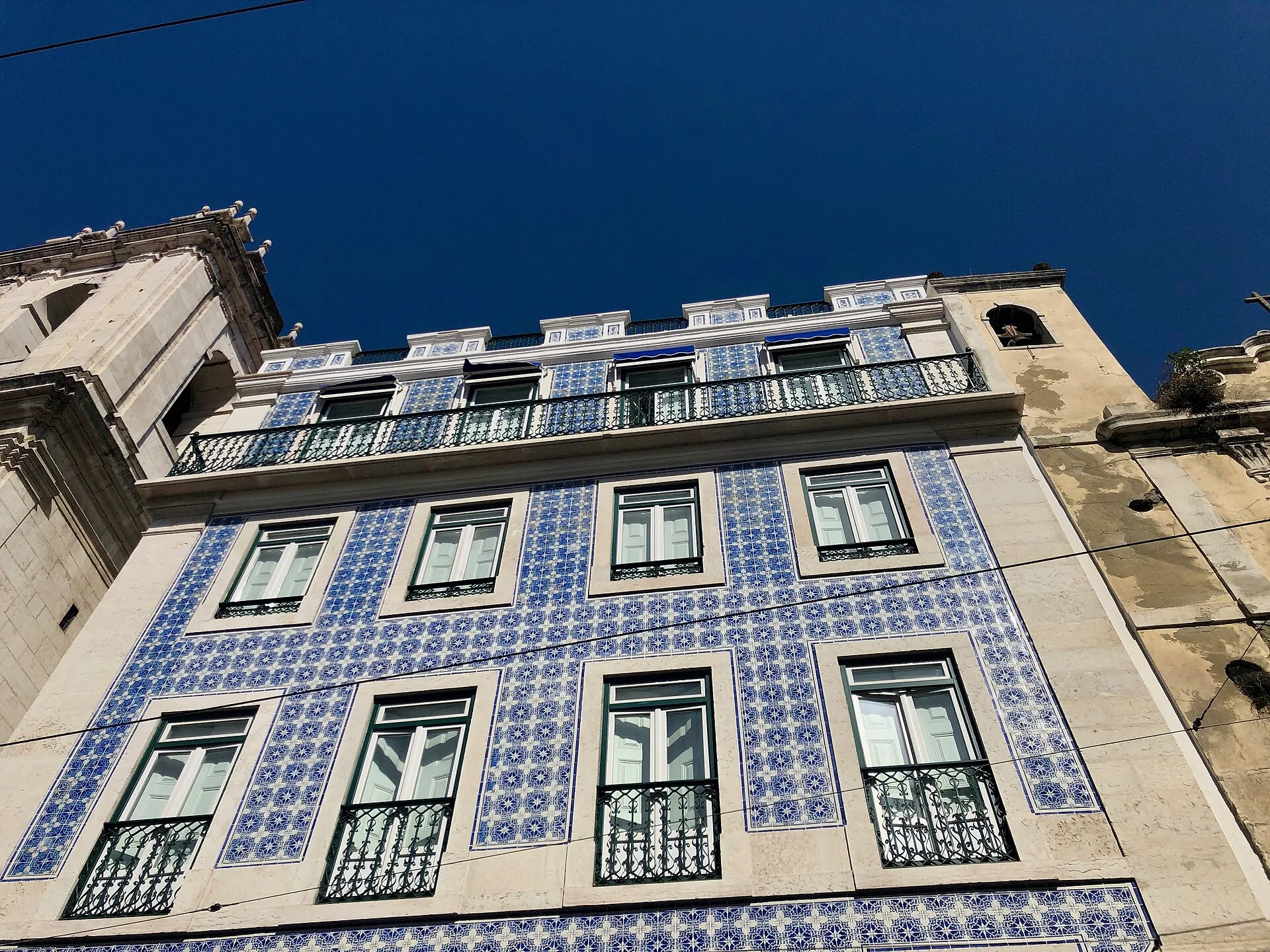
Looking up is the best way to visit Lisbon. And the cheapest.
Where are the best tiles in the city?
São Vicente de Fora. If you see one interior, see this one. The monastery on the hill above Alfama holds one of the largest collections of Baroque tiles in the world, still on the walls they were made for: the entrance hall, the two cloisters, the staircases, and a room of thirty-eight panels illustrating the fables of La Fontaine, foxes and storks in blue and white. The roof terrace has one of the best views in Lisbon.
Palácio dos Marqueses de Fronteira. A 17th-century country house on the northern edge of the city, still lived in by the family, with the most extraordinary tiled garden in Portugal: a water tank flanked by knights on horseback, a gallery of kings, terraces where monkeys play instruments and cats are barbers. Inside, the Battles Room tells the war of independence against Spain in tile. In 2026 the palace and gardens together cost 17 euros, with a guided visit of the interior; the gardens alone are 8 euros. It takes a taxi or a metro ride and a walk, and it is worth the detour.
Miradouro de Santa Luzia. The viewpoint over Alfama has two large panels on the church wall: the Praça do Comércio as it looked before the earthquake, and the Christian assault on the castle in 1147.
Igreja de São Roque. A plain Jesuit front in the Bairro Alto hiding 16th-century tiles signed and dated by Francisco de Matos, among the earliest of their kind, and a chapel of lapis lazuli and gold made in Rome and shipped here piece by piece.
The Viúva Lamego building. On Largo do Intendente, the former shop of the most famous tile factory in Lisbon is its own advertisement: a facade of 1865 covered with Chinese figures, flowers and allegories.
The house of Ferreira das Tabuletas. In Chiado, on Largo Rafael Bordalo Pinheiro: a yellow facade of 1864 with large allegorical figures of Earth, Water, Commerce, Industry, Science and Agriculture.
Campo de Santa Clara. The square of the flea market has several of the best 19th-century fronts in the city, and beside it, in the Botto Machado garden, a wall of more than 50,000 hand-painted tiles by the artist André Saraiva, finished in 2016: a cartoon map of his Lisbon.
Cervejaria Trindade. A beer hall in a former convent in Chiado, with 19th-century panels of the seasons and the elements. Lunch under the tiles costs the price of a steak.
Casa do Alentejo. Behind an anonymous door near Rossio, a Moorish-revival courtyard and upstairs dining rooms lined with blue panels of rural scenes.
Avenida Infante Santo. For the 20th century: large abstract and figurative panels of the 1950s set into the stairways of a modern avenue, among them The Sea by Maria Keil.
The Bordalo Pinheiro Museum. In Campo Grande: the ceramics of Rafael Bordalo Pinheiro, caricaturist and potter, whose relief tiles of frogs, grasshoppers and water lilies are the high point of Portuguese Art Nouveau. Entry is 5 euros.
The metro as a gallery
In the metro, several stations are clad in work by contemporary artists.
It began as a way of saving money. When the first lines opened in 1959 there was no budget for stone, and the painter Maria Keil proposed tile, then considered old-fashioned and poor. She designed nineteen stations herself, in abstract patterns, and single-handedly brought the azulejo back into Portuguese architecture. Later expansions commissioned artists for each station.
Worth getting off for: Parque, a blue cave of maps, texts and symbols on the Discoveries and human rights; Campo Grande, where 18th-century footmen are taken apart and reassembled; Cidade Universitária, by the painter Vieira da Silva; Oriente, at the 1998 Expo site, with panels by artists from five continents on the theme of the oceans; Olaias, a cathedral of color; and Cais do Sodré, where the White Rabbit of Alice hurries along the platform, late. A day ticket turns the network into a museum with trains.
Tram 28 as an excuse
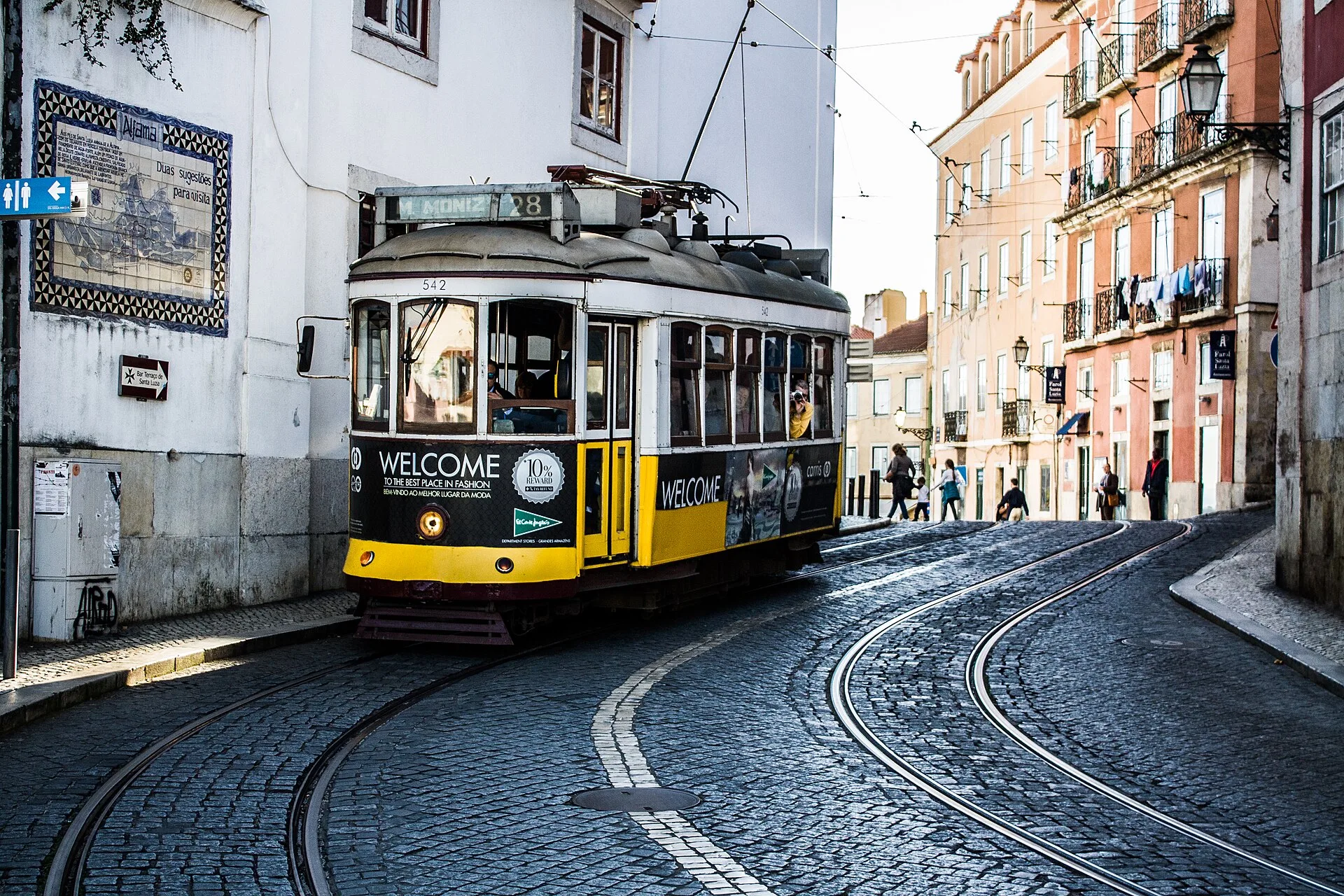
Tram 28 links Martim Moniz with Campo de Ourique and, on the way, climbs and drops through Graça, Alfama, Baixa, and Estrela. Its small yellow cars are the best-known way to cross the old neighborhoods, though in high season they run full.
An alternative: follow its tracks on foot. In Alfama, the oldest quarter, the rails pass within inches of the doorways, and every bend reveals another ceramic facade, another viewpoint and, beyond, the Tagus.
The cars are from the 1930s, rebuilt inside, and they are still in service because nothing longer could take the bends or the gradients. The whole line takes about fifty minutes. A ticket bought on board costs 3.30 euros in 2026; with a rechargeable transport card, the ride costs about half, and a 24-hour pass covers trams, buses, funiculars and the metro.
To ride it rather than queue for it: board before 9:00, or late in the evening, or at the western end, in Campo de Ourique, where the tram starts empty and you can also visit the Prazeres cemetery and one of the city's best food markets. The stop at Martim Moniz has the longest wait in Lisbon. Keep your bag in front of you: the 28 is the pickpockets' favorite office.
If you walk the route instead, start at the Graça viewpoint, go down past São Vicente de Fora and the Feira da Ladra, on Tuesdays and Saturdays, to Portas do Sol and Santa Luzia, and then lose yourself downhill through Alfama to the cathedral. A guide adds the stories and finds the stairways, as on this walking tour of Alfama, the old walls and three viewpoints.
A note on the funiculars. After the accident on the Glória funicular in September 2025, in which sixteen people died, the city's historic funiculars were taken out of service for inspection. Check with the operator, Carris, which of them are running when you visit.
A tile walk for one morning
A route of about three kilometers, downhill most of the way, that needs no ticket except at one stop.
Start at Largo do Intendente, at the Viúva Lamego facade, with a coffee on the square. Walk up through Mouraria, the old Moorish quarter and the birthplace of fado, where portraits of its elderly residents are printed on the walls, to the Graça viewpoint. Continue to São Vicente de Fora and give its cloisters an hour. Behind it, cross the Campo de Santa Clara, with its tiled fronts and André Saraiva's wall, and go down to the Santa Luzia viewpoint for the two historical panels. Follow the tram tracks past the cathedral into the Baixa, where the plain Pombaline patterns line the stairwells; look into any open doorway. End in Chiado, at the yellow house of the Tabuletas, and sit down to lunch under the panels of the Cervejaria Trindade.
Can you make a tile yourself?
Yes, and it is the best souvenir, as well as the only ethical one that is old in style. Several workshops in the center teach the technique in two or three hours: you choose or draw a pattern, transfer it to the raw glaze by pouncing charcoal through a pricked paper, as the 18th-century painters did, paint it with oxides that look gray and turn blue in the kiln, and collect the fired tile a day or two later, or have it sent.
And one piece of advice: do not buy antique tiles at flea markets. Many have been pried off facades, and that plunder is one of the main threats to this heritage.
The scale of the theft is hard to believe until you start noticing the gaps: blank rectangles in a patterned wall, at the height of an arm. A police program dedicated to stolen tiles has existed since 2007, and Lisbon has forbidden the removal of tiled facades during building works since 2013, a rule extended nationwide a few years later. A legitimate antique dealer can tell you where a panel came from and gives a receipt. For everything else, buy new: the old factories still paint by hand. Sant'Anna, founded in 1741, has a shop in Chiado and a factory you can visit; Viúva Lamego still produces for artists and architects; and small studios across the city sell contemporary work.
What else must you see in Lisbon?
Belém. Six kilometers west along the river, where the caravels left. The Jerónimos Monastery, built with the profits of the spice trade, is the masterpiece of the Manueline style, a late Gothic that turns stone into rope, coral and artichokes; its cloister costs 18 euros in 2026 and opens Tuesday to Sunday from 9:30 to 17:30. The Tower of Belém, the small fortress in the river, reopened in May 2026 after its first thorough restoration in decades; entry is 15 euros. Both have long queues: buy tickets online, come at opening time, or take a visit that includes them, like this tour of Belém and the Jerónimos Monastery with ticket. Afterwards, the custard tarts of the Pastéis de Belém bakery, made to the same recipe since 1837, in rooms lined, naturally, with blue and white tiles.
The Baixa and Chiado. The grid of the rebuilt city, from the arcades of Praça do Comércio on the river to Rossio, and uphill the cafés, theaters and bookshops of Chiado. The roofless Carmo church, left as the earthquake left it, is the most eloquent monument in Lisbon.
The castle and the viewpoints. São Jorge castle crowns the eastern hill; the view is the point. The free miradouros are just as good: Senhora do Monte and Graça for sunset, São Pedro de Alcântara for the castle lit at night.
The other bank. The orange ferry from Cais do Sodré crosses the Tagus in ten minutes to Cacilhas, for grilled fish and the best view of the city from the water.
And if you have more time?
Museums. The Gulbenkian, the collection of an oil magnate with perfect taste, from Egyptian cats to Lalique jewels, set in a garden; check its opening status, as its buildings have been undergoing renovation. The National Museum of Ancient Art, for the Portuguese primitives and a garden café over the river. The MAAT, in Belém, a low white wave of a building, itself clad in 15,000 three-dimensional tiles that catch the light off the water.
Neighborhoods. Príncipe Real, for its garden, its antique shops and its 19th-century palaces. Campo de Ourique, at the end of tram 28, for the life of a residential quarter and its market. LX Factory, a former textile works under the bridge, now shops, studios and restaurants. Parque das Nações, the site of the 1998 Expo, for the Oceanarium, one of the best aquariums in Europe, and Oriente station.
The coast. The train from Cais do Sodré follows the river to its mouth and reaches Cascais in forty minutes: beaches, a fishing harbor and an easy seaside walk.
How do you plan three days?
Day 1: the eastern hills. Tram 28 early from Campo de Ourique, or on foot from Graça. São Vicente de Fora, Santa Luzia, Alfama, the cathedral. Lunch in the Baixa. Afternoon in Chiado: São Roque, the Tabuletas house, the Carmo ruins, a beer under the tiles of the Trindade. Sunset at a viewpoint, fado at night.
Day 2: Belém and the modern city. Jerónimos at opening time, the tower, the tarts. Back by tram or train. In the afternoon, a tile workshop, or the metro stations and the Bordalo Pinheiro Museum, or Fronteira Palace if you have booked.
Day 3: Sintra. Or, for those who prefer the city, the Feira da Ladra and Campo de Santa Clara in the morning, the ferry to Cacilhas for lunch, and the riverside in the evening.
Is Sintra worth a day?
Yes. Forty minutes by train from Rossio station, in wooded hills that catch the Atlantic clouds, the Portuguese court built its summer palaces. For the tile-minded, the National Palace, in the town, is essential: it has the oldest azulejos in the country, the Sevillian ones ordered by Manuel I, in rooms of several centuries, under two enormous conical kitchen chimneys; the essential ticket is 13 euros in 2026. On the summit, the Pena Palace, a 19th-century king's fantasy in red and yellow, is the one everyone comes for; palace and park cost 20 euros, by timed ticket. The Quinta da Regaleira, with its initiation well, and the Moorish castle complete a long day.
Sintra is badly congested. Go on a weekday, take the first trains, buy the timed tickets ahead, and do not drive. A tour removes the logistics of buses and queues on the hill, such as this guided day in Sintra with Pena Palace from Lisbon.
What do you eat and drink?
Grilled fish. Sardines in summer, above all in June; sea bream, sea bass and horse mackerel the rest of the year, with boiled potatoes and salad.
Bacalhau. Salt cod, in a different recipe for each day of the year. Start with bacalhau à Brás, shredded with eggs and straw potatoes.
Petiscos. The Portuguese small plates: clams with garlic and coriander, octopus salad, peixinhos da horta, green beans in batter, the ancestor of tempura.
The bifana. A pork sandwich in a soft roll, with mustard, eaten standing at a counter.
Pastel de nata. The custard tart, warm, with cinnamon. Every neighborhood has a champion.
Ginjinha. Sour cherry liqueur, served in a thimble at hole-in-the-wall bars around Rossio.
Wine. Vinho verde, white and slightly sparkling, in the heat; reds from the Douro and the Alentejo; a glass of port or Madeira at the end.
Eat where the menu is short and handwritten. Avoid the terraces with photographs of the dishes, and remember that the bread, olives and cheese put on the table without asking are charged if you touch them.
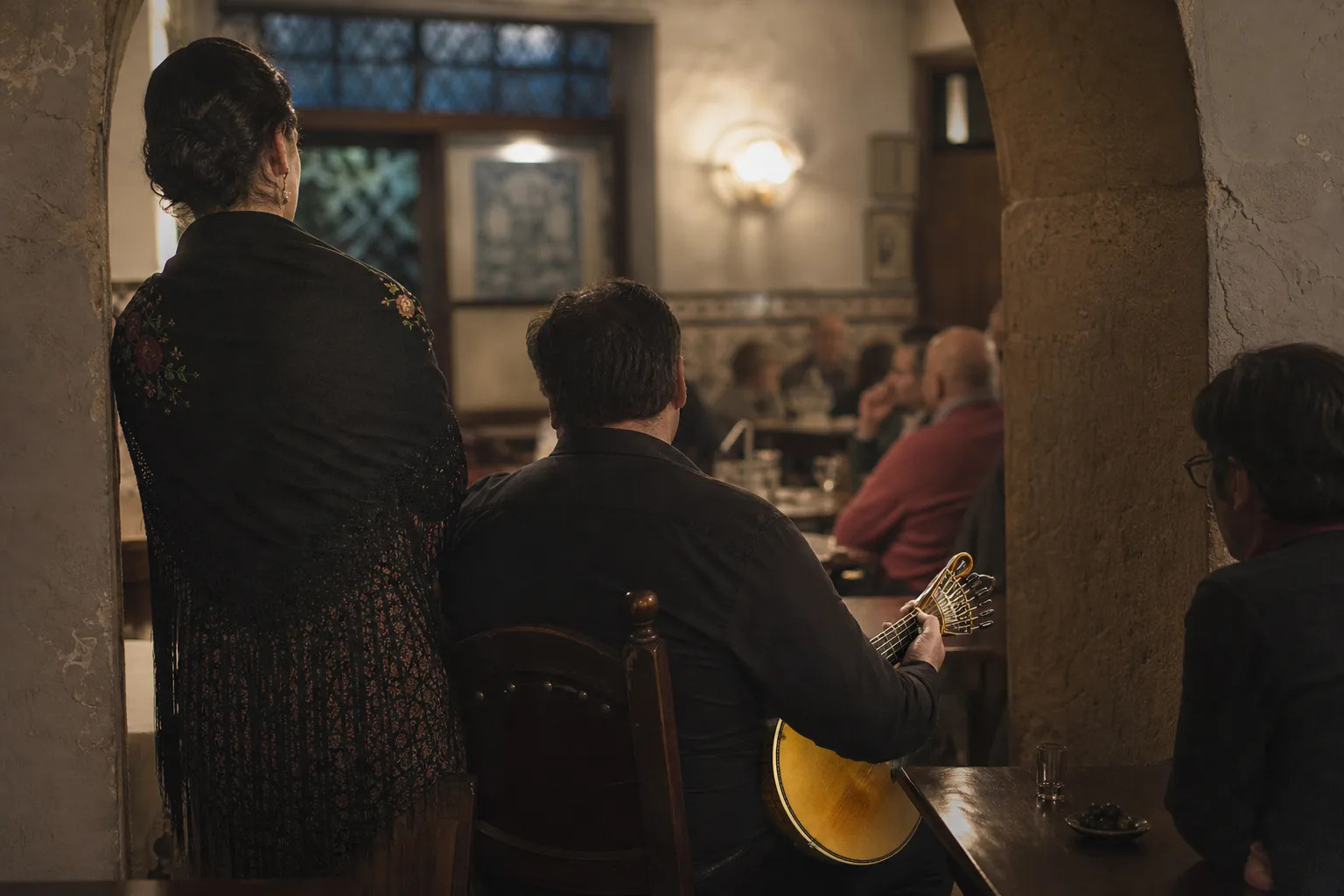
Fado. The city's music, born in the taverns of Alfama and Mouraria in the 19th century: a singer, a Portuguese guitar, a classical guitar, and silence in the room. Dinner-and-fado houses vary from the moving to the mechanical. Shorter sessions without dinner are an easy introduction, like this fado show with a glass of wine, and in the small bars of Alfama amateurs still sing late at night for the love of it.
When should you go?
Lisbon is good all year. Spring, from March to May, and autumn, from mid-September to early November, have mild days, soft light and fewer people. June is the month of the popular saints: on the night of the 12th to the 13th, for Saint Anthony, the old quarters fill with grilled sardines, paper garlands and parades. July and August are hot, dry and very crowded. Winter is mild and often rainy, with low prices and empty museums; the wet cobbles, though, are slippery.
How do you get around, and what does it cost?
From the airport. The metro's red line reaches the center in about half an hour with one change; a taxi or ride-hailing car takes fifteen to twenty minutes.
In the city. On foot, with good soles: the pavements are polished limestone mosaic, beautiful and treacherous on the hills. Use the metro for distance, trams and buses for the climbs, trains from Cais do Sodré for Belém and Cascais and from Rossio for Sintra. Buy a rechargeable card at any metro station and load it with single fares or a 24-hour pass. In 2026 the fares paid on board are 2.30 euros on buses, 3.30 on trams, 4.30 for the funiculars and 6.20 for the Santa Justa lift, about twice the price with the card.
Passes. The Lisboa Card combines transport with entry to many monuments, including Jerónimos and the Tower of Belém; do the sum for your own plans.
Tourist tax. Lisbon charges a municipal tax per person per night on stays in hotels and apartments, of a few euros, for up to seven nights.
Museums and monuments run by the state close on Mondays.
Where should you stay?
Baixa and Chiado. Central and flat, with everything on the doorstep and the least neighborhood life.
Alfama and Graça. The most atmospheric streets, steep, with stairs instead of pavements. Not for heavy suitcases or weak knees.
Príncipe Real and Bairro Alto. Gardens, design shops and restaurants; the lower Bairro Alto is noisy until dawn at weekends.
Avenida da Liberdade and beyond. Larger hotels, good metro links, quieter nights.
Lisbon has a serious housing problem, and short-term rentals are part of it. A hotel or a licensed guesthouse puts less pressure on the neighborhoods you have come to see.
Is Lisbon manageable with children, or with limited mobility?
With children, well: trams, ferries, a castle, an aquarium, custard tarts, and a tile workshop where they take home what they painted. The hills and the heat are the limits, so plan one area a day and a long lunch.
With limited mobility, Lisbon is hard. The old quarters are steep, cobbled and full of steps, the historic trams are not accessible, and only part of the metro has lifts. The flat parts are rewarding, though: the Baixa, the riverfront, Belém, Parque das Nações. Modern buses are low-floor, taxis are inexpensive, and the city tourist office publishes accessible itineraries.
What mistakes should you avoid?
Going to the Tile Museum without checking. It is closed for works in late 2026.
Queuing an hour for tram 28 at Martim Moniz. Board at the other end, or walk.
Buying old tiles at a street stall. They are probably stolen.
Wearing smooth soles. The pavements are polished stone.
Visiting Jerónimos at noon. Go at opening time, with a ticket.
Driving to Sintra. Take the train.
Planning museums for a Monday. They are closed.
Looking only at eye level. The best facades start on the second floor.
Quick answers
How many days do you need in Lisbon? Three: two for the city and Belém, one for Sintra.
Is the National Tile Museum open? No. In November 2026 it is closed for renovation, with part of its program moved to the Palácio da Calheta. Check its website for a reopening date.
Where can you see azulejos instead? São Vicente de Fora, Fronteira Palace, the Santa Luzia viewpoint, São Roque, the facades of Campo de Santa Clara and Chiado, and the metro stations.
How much is tram 28? 3.30 euros if you pay on board in 2026; about half with a transport card.
How much are Jerónimos and the Tower of Belém? 18 and 15 euros in 2026. The tower reopened in May 2026.
Can you buy antique tiles? Only from a dealer who documents their origin. Tiles sold at markets are often stolen from facades.
How do you get to Sintra? By train from Rossio station, in about forty minutes.
When is the best time? Spring and autumn; June for the festivals of the popular saints.
Prices, opening hours and closures in this guide were checked in November 2026 in official sources. Confirm them before you go.