Seville, a city you can hear
From the Royal Alcázar to Triana, a walk through Andalusia's capital to the rhythm of flamenco: where to hear it, how to listen, what to see between songs, when to go and a three-day plan with 2026 prices.
Culturera may earn a commission if you buy through the links on this page. As an Amazon Associate I earn from qualifying purchases. The selection is ours alone.
The short version: Seville needs three days, and one of the evenings belongs to flamenco, in a small room, without a microphone. See the Alcázar at opening time and the cathedral with its tower, cross the bridge to Triana in the late afternoon, eat standing up at a bar, and stay out late, because the city does. Come in spring or autumn. In 2027, Holy Week runs from March 21 to 28, and the April Fair follows two weeks later; both are unforgettable, and both need a room booked months ahead.
You can visit Seville for its monuments, and it has plenty: the cathedral, the Alcázar, and the Archive of the Indies are a World Heritage site. But you can also explore it by ear, because few cities have a music so much their own.
This guide does both. It explains flamenco to those who have never heard it live, says where to find it and how to behave when you do, and walks through the city that produced it. Where a ticket bought ahead, a guide or a class is useful, we link options on GetYourGuide. We have not taken these tours: they are chosen for what they cover.
What does Seville sound like?
Start with the things that are not music. At eight in the morning, the bells of the Giralda, two dozen of them, swinging right over on their axles. Swifts screaming around the tower in the evening from April to August. Horseshoes and iron-rimmed wheels on cobbles. Water in a marble basin in a courtyard glimpsed through an iron gate. The metal shutters of the bars going up at one. The roar of a street of terraces at midnight, which is the sound of a thousand conversations and no background music at all, because people here still talk.
Then there is the music that belongs to the calendar. In Holy Week, brass bands and drums behind the floats, the dry shuffle of the bearers' feet, and silence. In the Fair, sevillanas from every tent at once. At Christmas, villancicos sung in the bars with a bottle scraped as percussion. In summer, when it is too hot to do anything else, guitars after dark in the squares of the Alameda.
And there is flamenco, which is not folklore and not a show for visitors, although both things are sold under its name. It is a living art music, as demanding as jazz, made by a few thousand professionals and understood by a great many ordinary people in this corner of Spain. Seville is one of the three or four places where it was born.
The rest of the world has been listening for a long time. More than a hundred operas are set in Seville, among them The Barber of Seville, The Marriage of Figaro, Don Giovanni, Fidelio and Carmen, whose tobacco factory, an enormous 18th-century building, is now the university. Most of their composers never came. They did not need to: the city was already a legend.
How do you listen to flamenco?
Flamenco has three elements: cante, song; toque, guitar; and baile, dance. The song comes first. The oldest flamenco was sung without any instrument, and for those who know it, the singer is still the center, however dazzling the feet.
It is organized in forms called palos, each with its own rhythm, key and mood. You do not need to name them, but a few are worth recognizing. The soleá is slow, solemn and in twelve beats; its name comes from soledad, solitude. The seguiriya is the darkest, a lament. Alegrías, from Cádiz, are bright, in a major key, and danced with a long-trained dress. Tangos, nothing to do with Argentina, are earthy and in four. Bulerías are fast, playful and the form in which everyone, at the end of the night, takes a turn. Fandangos are sung more than danced.
What holds it together is the compás, the rhythmic cycle, marked by hand-clapping, palmas, which is an instrument in its own right, with hollow claps and sharp ones, on the beat and across it. If you follow nothing else, follow the hands.
The voice is rough by choice. A flamenco singer does not aim for beauty of tone but for truth, and the audience responds to the moment a line lands with a low ole or eso es. That response, the jaleo, is part of the performance; it comes from people who know exactly where in the cycle they are. For a visitor, the right contribution is silence and attention.
Duende is the word for what everyone is waiting for: the minute in which technique falls away and something raw comes through. The poet Federico García Lorca wrote a famous lecture about it. It cannot be scheduled, and it does not happen every night. When it does, the room knows.
And the sevillanas you will see danced at the Fair, in four verses, in couples? They are a folk dance, learned by every child in the city, cheerful and codified. They are related to flamenco as a waltz is to a string quartet.
Where did it come from?
Nobody knows precisely, and experts argue. What is clear is the place, the triangle between Seville, Jerez and Cádiz, and the time, the late 18th century, when the first written descriptions appear. And the people: above all the Gitanos, the Roma of Andalusia, who had arrived in Spain in the 15th century and suffered three hundred years of persecution, and who worked as blacksmiths, horse dealers and laborers in the neighborhoods where the music took shape. In their forges and family gatherings, older layers came together: Andalusian ballads and folk songs, the memory of Moorish and Jewish music, the rhythms of the Africans, enslaved and free, who were a large part of Seville's population in the 16th century, and, later, songs that came back transformed from Cuba and the Río de la Plata.
In the 1860s flamenco moved from the patio to the stage, in the cafés cantantes, music cafés, the first of which were opened in Seville by the singer Silverio Franconetti. It became a profession. Since then it has been declared dead or corrupted in every generation, and has renewed itself in each.
Triana, across the river
Across the Guadalquivir is Triana, a neighborhood of potters, sailors, and artists, and one of the places tied to the history of flamenco. This art, which brings together song, guitar, and dance, was declared intangible heritage of humanity by UNESCO in 2010.
Triana considers itself a separate town, and for most of its history it was one: outside the walls, on the flood-prone bank, home to those the city needed and did not want inside. Sailors, who shipped from here for the Americas. Potters, whose kilns made the tiles of every church and palace in Seville from the clay of the riverbank. And the Gitanos of the Cava, the old ditch that is now Calle Pagés del Corro, whose blacksmith families produced several of the dynasties of flamenco song.
They lived in corrales de vecinos, tenements of single rooms around a shared courtyard with a well, a washhouse and a communal kitchen, where every baptism and wedding was a party with music. In the 1960s and 1970s, most of the corrales were emptied and their residents moved, many against their will, to new housing blocks on the far southern edge of the city. Triana kept the legend and lost much of the people who made it. A few corrales survive, with geraniums and tiled Virgins, and can be seen from the gate or on a guided walk, such as this tour of the flamenco quarter of Triana and its corrales.
What to see on a walk. Cross by the Isabel II bridge, the iron bridge of 1852 that everyone calls the Triana bridge. On the far side, the market, built over the ruins of the castle of San Jorge, the seat of the Spanish Inquisition for three centuries; a small museum in the foundations tells that story. Along the river, Calle Betis, with the best view of the city's skyline, the bullring and the Golden Tower. One street back, Calle Pureza, with the sailors' chapel, home of the Virgin known as the Esperanza de Triana, and the church of Santa Ana, the oldest in the city, called the cathedral of Triana. And Calle Alfarería and Calle San Jorge, where the last ceramics shops display tiles painted by hand; the Centro Cerámica Triana, in a former factory with its bottle kilns, explains the craft, from Tuesday to Sunday.
Come at the end of the afternoon, when the neighborhood is in the street, and stay for the evening.
Where do you hear it?
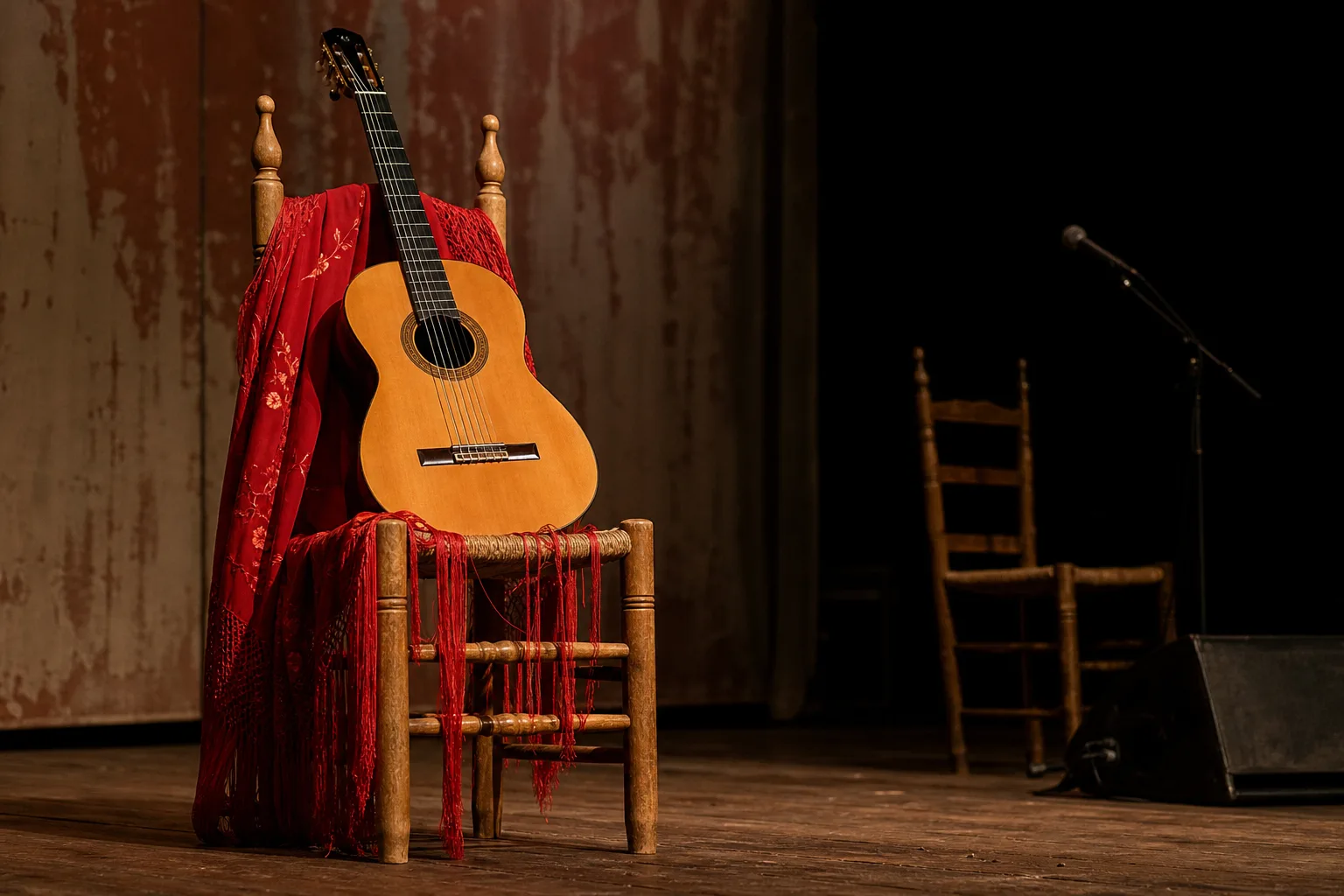
To hear it up close, look for a small club or tablao, where there are no microphones and the audience keeps quiet. The point is not to catch every lyric; it is to follow the rhythm.
In a good tablao, nobody talks during the singing. Silence is part of the music too.
There are several kinds of place, and they offer different things.
Small tablaos and cultural centers. Rooms for fifty to a hundred people, with a one-hour program by a singer, a guitarist and one or two dancers, usually twice an evening. No dinner, no amplification, professional artists, and an audience that has come to listen. This is the best first experience, and Seville has many, in Santa Cruz, in the center and in Triana. Book a day or two ahead, arrive early for a seat near the front, and put the phone away: most forbid filming until the last number.
Large tablaos with dinner. Bigger stages, longer shows with a full company, costumes and choreography, and a meal or a drink included. The level of dancing can be very high. The atmosphere is that of a theater restaurant.
Peñas. Clubs of aficionados, the guardians of the tradition, which hold recitals for their members and guests, often with the best singers and the least ceremony. The Peña Torres Macarena, by the old city walls, is the best known. Programs are irregular, in Spanish, and posted a few days ahead; if there is one during your stay, go.
Bars. A few bars have live flamenco most nights, with free entry and the price of a drink. The quality varies from students to masters passing through, the room is noisy, and now and then something happens.
Theaters and festivals. For the great names, the Teatro Central, the Lope de Vega and the Maestranza theater. Every two years, in even-numbered years, the Bienal de Flamenco fills the city for nearly a month; the 2026 edition ran from September 9 to October 3, and the next will be in 2028.
The museum. The Museo del Baile Flamenco, founded by the dancer Cristina Hoyos in an 18th-century house in Santa Cruz, explains the forms and the history with film and costume, and has its own evening shows.
In the street. Dancers and guitarists perform in the Plaza de España, by the cathedral and in Triana for coins. Some are very good. It is not the same thing, and it is a fine way to spend ten minutes.
And if listening is not enough, an hour's class will teach you the hands, the turn of the wrist and the first steps, and above all how hard it is: for example this flamenco dance class.
Two essential stops, and a third
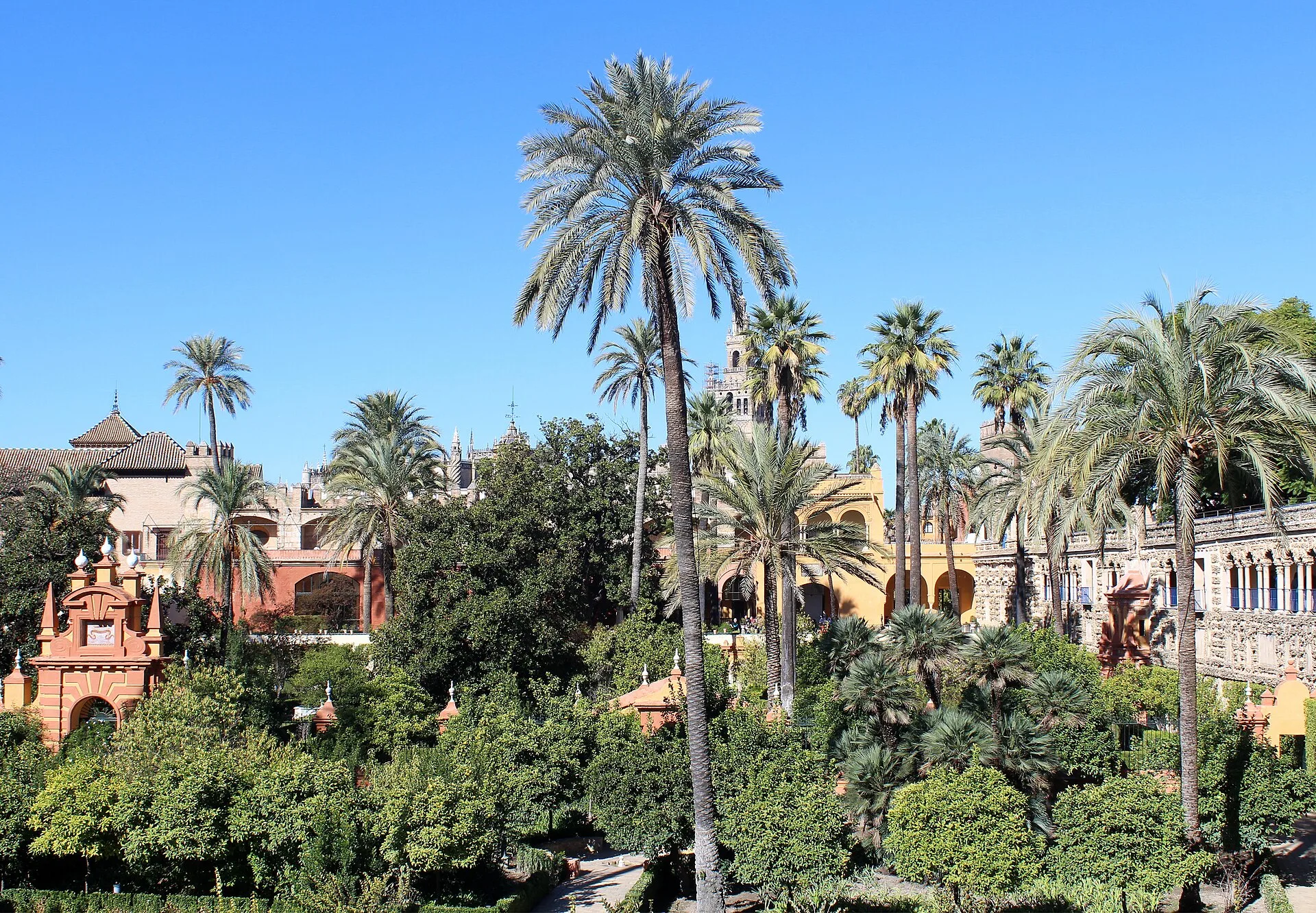
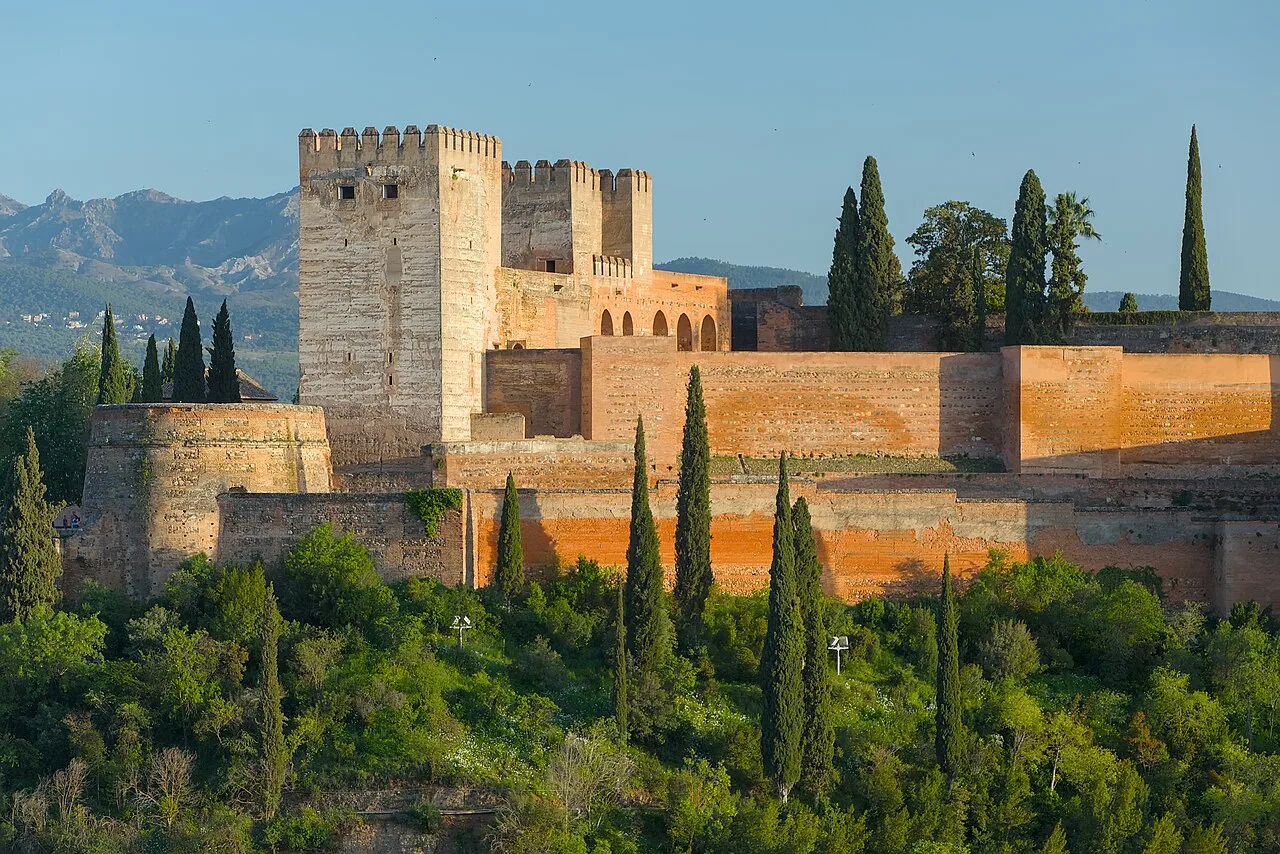
The Royal Alcázar is a group of palaces built over centuries. Its most famous part, the 14th-century Mudéjar palace of Pedro I, combines carved plaster, tiles, and courtyards with water; the gardens deserve an hour of their own. It is still the royal family's residence when they visit the city.
The paradox of the place is that its most "Moorish" rooms were built by a Christian king, a century after the conquest of the city, using craftsmen from Muslim Granada and Toledo: the walls carry Arabic inscriptions praising a monarch called Don Pedro. Listen here too. The palace was designed around the sound of water, and in the gardens a 17th-century hydraulic organ, one of very few left in the world, plays on the hour, powered by a fall of water.
Practical matters for 2026. General admission is 15.50 euros, with a timed ticket bought on the official website; the upper royal apartments are a separate, small-group visit. The Alcázar opens at 9:30 every day and closes at 17:00 from October to March and at 19:00 from April to September. The ticket office, in the Patio de Banderas, takes cards only. Take the first slot of the day.
The cathedral and the Giralda. The largest Gothic church in the world was built on the site of the great mosque by a chapter that, according to tradition, resolved to make something so vast that those who saw it finished would think them mad. Inside are the tomb of Columbus, carried by four heralds, and the largest altarpiece ever made. Two things survive from the mosque: the courtyard of orange trees, and the minaret, raised into a bell tower and called the Giralda for the weathervane on top. You climb it not by stairs but by thirty-five ramps, built so that the muezzin could ride up on horseback. In 2026 the visit costs 13 euros online and 14 at the ticket office, and includes the church of El Salvador. If you can, come also to a sung Mass or an organ recital: the building was made to be heard.
Both monuments have queues and timed entries, and a guide makes sense of their layers; one visit that covers them together is this guided tour of the Alcázar, the cathedral and the Giralda.
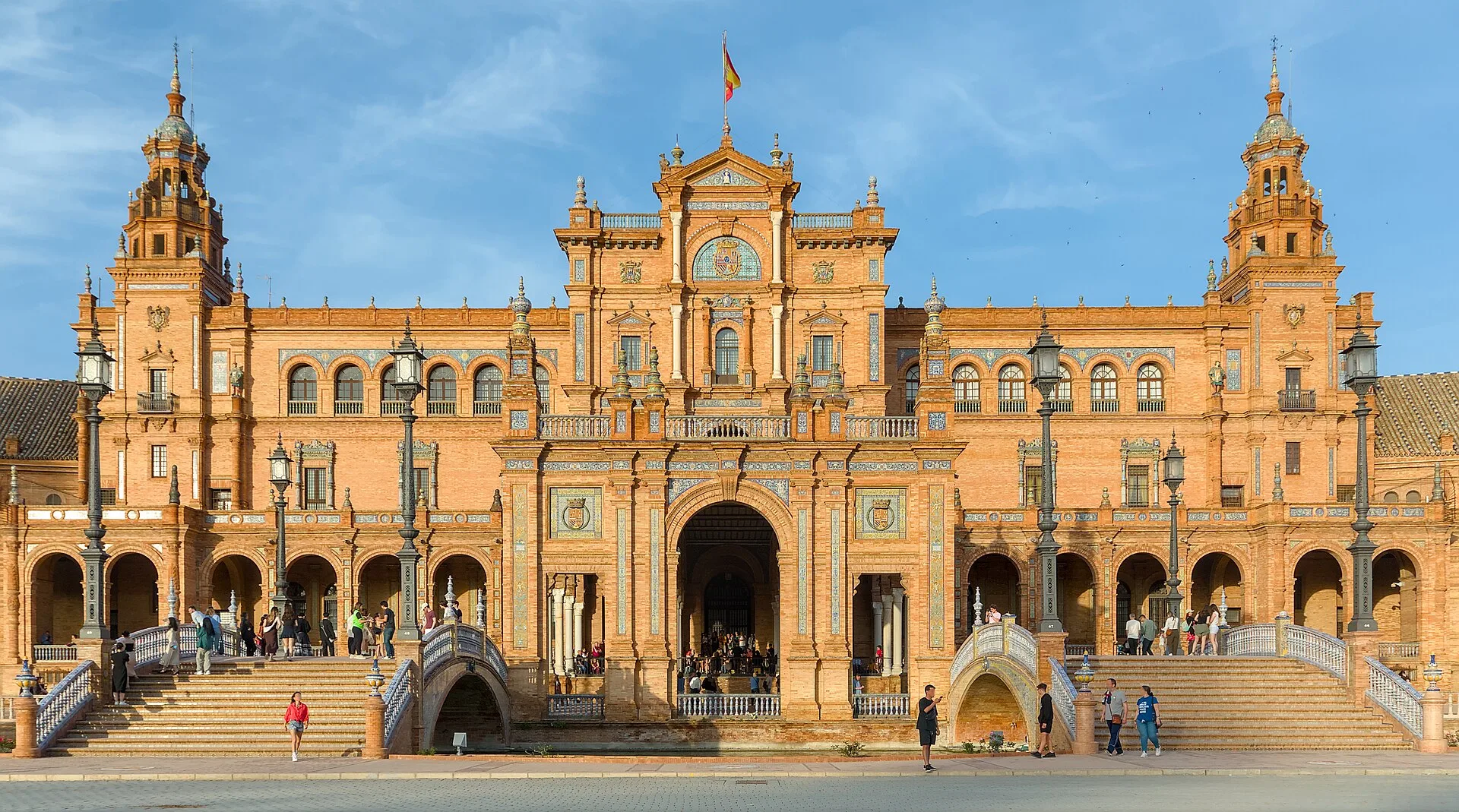
Plaza de España, designed by architect Aníbal González for the Ibero-American Exposition of 1929, is a half-circle of brick and ceramic with benches dedicated to Spain's provinces. At sunset, with luck, someone is playing guitar under its arches.
It is free and always open, and the galleries have an echo that buskers know how to use. Behind it, María Luisa Park is the city's shade: avenues of plane trees, tiled fountains, doves, and the two museum pavilions of the 1929 exhibition at its far end.
What else should you see?
Barrio de Santa Cruz. The old Jewish quarter, behind the cathedral: lanes too narrow for the sun, whitewash and ocher, squares with orange trees. It is very pretty and very visited. Go early or late.
The Archive of the Indies. A sober Renaissance building between the cathedral and the Alcázar that holds the paperwork of an empire: eighty million pages on Spanish America. Entry is free.
Casa de Pilatos and the Palacio de las Dueñas. Two aristocratic palaces still in family hands, with courtyards of tile and marble and gardens of bougainvillea. In the second, the poet Antonio Machado was born.
The Setas. A giant wooden parasol built over a square in 2011, officially the Metropol Parasol and called "the mushrooms" by everybody, with a walkway on top for the sunset and Roman ruins underneath.
The river. The Torre del Oro, the 13th-century watchtower, and the Maestranza, the bullring, whose museum can be visited without attending a bullfight.
The Museum of Fine Arts. In a former convent: Murillo, Zurbarán and Valdés Leal, the painters of Seville's golden century, in the light they painted for.
The Macarena. The northern, working-class end of the old city: the basilica of the most venerated Virgin in Seville, a stretch of Almohad wall, markets, convents that sell sweets through a revolving hatch, and the bars of the Alameda de Hércules.
How do you plan three days?
Day 1: the monuments. The Alcázar at 9:30. The cathedral and the Giralda before lunch. Tapas in the Arenal. A siesta, as the city takes. Santa Cruz in the evening light, and a flamenco show at night.
Day 2: Triana and the river. Casa de Pilatos or Las Dueñas in the morning, the Setas and the shopping streets. Lunch at the Triana market. The ceramics center, Calle Pureza, Santa Ana, sunset on Calle Betis, and dinner in Triana.
Day 3: the park and the north. Plaza de España and María Luisa Park early, the Fine Arts Museum, the Macarena. In the evening, the Alameda, or a peña if there is a recital.
With a fourth day, take the train to Córdoba, 45 minutes away, for its mosque-cathedral, or the bus to the Roman city of Itálica, twenty minutes from Seville, birthplace of the emperor Trajan, with one of the largest amphitheaters of the empire.
What do you eat, and when?
The schedule matters as much as the menu. Breakfast is toast with olive oil and tomato, or with ham, around ten. Lunch is from two to four. Dinner starts at nine and is at its height at ten thirty. Between five and eight the kitchens are closed, and so, in summer, is nearly everything else.
Seville claims to have invented the tapa, and eating here means moving: one or two small plates and a drink at each bar, standing at the counter, then on to the next. What to order:
Espinacas con garbanzos. Spinach and chickpeas with cumin and garlic, a dish with Moorish and Jewish roots.
Salmorejo. A thick cold cream of tomato, bread and olive oil, topped with ham and egg. From Córdoba, adopted here.
Pescaíto frito. Small fish and marinated dogfish, floured and fried in olive oil, sold in paper cones.
Montadito de pringá. A small toasted roll filled with the meats of the stew, shredded.
Solomillo al whisky. Pork loin in a sauce of garlic and whisky.
Jamón ibérico. From the acorn-fed pigs of the nearby sierra, cut by hand.
Carrillada. Pork cheeks braised in wine until they fall apart.
To drink: a small draught beer, very cold; manzanilla or fino, the dry sherries of the coast, the right companions for ham and fried fish; tinto de verano, red wine with lemonade, in the heat.
A warning about the oranges on the trees that line every street: they are bitter. They go to Britain for marmalade. In late February and March, their blossom perfumes the whole city, and that smell, with incense, is the announcement of Holy Week.
If you would like someone to choose the bars and explain the dishes on the first night, there are evenings such as this walking tour of tapas, taverns and history.
When should you go?
Spring is the great season: Holy Week, with its processions accompanied by bands and saetas sung from balconies, and two weeks later the April Fair, where sevillanas are danced day and night. Both fill the city and push up the price of rooms. Autumn is quieter and mild. Avoid July and August if you can: the thermometer often passes forty degrees Celsius.
Holy Week in 2027 runs from Palm Sunday, March 21, to Easter Sunday, March 28. Some sixty brotherhoods carry their images from their own churches to the cathedral and back, a journey of up to fourteen hours, with thousands of hooded penitents and floats borne on the necks of teams of hidden bearers. It is a religious act, a neighborhood loyalty and the greatest street theater in Europe, all at once. Listen for the saeta, an unaccompanied flamenco prayer sung to the image from a balcony, when the whole street falls silent; for the bands that play slow marches behind the Virgins; and for the brotherhoods that walk with no music at all. The climax is the night from Thursday to Friday, the Madrugá, when the most beloved images go out and nobody sleeps. Rooms cost double or triple, many streets are impassable, and you need a program, patience and comfortable shoes.
The April Fair began as a cattle market in 1847 and is now a temporary city of more than a thousand striped tents, the casetas, on a fairground in the Los Remedios district: horses and carriages by day, lanterns by night, and a week of dancing, eating and drinking rebujito, manzanilla with lemon soda. Most casetas are private, belonging to families, clubs and companies, and you need an invitation. There are public ones run by the city districts and by political parties and unions, open to all. Dress up; Sevillians do. Dates move with Easter, so check them when you plan.
The rest of the year. March to May and October to November have the best weather. Winter is mild, sunny and quiet, with oranges on the trees. June and September are hot. July and August are an oven by day, and many family-run bars close for holidays; the city compensates with late nights, open-air cinema and concerts in the Alcázar gardens.
How do you get there and around?
Arriving. High-speed trains link Madrid with Seville's Santa Justa station in about two and a half hours, and Córdoba in 45 minutes. The airport is ten kilometers from the center, with a bus to the center and taxis at a fixed fare.
In the city. The historic center is one of the largest in Europe and is almost entirely flat. Walk. For longer hops there are a tram through the monumental area, one metro line, buses and a public bicycle scheme on an excellent network of cycle lanes. Horse-drawn carriages wait by the cathedral; prices are regulated and posted.
The heat. From June to September, do as the locals do: out early, indoors from two to seven, and out again until late. Walk on the shaded side, under the awnings stretched across the shopping streets, and carry water.
Where should you stay?
Santa Cruz and around the cathedral. In the middle of everything, in small hotels in old houses. Lanes are inaccessible to taxis, so check how far you will carry your bags.
El Arenal and the center. Between the cathedral and the river: practical, lively, good for eating.
Triana. Across the bridge, more local and a little cheaper, fifteen minutes' walk from the cathedral.
Alameda and Macarena. Younger, with bars and a nightlife that runs late; choose a quiet street.
For Holy Week and the Fair, book as early as you can, and expect minimum stays.
What should you know before a flamenco night, and before a procession?
At a show. Arrive on time; latecomers are sometimes kept out until a pause. Do not clap along unless you know the compás: off-beat palmas throw the performers. Do not talk. Film only when you are told you may. Applaud at the end of each piece, and say ole if it comes out of you by itself.
In Holy Week. Do not cross a procession between the penitents. Keep quiet when an image passes, and take off your hat. Do not touch the floats. Dress with a little care on Thursday and Friday, when many locals wear dark suits and black lace mantillas.
At the Fair. Do not walk into a private caseta. Go to the public ones, or accept the first invitation you get, which will come sooner than you think.
Everywhere. Greet when you walk into a bar, order at the counter, pay at the end. Tipping is modest: the small change, or a euro or two.
Is Seville good with children, or with limited mobility?
With children, very: parks, boats on the river and rowing in the Plaza de España, carriages, a tower climbed by ramps, ice cream at midnight alongside every other child in the city. Flamenco shows of an hour suit children from about eight who can sit still. Avoid the middle of summer.
With limited mobility, Seville is one of the easier historic cities in Spain: flat, with level access to the Alcázar's ground floor and gardens and to the cathedral, though not to the Giralda. The lanes of Santa Cruz are cobbled and narrow, and during Holy Week the center is nearly impassable for a wheelchair.
What mistakes should you avoid?
Choosing flamenco by the size of the poster. Small room, no microphone, no dinner.
Talking through the singing. The song is the point.
Arriving at the Alcázar without a ticket. Book the first slot online.
Sightseeing at four in the afternoon in July. Sleep, like everyone else.
Eating dinner at seven. The kitchens are closed, and the bars that are open are the wrong ones.
Coming for Holy Week without a room. Or expecting to cross the center quickly.
Tasting an orange from a tree. Once is enough.
Staying on one side of the river. Cross to Triana.
Quick answers
How many days do you need in Seville? Three, with a fourth for Córdoba or Itálica.
Where can you see authentic flamenco? In the small tablaos and cultural centers of Santa Cruz, the center and Triana, and in the peñas when they have recitals. Choose a small room without amplification.
How much is the Alcázar in 2026? 15.50 euros for general admission. It opens at 9:30 and closes at 17:00 from October to March and at 19:00 from April to September.
How much are the cathedral and the Giralda? 13 euros online and 14 at the ticket office in 2026, including the church of El Salvador.
When is Holy Week in 2027? From March 21 to 28. The April Fair follows about two weeks later.
When is the Bienal de Flamenco? In even-numbered years, in September. The next edition is in 2028.
Is Plaza de España free? Yes, and open at all hours.
When is it too hot? July and August, when temperatures often pass forty degrees.
Prices, opening hours and dates in this guide were checked in November 2026 in official sources. Confirm them before you go.