The Alhambra: how to visit without missing what matters
Timed tickets, three enclosures and a viewpoint across the river. A complete, practical guide to Granada's Nasrid palace: 2026 prices, what to do when it is sold out, the route inside and the city around it.
Culturera may earn a commission if you buy through the links on this page. As an Amazon Associate I earn from qualifying purchases. The selection is ours alone.
To visit the Alhambra well you need three things: a general ticket bought weeks ahead on the official site (€22.27 in 2026), your passport, because tickets carry your name, and three to four hours. The ticket fixes one thing only, the half-hour slot in which you enter the Nasrid Palaces; miss it and you do not get in. Everything else in this guide is about choosing that slot and building the day around it.
The Alhambra was the palace city of the Nasrid sultans, the last Muslim dynasty on the Iberian Peninsula, until Granada surrendered to the Catholic Monarchs in 1492. Its name comes from the Arabic al-Hamra, "the red one." With the Generalife and the Albaicín quarter, it is a World Heritage site.
It is also the most visited monument in Spain, with well over two million people a year, and the number who can enter the palaces is strictly limited. That is why planning matters here more than almost anywhere else in Europe. Where a guide or a reseller helps, we link tours and tickets on GetYourGuide. We have not taken these tours: they are chosen for what they cover.
What is the Alhambra, in five minutes?
A city, not a building. At its height the walled hill held six palaces, a mosque, baths, workshops, barracks and the houses of some two thousand people who served the court. What survives are three groups of buildings from different centuries, and it helps to keep them apart in your head.
The Alcazaba is the fortress at the prow of the hill, the oldest part, from the 13th century. The Nasrid Palaces are the royal residences of the 14th century, the reason people cross the world to come here. The Generalife is the country estate on the hill behind, where the sultans escaped the court. Around them are gardens, the remains of the town, and a huge Renaissance palace added by the Christian kings.
The history is short and dramatic. In 1238, while the Christian kingdoms were taking the great cities of Muslim Spain one after another, a local lord named Muhammad ibn al-Ahmar made himself ruler of Granada and survived by paying tribute to Castile. His dynasty, the Nasrids, lasted two and a half centuries, squeezed between stronger neighbors, and spent that time building one of the most refined courts of the Middle Ages out of cheap materials: brick, wood, plaster and water. The last sultan, known as Boabdil, handed over the keys on January 2, 1492. The pass in the mountains where he is said to have looked back and wept is still called the Moor's Sigh.
After the conquest the Alhambra became a royal residence, then a barracks, then a ruin. Napoleon's troops, who occupied it, mined the towers when they withdrew in 1812; the story goes that a wounded Spanish soldier cut the fuses and saved most of it. The Romantic travelers of the 19th century did the rest, and restoration has not stopped since.
First things first: tickets
Tickets sell out weeks ahead. Buy them on the official website. They carry a fixed time for entering the Nasrid Palaces: arrive late and you will not get in.
The official seller is the Patronato de la Alhambra y Generalife, the public body that runs the monument. These are the 2026 prices, to which the website adds a small booking fee.
Alhambra General, €22.27. The one you want: Nasrid Palaces, Alcazaba, Generalife and Partal, by day.
Gardens and Generalife, €12.73. The gardens and the Generalife, without the Nasrid Palaces. It is a consolation prize when the general ticket is sold out, and a pleasant one.
Night visit to the Nasrid Palaces, €12.73. Only the palaces, lit, after closing.
Night visit to the Generalife gardens, €8.48.
Dobla de Oro, €30.48. The general ticket plus a handful of Moorish monuments in the Albaicín, such as the 11th-century baths.
Children under 12 enter free, but they need their own ticket, booked at the same time as the adults'. There are reduced prices for EU citizens over 65 and holders of the European youth card.
Three rules cause most of the problems at the gate. The ticket is personal. It carries your name and document number, and staff check it against your original passport or ID card, not a photo on your phone. The time is strict. The slot printed on the ticket is for the Nasrid Palaces; the rest of the complex you can see before or after, on the same day. The ticket office is a last resort. It sells only what is left for that same day, if anything, and never less than two hours before a palace slot.
What do you do when the Alhambra is sold out?
It usually is, in spring and autumn. You still have six options, roughly in this order.
Look again. Cancelled and unpaid tickets go back on sale on the official site without warning. Check early in the morning and late at night for several days.
Book a guided tour. Tour companies hold their own allocation of tickets, so a guided visit is often available when individual tickets are not. It costs more, and you get a guide for a monument that explains itself poorly: there are almost no signs inside. You can check dates for one such tour here.
Buy from a reseller. Authorized resellers such as GetYourGuide also sell the Alhambra ticket with entry to the Nasrid Palaces, sometimes with an audio guide, at a higher price than the official one.
Buy the Granada Card. The city's tourist pass has its own quota of Alhambra entries and adds the cathedral, the Royal Chapel and several bus rides. In 2026 it costs €50 for 24 hours, €55 for 48 and €60 for 72.
Go at night. The night visit to the palaces is a different experience, quieter and more theatrical, and it sells out later than the day ticket.
Take the gardens ticket and the free areas. You will miss the palaces, and still see more than half of the hill.
What can you see in the Alhambra without a ticket?
More than most visitors realize. Walk up from Plaza Nueva through the woods and enter by the Gate of Justice, the great horseshoe arch of 1348 with a hand carved on the outer arch and a key on the inner one. No one will ask you for anything.
Inside the walls, the Palace of Charles V is free: a Renaissance square with a circular courtyard inside, begun in 1527 for an emperor who never lived in it and left without a roof for centuries. On its ground floor, the Museum of the Alhambra, also free, holds the objects that came out of the palaces, among them a famous blue-and-gold vase taller than a child. You can also walk the main street, see the Wine Gate and the church built on the site of the mosque, and look down over the city from the square in front of the Alcazaba.
The Nasrid Palaces
The heart of the complex. The Comares Palace surrounds the Court of the Myrtles, with its pool reflecting the tower. The Palace of the Lions is arranged around a fountain borne by twelve marble lions and 124 very slender columns. The walls are covered in carved plaster, tiles and poems in Arabic.
You go through three palaces in a fixed order, and it helps to know what each one was for.
The Mexuar comes first: the room where the sultan's council met and justice was given. It is the most altered of the three, turned into a chapel after the conquest, but its small oratory has the first of the views over the Albaicín.
The Comares Palace was the official residence, built mostly under Yusuf I in the mid-14th century. After the Court of the Myrtles you enter the Hall of the Ambassadors, the throne room, inside the largest tower of the Alhambra. Look up: the ceiling is made of more than 8,000 pieces of cedar, fitted together to represent the seven heavens of Islam. The sultan sat with his back to the central window, so that visitors saw him against the light.
The Palace of the Lions, built by Muhammad V a few decades later, was the private part. The courtyard is a forest of columns around the fountain, whose twelve lions were cleaned and returned to their place in 2012 after years of restoration. Four halls open onto it. In the Hall of the Abencerrajes, legend says the knights of a noble family were beheaded, and guides point to a rust stain in the fountain as their blood. Opposite, the Hall of the Two Sisters has the most astonishing ceiling of all: a dome of thousands of small plaster cells, like a honeycomb or a cave of stalactites, lit from below by windows. This decoration is called muqarnas, and nothing in Europe matches it.
One phrase repeats across the walls: "There is no victor but God," the dynasty's motto.
The walls can be read, literally. Besides the motto, there are verses by the court poets, above all Ibn Zamrak, written to be carved on the rooms they describe: the fountain speaks in the first person, and so does the hall. The plaster was once painted in blue, red and gold; what you see now is the bone under the skin.
One more room, easy to miss on the way out: the apartments where the American writer Washington Irving stayed in 1829, when the Alhambra was half abandoned and families of squatters lived in its halls. His Tales of the Alhambra made it famous in the English-speaking world and helped to save it.
Practical notes for the palaces. Be at the door of the palaces, not at the main entrance, fifteen minutes before your time: the two are a good fifteen-minute walk apart. About 300 people go in every half hour, and once inside nobody hurries you, though you cannot go back. Backpacks must be carried in front, strollers are not allowed in the palaces, and touching the walls is forbidden: the plaster is seven hundred years old.
Is the night visit worth it?
Yes, as a second visit, or as the only one if the day tickets are gone. At night you see only the Nasrid Palaces, with small groups and low lighting that picks out the plasterwork and turns the pools into mirrors; the Court of the Lions in the half-dark is unforgettable. What you lose is the detail of the ceilings, the color of the tiles and the views from the windows, and the Alcazaba and the Generalife are not included. In summer it has one great advantage: the temperature.
The Alcazaba
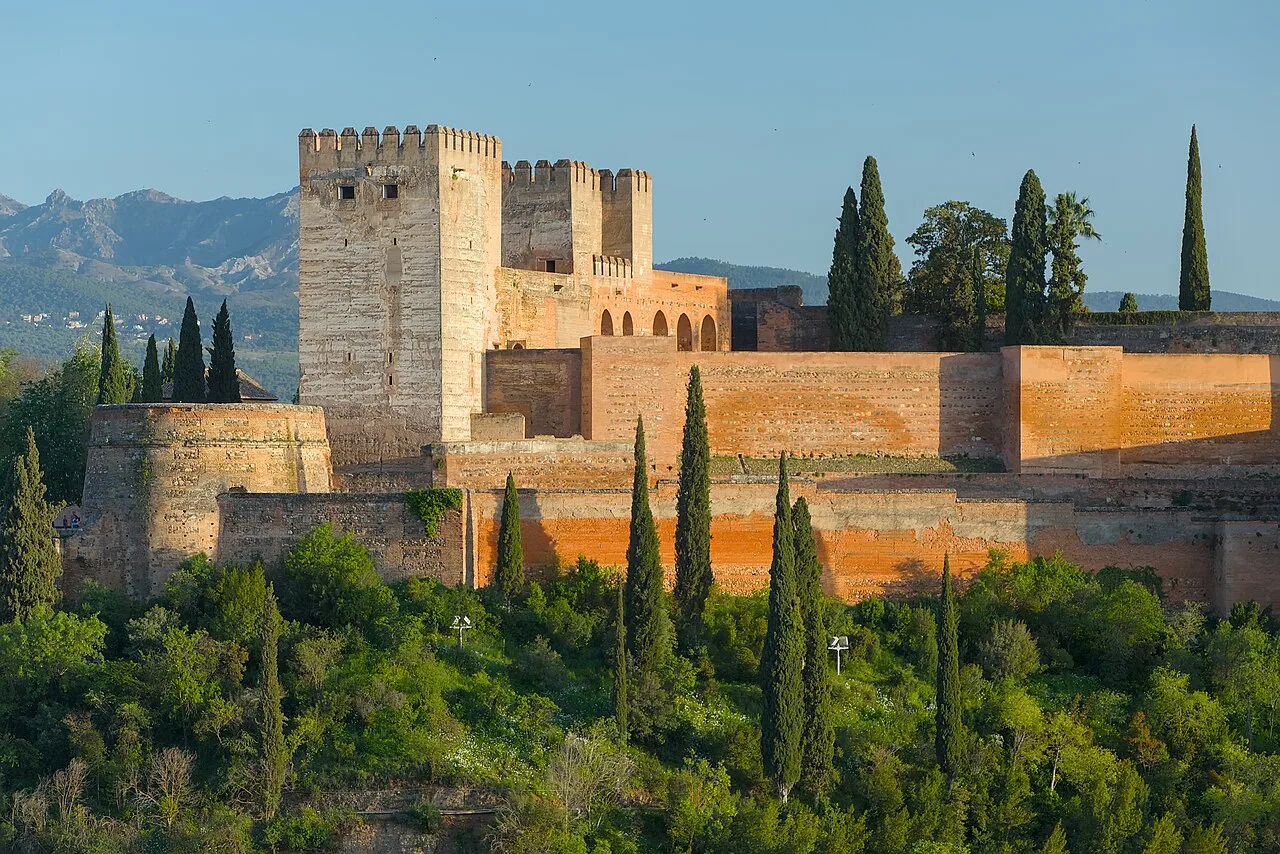
The oldest, military part. From the Torre de la Vela you see the whole city.
This was the fortress where the first Nasrid ruler, Muhammad I, settled in 1238 when he chose the hill as his capital. What remains are the walls, the foundations of the soldiers' quarter and the towers. Climb the Torre de la Vela, the watchtower: the bell at the top regulated the irrigation of the fields below for centuries, and on January 2, the anniversary of the conquest, tradition holds that single women who ring it will marry within the year. On that tower the flag of Castile was raised in 1492. The view takes in the Albaicín, the cathedral, the plain and, behind you, the snows of the Sierra Nevada.
The Generalife
The sultans' summer estate: orchards, cypresses and the Patio de la Acequia, with its water jets.
The Generalife stands on the next hill, ten minutes' walk from the palaces through the Partal, a garden of terraces with a pool and a portico that is the oldest surviving palace on the site. The estate was a working farm as well as a retreat, and its kitchen gardens are still cultivated. The Patio de la Acequia is the image everyone knows, a long channel under crossing jets of water; the jets, as it happens, were added in the 19th century, and the sultans knew a quieter garden. Do not miss the Water Stairway, higher up: a flight of steps under laurels whose handrails are channels of running water, one of the few parts that have come down almost unchanged.
In what order should you see it all?
It depends on your palace slot, and this is the decision that matters.
The best slot is the first one, 8:30. Enter by the Gate of Justice, go straight to the palaces, and you will see them almost empty and in cool air. Then the Partal, the Generalife while the morning is still fresh, and the Alcazaba last.
With a late-morning or midday slot, start at the main entrance when the complex opens, see the Generalife first, walk down through the Partal and reach the palaces on time. Leave the Alcazaba for afterwards.
With an afternoon slot, do the Alcazaba and the free areas first, the palaces at your hour and the Generalife at the end, in the low light.
The complex opens from 8:30 to 20:00 from April 1 to October 14, and from 8:30 to 18:00 the rest of the year. It closes only on December 25 and January 1. Night visits run from Tuesday to Saturday in the warm months and on Fridays and Saturdays in winter.
How do you get up there?
On foot, it takes about twenty minutes from Plaza Nueva up the Cuesta de Gomérez, a steep, shaded street that passes under a stone gate and into the Alhambra woods. It is a lovely walk and a real climb. The small red city buses of the C30 line go up from the center every few minutes; a single ticket costs €1.60 in late 2026, paid to the driver or by contactless card. The C32 links the Alhambra with the Albaicín.
There are two entrances. The main entrance, by the ticket office at the top of the hill, is nearest to the Generalife. The Gate of Justice, lower down, is nearest to the palaces and the Alcazaba, and you can use it if you already have your ticket on your phone or printed. Drivers will find a paid car park by the main entrance, reached by the ring road and not through the center, which is closed to visitors' cars.
The best viewpoint
Cross to the Albaicín and climb to the Mirador de San Nicolás at sunset: the Alhambra lights up with the Sierra Nevada behind.
Everyone else has the same idea, so the little square is packed, with guitarists, sellers and, it must be said, pickpockets. Two alternatives a few steps away have the same view. The garden of the Great Mosque of Granada, next to the church, is open to visitors at certain hours and is far calmer. And the terrace bars just below the square will sell you a drink with the postcard included. For a higher and emptier view, keep climbing to the Mirador de San Miguel Alto, above the old city wall.
What is there to see in the Albaicín and Sacromonte?
The Albaicín is the old Moorish quarter on the hill facing the Alhambra: whitewashed houses, walled gardens called cármenes, and lanes too narrow for cars. It is best explored without a plan, but look for three things. The Carrera del Darro, the street along the little river at the foot of the hill, is one of the prettiest in Spain. On it, El Bañuelo is an 11th-century bathhouse, with star-shaped skylights in its vaults, that survived because a house was built on top of it. And on Calderería Nueva, near Plaza Nueva, the tea houses and pastry shops recall a Moroccan souk.
Higher and further east, Sacromonte is the quarter of the cave houses, dug into the hillside and home for centuries to Granada's Roma community. This is where the zambra was born, the local form of flamenco, danced in the caves themselves, with the audience on chairs along the walls. The shows are aimed at visitors, and the setting is like no other; you can book ahead a flamenco show in a Sacromonte cave. A small museum of cave houses, at the top, shows how people lived in them.
Both neighborhoods are steep and confusing, and a guided walk makes sense here, especially at the end of the day: this sunset walking tour of the Albaicín and Sacromonte ends at the viewpoints when the Alhambra lights come on.
What else should you see in Granada?
The Christian city that was built after 1492 lies at the foot of the two hills, and it deserves half a day.
The Royal Chapel. Isabella and Ferdinand, the Catholic Monarchs, chose to be buried in the city whose conquest crowned their reign. Their marble tombs are upstairs; go down the few steps to the crypt and you will see the plain lead coffins, which is the part people remember. The sacristy holds the queen's own collection of Flemish paintings.
The cathedral, next door, is a huge, bright Renaissance church, begun in 1523 on the site of the main mosque.
The Alcaicería, the old silk market, is now a tangle of souvenir shops, but the layout is that of the original bazaar. Nearby, the Corral del Carbón is a 14th-century inn for merchants, the only one of its kind left in Spain, and free to enter.
Federico García Lorca was born near Granada and was killed outside it in 1936, at the start of the Civil War. His family's summer house, the Huerta de San Vicente, where he wrote some of his best-known plays, is now a small museum in a park.
And after a day of walking, the city's Arab-style baths are a pleasant ritual: warm, hot and cold pools under brick vaults, in silence. Sessions are timed and need a reservation, for example for the Hammam Al Ándalus, at the foot of the Alhambra.
Tips
Allow three or four hours and wear comfortable shoes. In summer, choose the first slot or the night visit.
A few more. Bring water: there are fountains inside, and few places to buy anything. The only café and most of the toilets are near the entrances and the Charles V palace, not inside the palaces. The ground is cobbled and uneven, and the full visit covers about three and a half kilometers. An audio guide can be rented at the entrance or downloaded; without any guide at all you will see beautiful rooms and understand little.
After the visit
Walk down the Cuesta de Gomérez or the Cuesta de los Chinos to the River Darro and carry on along the Paseo de los Tristes, with the Alhambra above. Granada also keeps a custom other cities have lost: with every drink, bars serve a free tapa. And in the caves of Sacromonte, the Roma quarter, flamenco is sung and danced every night.
The free tapa deserves an explanation. You order a beer, a glass of wine or a soft drink, and a small plate arrives with it: a stew, fried fish, a little sandwich, rice. You do not choose the first one; with the second and third drinks, the tapas get better. Three rounds are a dinner. The streets to try are Calle Navas, near the town hall, Calle Elvira and the Realejo, the old Jewish quarter under the Alhambra, around the Campo del Príncipe.
On the menu, look for habas con jamón, broad beans with cured ham; remojón, a salad of orange and salt cod; fried aubergines with cane honey; and for dessert a pionono, a small rolled sponge cake soaked in syrup and crowned with toasted cream, invented in the nearby town of Santa Fe.
Can you visit with children, or with reduced mobility?
With children, yes, and well. Under-12s are free, the Alcazaba is a real castle with towers to climb, and the Generalife has water everywhere. Strollers must be left at the entrance to the Nasrid Palaces, where staff lend baby carriers. Bring hats and snacks: the visit is long.
With reduced mobility the Alhambra is harder. The Patronato publishes an adapted route that covers a good part of the Nasrid Palaces, the Charles V palace and the lower gardens of the Generalife, and lends wheelchairs at the entrance. The Alcazaba, with its stairs and towers, and the upper Generalife are not accessible. Ask at the main entrance on arrival, and allow more time.
Is there time for a day trip?
If you have a third day, yes, and both options start from the mountains you have been looking at. The Sierra Nevada has the southernmost ski resort in Europe, 45 minutes from the city by road, open roughly from December to April; in spring it is possible to ski in the morning and have tapas in the sun in the evening. On the southern side of the range, the white villages of the Alpujarras, built on terraces by the last Muslims of Spain after the conquest, are an hour and a half away: Pampaneira, Bubión and Capileira climb one above the other up a gorge, and the air-cured ham of Trevélez comes from the highest village of all.
When is the best time to go?
Spring, from late March to early June, is ideal: the gardens are in flower, the snow is still on the Sierra Nevada, and tickets are at their scarcest. Autumn, from mid-September to November, has the same light and somewhat fewer people. Summer is very hot, often above 35 degrees in the afternoon, and that is when the first slot of the morning and the night visit earn their place. Winter is cold and bright, with the shortest lines of the year; the city sits at almost 700 meters, and nights are near freezing.
Two dates fill the city: Holy Week, with processions climbing the Albaicín and Sacromonte, and the International Festival of Music and Dance, in June and July, when concerts are held inside the Alhambra itself, in the Charles V palace and the Generalife gardens.
How do you get to Granada and where should you stay?
Granada has a small airport with domestic flights. Most international visitors arrive through Málaga, an hour and a half away by direct bus or about an hour and a quarter by train. High-speed trains link Granada with Madrid in about three and a half hours and with Seville in about two and a half.
One night is the minimum and two are right: one day for the Alhambra, another for the Albaicín, the center and the tapas. The Albaicín has the views and the charm, and also cobbled slopes that taxis cannot always climb; pack light. The center, around the cathedral and Plaza Nueva, is flat and practical. The Realejo is quieter and close to the walk up. And a few hotels, including a state-run parador in a former convent, are inside the Alhambra walls, for those who want the hill to themselves after closing time.
What mistakes should you avoid?
Leaving the ticket for later. Book the Alhambra before the flights, not after.
Bringing a copy of your passport. They ask for the original document, the one whose number is on the ticket.
Arriving at the main entrance at your palace time. The palaces are fifteen minutes further on. Be at their door early.
Buying in the street or from unknown sites. Official tickets are sold only by the Patronato; resellers charge more, and some sites charge much more for the same thing.
Visiting at 15:00 in July. There is little shade outside the palaces. Take the first slot or the last.
Skipping the Albaicín. The Alhambra was built to be looked at from there, and the other way round.
Paying for tapas you were going to get free. Order a drink first and see what comes.
Quick answers
How much is the Alhambra in 2026? The general ticket costs €22.27 on the official site, plus a small booking fee. Children under 12 are free with their own ticket.
How far ahead should you book? Several weeks in spring and autumn, and as early as you can for Easter and long weekends.
How long does the visit take? Three to four hours for the Nasrid Palaces, the Alcazaba and the Generalife.
Can you visit without a ticket? Yes, in part: the Gate of Justice, the Palace of Charles V and the Museum of the Alhambra are free.
What time is best? The 8:30 slot, or the night visit in summer.
Do you need your passport? Yes, the original. Tickets carry your name.
Is a guided tour worth it? If official tickets are sold out, it is often the only way in. If they are not, it is still the easiest way to understand what you are looking at.
Where is the best view of the Alhambra? From the Mirador de San Nicolás, in the Albaicín, at sunset.
Prices and opening hours in this guide were checked in November 2026 on the Patronato's official pages. Confirm them there before you book.