'The Hunters in the Snow': winter according to Bruegel
Three tired men, a pack of dogs and a frozen valley full of life. The picture that invented the winter landscape.
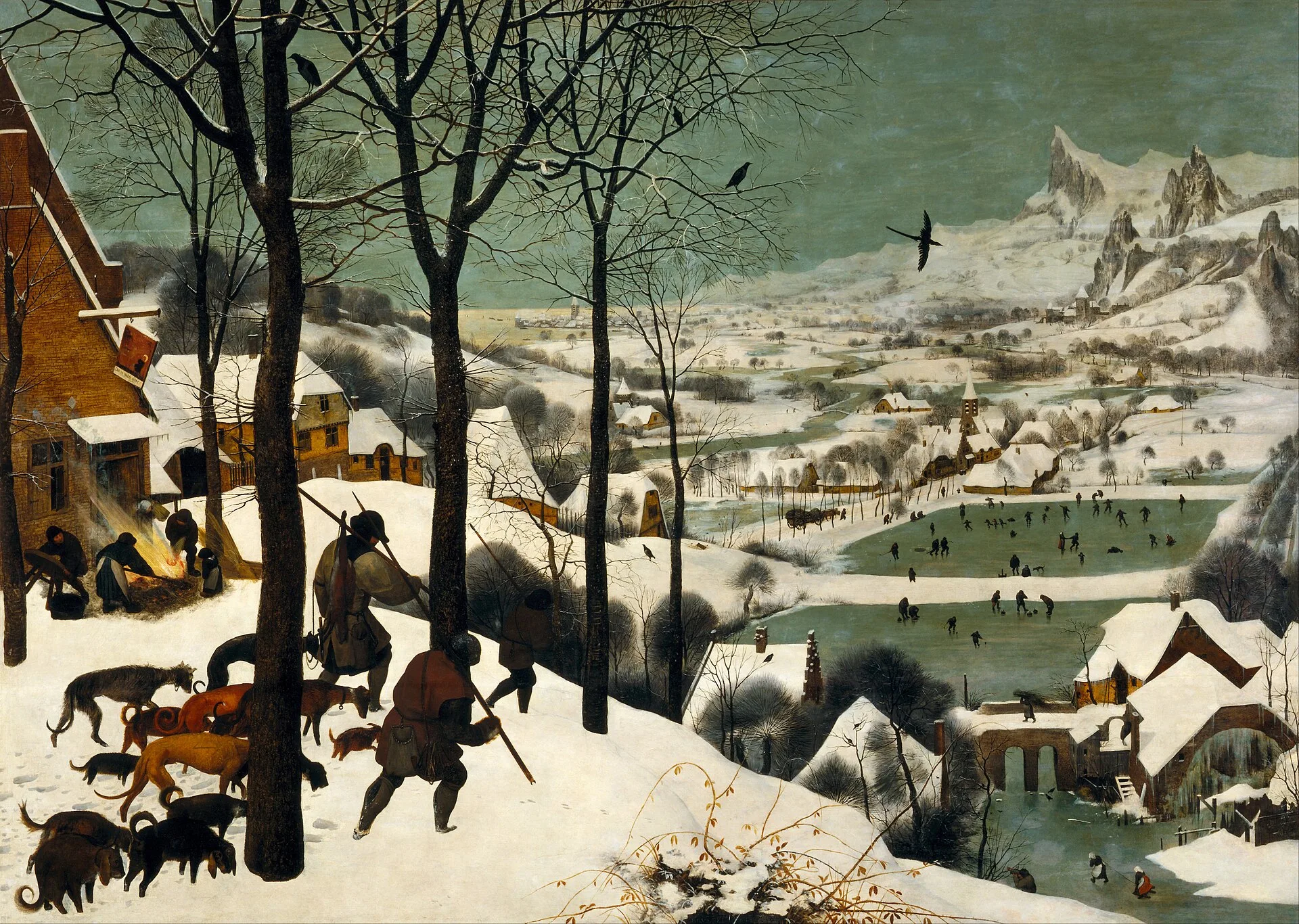
In 1565, Pieter Bruegel the Elder painted a series on the months of the year for an Antwerp banker. Five panels survive. The most famous corresponds to December and January: The Hunters in the Snow.
The foreground
Three hunters return with their backs to us, heads down, with a pack of thin dogs. They carry only a fox. On the left, in front of an inn whose sign hangs loose, a family singes a pig over a fire.
The valley
The hill drops diagonally and the eye goes down with it into an immense valley. On the frozen ponds, tiny figures skate, play something like curling and spin tops. A woman crosses a bridge with firewood. In the distance stand Alpine peaks that do not exist in Flanders: Bruegel had drawn them on his journey to Italy.
The hunters come back defeated, but below, life goes on. The picture holds both things.
Why it matters
Until then, landscape was a backdrop. Bruegel makes it the protagonist and fills it with peasants, not saints or kings. The blacks of the trees and birds against the greenish white of the sky give a cold you can almost hear.
Its echo
Cinema has quoted it often: Tarkovsky travels across it with the camera in Solaris.
Where to see it
At the Kunsthistorisches Museum in Vienna, which holds the world's largest Bruegel collection.
The series
The Hunters in the Snow belonged to a cycle of six panels on the months of the year, commissioned in 1565 by the Antwerp banker Niclaes Jonghelinck. Five survive. Three are in Vienna, including this one; The Harvesters, with its reapers taking a nap, is at the Metropolitan in New York; and Haymaking is in Prague. Seeing them together, even in reproduction, is a walk through a whole year of the 16th century.