Turner, the painter who dissolved landscape into light
Fog, steam and sunsets: how a gruff Englishman anticipated Impressionism and abstraction.
Joseph Mallord William Turner (1775–1851), son of a London barber, entered the Royal Academy at fourteen. He began painting precise landscapes and ended up painting almost nothing but light.
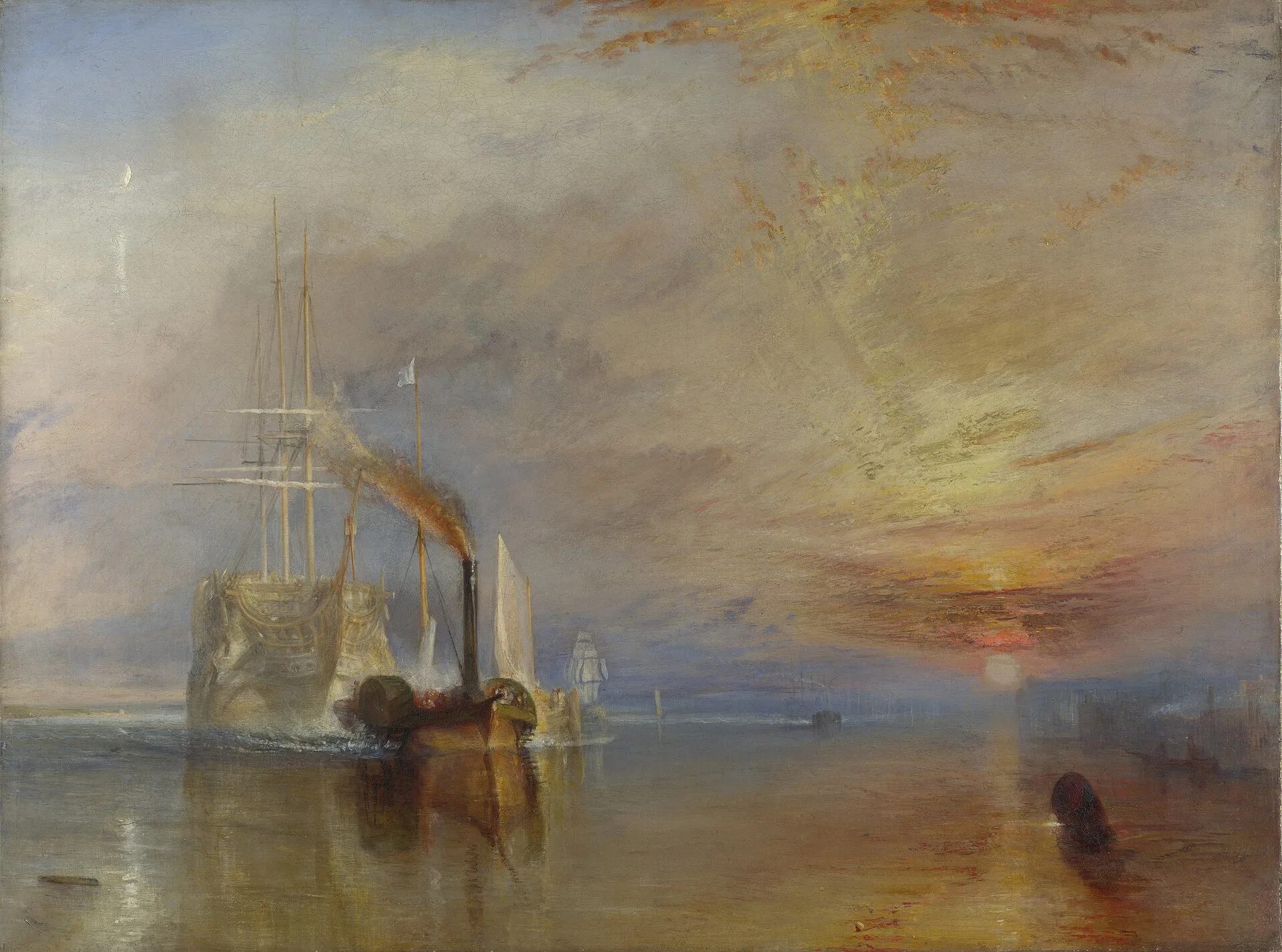
The Temeraire
The Fighting Temeraire, tugged to her last berth to be broken up (1839) shows an old warship, a hero of Trafalgar, hauled by a small steam tug. The sailing ship is pale as a ghost; the steamer, black and smoking. Behind them the sun goes down. It is an elegy for the age of sail and, at once, a portrait of the age arriving. The British have several times voted it their favorite painting.
Rain, Steam and Speed
In 1844 he painted a train crossing a bridge in a downpour. Almost everything is golden haze; the locomotive emerges on a diagonal. It was one of the first times a major painter took on the railway.
His critics said he painted "with soapsuds and whitewash." They were right, and that is why he is modern.
A method
Turner traveled with sketchbooks and watercolors, and retouched his pictures in the exhibition rooms themselves, days before opening. He is said to have had himself tied to a ship's mast to observe a storm; it is probably a legend he fed himself.
Where to see him
He left his work to the nation. Tate Britain in London holds most of it; The Fighting Temeraire is at the National Gallery.
The legacy
Turner died in 1851 and left his works to the British nation: about three hundred oil paintings and thousands of watercolors and drawings. He asked for them to be shown together. Today most are at Tate Britain in London, and the United Kingdom's best-known contemporary art prize bears his name. Monet and Pissarro saw his pictures in London in 1870: Impressionism began, in part, there.