'The Starry Night': what Van Gogh saw from his window
He painted it by day and from memory, in an asylum in Provence. A year later he was dead.
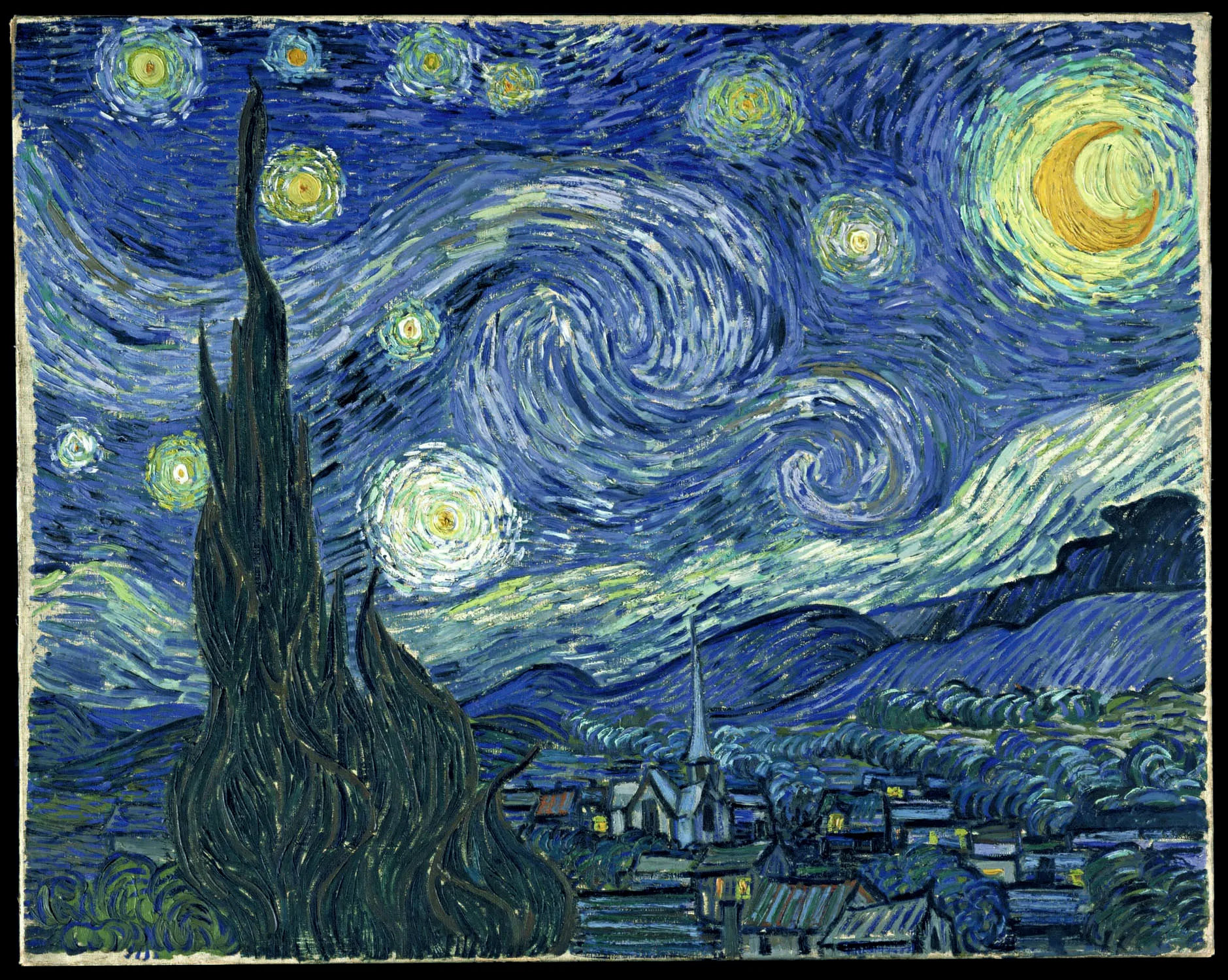
In May 1889, Vincent van Gogh admitted himself to the asylum of Saint-Paul-de-Mausole, in Saint-Rémy-de-Provence. From the barred window of his room he could see the fields and, before sunrise, the morning star. In June he painted The Starry Night.
The real and the invented
The sky matches what he saw; the bright star is Venus. But the village is imaginary: none was visible from his window, and the church spire recalls his native Holland more than Provence. He painted it by day, in his studio, from memory.
The cypress
The dark shape in the foreground is a cypress, the tree of Mediterranean cemeteries, rising like a flame and joining earth and sky.
Van Gogh did not paint what the night looked like, but what it felt like to look at it.
The brushwork
The paint is applied in thick, curved strokes, almost in relief. The sky turns in spirals that some scientists have compared to turbulence in fluids.
What he thought
In his letters to his brother Theo he barely mentions it, and he considered it a failure. He died in July 1890, at 37, having sold very few paintings.
Where to see it
It has been at the Museum of Modern Art in New York since 1941.
The year at Saint-Rémy
Van Gogh admitted himself to the asylum of Saint-Paul-de-Mausole in May 1889, after the crisis in which he cut off part of an ear. He spent a year there and painted about 150 works: the irises in the garden, the olive trees, the wheat fields beyond the bars. He died in July 1890, aged 37, having sold very few pictures. His fame came later, thanks in large part to his sister-in-law, Jo van Gogh-Bonger.